The irony about the the current Israeli version of Spielberg's cinematic epic, is that the two kidnapped soldiers are more likely to be killed by Israel's indiscriminate air bombing of Lebanon than anything else. It would appear that in the currency exhange of human life, the life of an innocent Arab civilian blown to bits by a US-made satellite guided bomb is worth infinitely less than that of a non-Arab.
And on another note - it is curiously interesting to note that western news media avoid use of the term 'war' in articles about Lebanon, Iraq etc preferring the more neutral 'conflict' as a term of reference. (Terms like 'illegal occupation', 'invasion' and 'installation of pro-US puppet regime' are similarly avoided but that's another topic for another day). My dictionary defines 'War' as a state of armed conflict between two or more opposing groups, usually state sponsored. What is happening in Lebanon is war....nothing less. Israel destruction of Lebanon's infrastructure and the indiscriminate killing of hundreds of civilians is nothing short of war, and is a disproportionate and barbaric response to the kidnapping of two soldiers (note: Hezbollah targetted soldiers not civilians, with the aim of a prisoner swap for which previous precedents exist). There is nothing 'self-defence' about the Israeli response and they and their puppet masters, the US, risk further alienation in a world which is teetering on the brink of regional anarchy due to constant invasions and illegal occupations.
Saturday, 22 July 2006
Tuesday, 9 May 2006
Happiness...Bhutanese style
Found this interesting to read about (from the BBC):
The remote Himalayan kingdom of Bhutan is the only country in the world which puts happiness at the heart of government policy.

The government must consider every policy for its impact not only on Gross Domestic Product, but also on GNH: "Gross National Happiness".
The politics of happiness has led Bhutan to make very different decisions from countries simply searching for wealth.
The capital, Thimpu, is remarkable for its lack of advertising. In an attempt to hold back consumerism the city council recently banned hoardings promoting Coke and Pepsi.
Bhutan was the last nation in the world to introduce television in 1999. Recently they banned a number of channels including international wrestling and MTV, which they felt did little to promote happiness.

Bhutan has even banned plastic bags and tobacco on the grounds that they make the country less happy.
The one set of traffic lights Bhutan ever had was on this junction. But people found them frustrating, so they went back to a human being.

In Bhutan the government puts inner spiritual development on a par with material improvement.
One of the pillars of Bhutan's happiness philosophy is care for the environment. Strict conservation laws are aimed at achieving sustainable development.

Development has been moderated and people are less well off financially than they could have been.
Bhutan has been able to adopt radical policies partly because it is a remote kingdom and partly because it is an absolute monarchy.

The remote Himalayan kingdom of Bhutan is the only country in the world which puts happiness at the heart of government policy.
The government must consider every policy for its impact not only on Gross Domestic Product, but also on GNH: "Gross National Happiness".
The politics of happiness has led Bhutan to make very different decisions from countries simply searching for wealth.
The capital, Thimpu, is remarkable for its lack of advertising. In an attempt to hold back consumerism the city council recently banned hoardings promoting Coke and Pepsi.
Bhutan was the last nation in the world to introduce television in 1999. Recently they banned a number of channels including international wrestling and MTV, which they felt did little to promote happiness.
Bhutan has even banned plastic bags and tobacco on the grounds that they make the country less happy.
The one set of traffic lights Bhutan ever had was on this junction. But people found them frustrating, so they went back to a human being.
In Bhutan the government puts inner spiritual development on a par with material improvement.
One of the pillars of Bhutan's happiness philosophy is care for the environment. Strict conservation laws are aimed at achieving sustainable development.
Development has been moderated and people are less well off financially than they could have been.
Bhutan has been able to adopt radical policies partly because it is a remote kingdom and partly because it is an absolute monarchy.
Friday, 14 April 2006
On assignment in the Lone Star state

I recently returned from a consulting engagement in Dallas, Texas and the above is the view from my hotel room, which was what I called 'home' for 6 days and 5 nights. Of course it was nothing like home, lacking in the usual creature comforts and the routines that come with home family life. There was no pyaar or emotional support that radiated from the 4 walls of my room. My only link to the outside world, apart from my daily visits to the client, were the room TV, the high speed internet connection and of course, my cell phone. Otherwise, I think I would have (as the Brits call it) 'lost my marbles'.
On another level observations I noted in general about Texan life:
a) Texans love their food (even by the excessive standards of North America). Every day of the week, the restaurants were packed. And it would appear that the concept of 'vegetarianism' does not exist in these parts.....now don't get me wrong, as a red-blooded Punjabi shere (hahahaha) I enjoy meat too, but not to the extent that Texans devour the stuff with the appetite of a resident of Jurassic Park.
b) Maybe related to the above, the average waistline of the Texans I met were 2-3 inches wider than their Torontonian counter-parts...I kid you not amigos. :)
c) I guess my appearance confused some of my Texan clients - both Anglos and Hispanics. The only Indians most Texans have had dealings with are the south Indian software coolie types (LOL) or watching Apu on the Simpsons. North Indian types are a rarity in their world. They automatically presumed I was of Latino origin, and occasionally a Spanish phrase would come my way awaiting an expectant response. And I suppose it was even more disorientating for them when I opened my mouth and sounded more like Hugh Grant in About a Boy rather than Manuel from Guadalajara...lol. :)
d) Overall, Texans are a very friendly open bunch of people whom I'd gladly invite to my next backyard barbecue. :) (Though I'd probably want to filter out the bible preaching types).
e) Texas is a big place. Even Dallas airport has it's own 3 lane highway connecting between the different terminals.
That all said, glad to be back in Maple Leaf country. :)
Thursday, 6 April 2006
Review: V for Vendetta
 Have to say I totally enjoyed this movie based on the book of the same name. Set in a totalitarian fascist Britain, the film follows the story of 'V' a political anarchist whose reasons for his violent actions are gradually revealed through a series of flashbacks of his past life. At one level the film is a very human drama with all kinds of emotions on display. Yes, there is violence too, but thankfully it is all in the context of the plot.
The film diverges significantly in parts from the book which I read a while back, but that is okay as allows the viewer and reader to have two different comparative interpretations. Interpretation is a subjective thing, and one of the messages I took away is that sometimes it is harder to free yourself from the prison of your own mind than it is to break free from the bricks and mortar kind.
A most definitive 10/10.
Monday, 3 April 2006
I am Canadian !
 After almost 2 long years since applying, I finally became a Canadian citizen last Thursday. The sense of belonging is now complete. Things would definitely have been quicker had it not been for the events of 9/11. Still, I can now show my Canadian passport at Pearson Airport without the usual accusatory glances from Canadian/and or onsite US immigration officers wanting to know where I'm going, where I'm coming from, why am I going/arriving etc. The times when a British passport would inspire awe and head-bowing respect from the natives have long since gone.....LOL. :)
The citizenship ceremony was interesting enough. There were 127 people from 28 countries represented at the Mississauga Citizenship Office. The oath of allegiance could do with some updating though......4 of the 5 lines were all to do with swearing allegiance to the Queen and her successors. Once all the speeches were done and we received our citizenship certificates, we were asked to congratulate folks sitting on either side and you could sense the genuine happiness and warmth of the occasion.
After that, it was a fast drive to the passport office to apply for my new shiny blue passport.
Friday, 24 March 2006
My God is better than your God
How is it that conversion only works one-way for certain religions ? After hearing about this case I wonder if the world would be better off if we all turned atheist......
Asia Times:
Losing faith in Afghanistan
Syed Saleem Shahzad KARACHI
Even as the Bush administration steps up pressure on Afghanistan over the plight of a Christian convert, thousands of youths are descending on Kabul to demand that he be hanged for renouncing Islam.
US President George W Bush and other Western leaders have latched onto the case of Abdul Rahman, 41, who was arrested last month and accused of apostasy for converting to Christianity in 1990, saying that the issue was one of "honoring the universal principle of freedom".
For many Afghans, though, it is just another rallying point to step up pressure for a broader alliance against the presence of foreign forces in the country, while for the Bush administration and its allies it is an opportunity to rethink their position on Afghanistan. The United States has more than 18,000 troops in the country, while the UN-mandated International Security Assistance Force numbers about the same. Germany and Italy have already hinted they may reassess military support for Afghanistan. And German Interior Minister Wolfgang Schaeuble suggested that Afghanistan could lose aid or technical support for reconstruction because of the case.
The US begun reducing its troop strength in Afghanistan this year and has indicated that it will continue to do so. Bush said this week that US forces did not help liberate Afghanistan from Taliban rule so that conservative Islamic judges could issue death sentences against people because of their religious beliefs. He added that he was "deeply troubled" by the case, while Secretary of State Condoleezza Rice phoned Afghan President Hamid Karzai to call for a "favorable resolution to this case at the earliest possible moment". The masses in Afghanistan are not listening, though.
"Regardless of the court decision [whether or not he is hanged], there is unanimous agreement by all religious scholars from the north to the south, the east to the west of Afghanistan, that Abdul Rahman should be executed," Engineer Ahmad Shah Ahmad Zai told Asia Times Online on telephone from Kabul.
Ahmad Shah is a prominent mujahideen leader and head of the Hizb-i-Iqtadar-i-Islami Afghanistan. He was an acting prime minister in the government of Professor Burhanuddin Rabbani before the Taliban came to power in 1996.
"There is widespread dissent among the masses against the activities of Christian missionaries. These missions exploit the poverty of Afghan people and they pay them to convert. These activities will only translate into fierce reaction as Afghans do not tolerate anything against their religion," Ahmad Shah said.
"Since Abdul Rahman comes from the Panjshir Valley, people of the area are coming down to Kabul to show their dissent against him and demand that the court execute him," Ahmad Shah explained.
Rahman, a former medical aid worker, faces the death penalty under Afghanistan's Islamic laws for becoming a Christian. His trial began last week, and now the Afghan government is desperately searching for a way to drop the case, with the latest move being to call for Rahman to undergo psychological examinations to see whether he is fit to stand trial. Senior clerics in Afghanistan, however, have already given their verdict: he should die.
"We will not allow God to be humiliated," Abdul Raoulf, a member of the Ulama Council, Afghanistan's main clerical organization, told Associated Press. "We will call on the people to pull him into pieces so there's nothing left."
Asia Times Online contacts in Afghanistan say that ministers in the cabinet are reluctant to take a stand on the issue because of fierce public reaction. There are clear indications that the minute the court gives any decision other than death penalty, Islamic parties will make it an issue with which to tackle the US-backed Karzai government and allied forces for intervening in the Islamic laws of Afghanistan. The Afghan constitution has contradictory provisions. Article 7 commits Afghanistan to observing the United Nations charter and the Universal Declaration of Human Rights, which guarantees freedom of religion. But Article 3 says that no law can contradict Islam.
It is significant that the issue has come at a time that efforts are being made by Islamic parties in the north and south to forge an alliance inside and outside parliament. Unpublicized negotiations have taken place in southern Afghanistan between various tribal leaders so that they can present a united front against the foreign presence in the country.
In a separate development, the Taliban's spring offensive has begun, with the insurgency significantly increasing its activities. Rahman's case is the latest of several controversial issues that have served to strengthen the hands of clerics calling for a nationwide, broad-based opposition to foreign elements in the country. Last year, anger swept the country over reports that US interrogators had desecrated the Koran at the Guantanamo prison facility in Cuba, while cartoons published in Europe this year ridiculing the Prophet Mohammed further inflamed passions.
Religious aspects apart from the serious political implications, Rahman's case raises some thorny religious issues, with non-Muslims questioning how it can be acceptable for people of other faiths to convert to Islam, but not the other way round.
"It is more of an ontological debate than anything," said renowned Muslim intellectual Shahnawaz Farooqui. "If somebody tries to practice his religion or faith, Muslim society will not stop him or pressurize him to change his faith. Nobody is allowed to even motivate a non-Muslim to change his religion. However, discourse is allowed. After such discourse, if somebody feels they want to embrace Islam, it is allowed," Shahnawaz said.
However, for a Muslim to change his religion, "he will have to be executed because it is related to an ontological debate". "If somebody at one point affirms the truth [belief in God] and then rejects it or denies it, it would jeopardize the whole paradigm of truth. This is such a big offense that the penalty can only be death." Execution for apostasy has been accepted in Muslim society from the times of the Prophet Mohammed, and there is no difference among the schools of Islamic jurisprudence, be they Hanafi, Malaki, Shaafai, Hanbli or Jafari (Shi'ite). "At the very most, some scholars argue that the person should be given time to rethink, and if he embraces Islam again, he will be forgiven," said Shahnawaz. "I saw President Bush's statement in which he asked to honor the universal principle of freedom. This is not a question of social liberty or social rights or freedom, this is a question for the affirmation of truth and nobody will be allowed to distort the truth. No society can give people the right to distort the truth or play around with it".
Asia Times:
Losing faith in Afghanistan
Syed Saleem Shahzad KARACHI
Even as the Bush administration steps up pressure on Afghanistan over the plight of a Christian convert, thousands of youths are descending on Kabul to demand that he be hanged for renouncing Islam.
US President George W Bush and other Western leaders have latched onto the case of Abdul Rahman, 41, who was arrested last month and accused of apostasy for converting to Christianity in 1990, saying that the issue was one of "honoring the universal principle of freedom".
For many Afghans, though, it is just another rallying point to step up pressure for a broader alliance against the presence of foreign forces in the country, while for the Bush administration and its allies it is an opportunity to rethink their position on Afghanistan. The United States has more than 18,000 troops in the country, while the UN-mandated International Security Assistance Force numbers about the same. Germany and Italy have already hinted they may reassess military support for Afghanistan. And German Interior Minister Wolfgang Schaeuble suggested that Afghanistan could lose aid or technical support for reconstruction because of the case.
The US begun reducing its troop strength in Afghanistan this year and has indicated that it will continue to do so. Bush said this week that US forces did not help liberate Afghanistan from Taliban rule so that conservative Islamic judges could issue death sentences against people because of their religious beliefs. He added that he was "deeply troubled" by the case, while Secretary of State Condoleezza Rice phoned Afghan President Hamid Karzai to call for a "favorable resolution to this case at the earliest possible moment". The masses in Afghanistan are not listening, though.
"Regardless of the court decision [whether or not he is hanged], there is unanimous agreement by all religious scholars from the north to the south, the east to the west of Afghanistan, that Abdul Rahman should be executed," Engineer Ahmad Shah Ahmad Zai told Asia Times Online on telephone from Kabul.
Ahmad Shah is a prominent mujahideen leader and head of the Hizb-i-Iqtadar-i-Islami Afghanistan. He was an acting prime minister in the government of Professor Burhanuddin Rabbani before the Taliban came to power in 1996.
"There is widespread dissent among the masses against the activities of Christian missionaries. These missions exploit the poverty of Afghan people and they pay them to convert. These activities will only translate into fierce reaction as Afghans do not tolerate anything against their religion," Ahmad Shah said.
"Since Abdul Rahman comes from the Panjshir Valley, people of the area are coming down to Kabul to show their dissent against him and demand that the court execute him," Ahmad Shah explained.
Rahman, a former medical aid worker, faces the death penalty under Afghanistan's Islamic laws for becoming a Christian. His trial began last week, and now the Afghan government is desperately searching for a way to drop the case, with the latest move being to call for Rahman to undergo psychological examinations to see whether he is fit to stand trial. Senior clerics in Afghanistan, however, have already given their verdict: he should die.
"We will not allow God to be humiliated," Abdul Raoulf, a member of the Ulama Council, Afghanistan's main clerical organization, told Associated Press. "We will call on the people to pull him into pieces so there's nothing left."
Asia Times Online contacts in Afghanistan say that ministers in the cabinet are reluctant to take a stand on the issue because of fierce public reaction. There are clear indications that the minute the court gives any decision other than death penalty, Islamic parties will make it an issue with which to tackle the US-backed Karzai government and allied forces for intervening in the Islamic laws of Afghanistan. The Afghan constitution has contradictory provisions. Article 7 commits Afghanistan to observing the United Nations charter and the Universal Declaration of Human Rights, which guarantees freedom of religion. But Article 3 says that no law can contradict Islam.
It is significant that the issue has come at a time that efforts are being made by Islamic parties in the north and south to forge an alliance inside and outside parliament. Unpublicized negotiations have taken place in southern Afghanistan between various tribal leaders so that they can present a united front against the foreign presence in the country.
In a separate development, the Taliban's spring offensive has begun, with the insurgency significantly increasing its activities. Rahman's case is the latest of several controversial issues that have served to strengthen the hands of clerics calling for a nationwide, broad-based opposition to foreign elements in the country. Last year, anger swept the country over reports that US interrogators had desecrated the Koran at the Guantanamo prison facility in Cuba, while cartoons published in Europe this year ridiculing the Prophet Mohammed further inflamed passions.
Religious aspects apart from the serious political implications, Rahman's case raises some thorny religious issues, with non-Muslims questioning how it can be acceptable for people of other faiths to convert to Islam, but not the other way round.
"It is more of an ontological debate than anything," said renowned Muslim intellectual Shahnawaz Farooqui. "If somebody tries to practice his religion or faith, Muslim society will not stop him or pressurize him to change his faith. Nobody is allowed to even motivate a non-Muslim to change his religion. However, discourse is allowed. After such discourse, if somebody feels they want to embrace Islam, it is allowed," Shahnawaz said.
However, for a Muslim to change his religion, "he will have to be executed because it is related to an ontological debate". "If somebody at one point affirms the truth [belief in God] and then rejects it or denies it, it would jeopardize the whole paradigm of truth. This is such a big offense that the penalty can only be death." Execution for apostasy has been accepted in Muslim society from the times of the Prophet Mohammed, and there is no difference among the schools of Islamic jurisprudence, be they Hanafi, Malaki, Shaafai, Hanbli or Jafari (Shi'ite). "At the very most, some scholars argue that the person should be given time to rethink, and if he embraces Islam again, he will be forgiven," said Shahnawaz. "I saw President Bush's statement in which he asked to honor the universal principle of freedom. This is not a question of social liberty or social rights or freedom, this is a question for the affirmation of truth and nobody will be allowed to distort the truth. No society can give people the right to distort the truth or play around with it".
Saturday, 18 March 2006
Person of the week award goes to...
 ...Senator Celine Hervieux-Payette.
CanWest News Service:
Coming to the defense of Canada's seal hunt, a Liberal senator has lashed out at the United States' foreign policy, the Iraq war, the death penalty and the country's gun culture in an email to an American family considering cancelling a vacation because they are opposed to the "horrific" annual seal cull.
"What I find 'horrific' about your country is the daily killing of innocent people in Iraq, the execution of mainly black prisoners in U.S., the massive sale of guns to U.S. citizens every day, the destabilization of the whole world by the aggressive foreign policy of U.S. government, etc.," Senator Celine Hervieux-Payette wrote in an email response to the McLellan family of Minnesota.
The initial March 12 letter, from Ann, Pam, Nancy and Dale McLellan to all Canadian senators, urges an end to the "horrific mass slaughter of innocent harp seals" and warns of a boycott on travel and Canadian seafood because the annual cull is "going against what we like about Canada."
The McLellans wrote they have "great respect" for the country because their "ancestors" were Canadians and they live near the Canada-U.S. border, but they are loathe to spend $8,000 on a vacation while the hunt goes on.
Hervieux-Payette's response, coming two days later, defended the harp seal hunt as an exercise in controlling the population and ensuring the livelihood of local hunters and fishermen.
"They are not killed for sport reasons like our deer, moose by Canadian and U.S. hunters," the senator from Montreal wrote. "You may visit us and you will see that we are a safe and humane society, respecting the traditions of the aboriginal people, not trying to impose the 'white people' standards of living on them."
The regulated, two-month hunt of the 5-million-strong seal herd is intended to keep the fast-growing population in check and to maintain the fish stocks on which Inuit and Atlantic Canadian fishermen earn a living.
Senator George Baker, a Newfoundland Liberal, deemed his colleague's response inappropriate, but he said it may have been influenced by her time on the Senate legal affairs committee, where members were subject to a fierce protest when they were studying a recent animal cruelty bill.
© The Gazette (Montreal) 2006
Friday, 10 March 2006
Beowulf & Grendel
 This releases tonight at the movies, and assuming I stay sober and/or no relatives drop by uninvited, I have a feeling I will go out and watch this tonight. :) Looks interesting, and I can finally visualize what my former English Literature teacher used to rave about on many a long lazy summer afternoon as I looked longingly outside the classroom window wishing I was somewhere else...
From The Guardian:
He is the original action hero, a fearless Norse warrior who slew a murderous troll and helped inspire Tolkien's Lord of the Rings. And he is coming to a multiplex near you.The race to turn Beowulf, the hero of the first great written English poem, into a box-office star to rival the likes of Aragorn, Achilles and Alexander the Great, has begun.
Two films starring the fictional 6th-century sword-slinger are in production.Beowulf & Grendel, directed by Sturla Gunnarsson, is a $12m co-production from Britain, Canada and Iceland, starring the Scots actor Gerard Butler. Filmed in Iceland, it is described by its producers as a "spiritual film".
Butler's Beowulf is a complex man who grows to understand and even sympathise with the troll Grendel.The second film, Beowulf, is a $70m Hollywood production financed by the American millionaire Steve Bing and Sony Pictures. Its director is Robert Zemeckis, whose crew will use the stop-motion technology recently employed in the children's film The Polar Express.
Beowulf is no children's film, however. The script, co-written by Roger Avary, Quentin Tarantino's collaborator on Pulp Fiction, has been described by its co-author Neil Gaiman as "... a sort of dark-ages Trainspotting [as in the film], filled with mead and blood and madness".Beowulf & Grendel is to be released this year; Zemeckis' film is in pre-production.
Adam Minns, the British film editor of Screen International magazine, said filming Beowulf was symptomatic of the industry's interest in "epic-scale, fantasy-type" material following the success of Harry Potter and the Lord of the Rings trilogy."Beowulf was one of the key inspirations for Lord of the Rings and I'm not at all surprised the success of that franchise has galvanised these two projects," he said.But adapting the poem to the big screen has proved difficult in the past. The 1999 Beowulf-inspired epic The 13th Warrior, directed by John McTiernan, was an expensive flop. It was followed a year later by Beowulf, a lamentable science-fiction take on the poem starring Christopher Lambert. Both films failed to impress critics and audiences.Andrew Rai Berzins, the Canadian screenwriter for Beowulf & Grendel, cites the implausibility of parts of the story, which was written in Anglo-Saxon by an unknown author sometime between 700 and 1000.There was also a 50-year gap between the early events of the poem and Beowulf's climactic battle with a dragon, which proved a big hurdle in filming.His screenplay focuses on the battle between Beowulf and the troll, and fleshes out the story with "several significant characters".But he believes the script is true to "the bones of the story, the horror, the beauty and the doom".He said: "If the Beowulf poet rolls over in his grave, I'm trusting it'll just be to get a better view of the screen."A spokeswoman for Steve Bing's production company, Shangri-La Entertainment, declined to comment on its Beowulf script.
John Burrow, emeritus professor in the University of Bristol's English department, said Seamus Heaney's accessible 1999 translation of the "ripping yarn" had broadened interest, and that he would welcome the kind of mainstream interest the films might provoke.
Wednesday, 1 March 2006
Review: The Snow
 The snow started falling on the sixth of September, soft noiseless flakes filling the sky like a swarm of white moths, or like static interference on your TV screen - whichever metaphor, nature or technology, you find the more evocative.....And at the beginning the people were happy.
But the snow doesn't stop. It falls and falls and falls. Until it lies three miles thick across the whole of the earth. Six billion people have died. Perhaps 150,000 survive.
'The Snow' is the latest offering from British sci-fi novelist Adam Roberts, and deals in part with themes of global apocalypse and human survival in in the face of catastrophic climatic change, and need to re-create social and political structures in the new era.
Curiously enough, Adams decides to choose as his main protagonist, Tira, a woman of south Asian Indian background (a profile also shared by Ursula Le Guin's main character in 'The Telling').
Adams succeeds in keeping the suspense going as to the origin of the snow and nature of what lies beneath the white frozen deserts. The book has shortcomings and is no classic, but is definitely an interesting book to read as those snowflakes settle gently outside on your window pane. :)
7.5/10.
Friday, 17 February 2006


Thursday, 16 February 2006
Lychees
 I love lychees....in fact I'm addicted to them. Unlike 99.99999% of my fellow desis I'm not really into mangoes, but lychees are so deliciously different...
My local stores have not had any shipments for the last three weeks and I'm going insane just thinking about the rose fragranced fruit, and it's delicate flesh inside.....
If this drought continues for much longer I may have to make my way to Thailand myself...
Thursday, 2 February 2006
Interviews....
Right now, I'm totally whacked out from going to interviews and relaying to total strangers what I've done, achieved and how I'm going to help their bottom line - all with a generous sprinkling of business school speak like how I will be 'adding to the knowledge supply chain process' and 'the value proposition inherent in my inventory of skills and experience to date' blah blah blah... :) LOL...sometimes I surprise even myself with some of stuff that comes out of my mouth...hahahaha.
It's not so much the interviews, but the mental preparation required beforehand and being prepared to answer questions from whatever angle they may come. I actually look forward (yes I know how sad I am) to panel interviews where the interviewers attempt to look 'sophisticated' in psychological techniques by adopting the 'good cop, bad cop' approach as if they're re-enacting their media fantasy of being on CSI (or Guantanamo Bay for that matter). And sometimes, they'll have that 'silent' figure in the background who doesn't say anything and is writing something on his/her notepad when in fact they're probably trying to decide what they're gonna eat tonight.... :)
Hopefully the end is in sight very soon.... :)
It's not so much the interviews, but the mental preparation required beforehand and being prepared to answer questions from whatever angle they may come. I actually look forward (yes I know how sad I am) to panel interviews where the interviewers attempt to look 'sophisticated' in psychological techniques by adopting the 'good cop, bad cop' approach as if they're re-enacting their media fantasy of being on CSI (or Guantanamo Bay for that matter). And sometimes, they'll have that 'silent' figure in the background who doesn't say anything and is writing something on his/her notepad when in fact they're probably trying to decide what they're gonna eat tonight.... :)
Hopefully the end is in sight very soon.... :)
Thursday, 26 January 2006
Republic Day
Happy India Republic day greetings to everyone, including our friends across the electrified barbed wire border... :)

Friday, 6 January 2006
My back !
 The human body is an amazingly complex marvel of evolution. Yet much of it remains undiscovered in terms of cause and effect of ailments that beset it. Take me for example... :) 3 days ago whilst tying my shoelaces prior to leaving the house for work, I got this inexplicable shooting pain that went across my back....I felt like some black dude that had just been taser shocked by Toronto police (not that I've ever had the pleasure of being tasered by any law enforcement agent...LOL).
The pain has not fully subsided and even now, three full days later, I have this area just below my right shoulder blade which sears me like a hot poker...sleeping is painful and only gets better during the day when I'm upright. (All this coming from a person who previously never got back pain and gets a headache maybe once every 2 years). I don't really want to see a doctor - medical or witch - coz I suspect the pain will go away just as quickly as it arrived (I hope). I will check out my 'medical cabinet' over the weekend and see if certain medicines like Black Label and/or Bacardi will help loosen the intransigent muscles in my back.... :))
Wednesday, 4 January 2006
Egyptian film tackles social taboos
 One suspects that issues raised in this film stretch far beyond the borders of Egypt. Why is it that many established religions and socially conservative societies, especially those of the more dogmatic variety, attempt to suppress certain indeniable aspects of human behaviour ? (As an aside, honour killings are one of the more extreme examples of ignorant social reaction, even when both partners are of the same race, same religion, same region and obviously like each other).
Article from Al-Jazeera:
http://english.aljazeera.net/NR/exeres/7B692E07-80C6-4D3A-B44D-A2CC737815E8.htm
A new Egyptian film has sparked controversy over its scenes of intimacy between a woman wearing the Islamic headscarf and man on a bus. A young man on the back of a Cairo bus kisses and gropes the woman next to him as he peels off her hijab.
The scene from an independent film about sex and double standards in Egypt shows little nudity but provokes gasps of surprise from audiences in the largely conservative country.
Director Ahmed Khaled's 14-minute film, the Fifth Pound, follows the weekly bus journey of a young man and woman who dodge the suspicious glances of other passengers and exploit the unused back seats to indulge in physical intimacy.
Cairo has a long-established film industry and is traditionally regarded as the centre of Arab artistic production but themes linking sex and religion remain largely untouched by filmmakers in the predominantly Muslim country.
In Khaled's film, verses from the Quran play in the bus as the driver steals glances in his rear-view mirror of the young man and the veiled woman.
Khaled says most venues in Egypt, the Arab world's most populous nation, have refused to show his film because its subject matter could draw criticism in a country where the hijab is seen by many as the height of female respectability.
But many young Egyptians say the setting is entirely realistic. They say use of public buses as a setting for romantic encounters is so common the air-conditioned vehicles favoured by couples have earned the nickname "mobile beds".
Khaled said: "The film is about double standards in our society, about how people try to portray themselves in one way and then behave in a different conflicting way.
"There are a lot of things that happen in Egyptian society that Egyptians don't like to talk about."
"The film is about double standards in our society, about how people try to portray themselves in one way and then behave in a different conflicting way"
Khaled said independent filmmakers in Egypt seeking to tackle controversial issues often struggle finding funds to make the films, and, once done, they cannot always raise the cash to show them at festivals at home or abroad.
He said: "The people who make the decisions, those people in the government cultural centres, they like safe films that don't break any boundaries."
Among the boundaries that young Egyptian women want to challenge is the preferential treatment men receive.
Rania al-Far, a film-goer, said: "What will shock people about this film is the fact that it's a woman, and a woman in a veil at that, who is doing these things ... but no one says anything about what men are doing."
The film shows the young couple boarding the bus and paying the driver four Egyptian pounds ($0.70) for two tickets before shuffling past other suspicious passengers on their way to the back seats.
In the film, the young man address the audience, saying: "The scariest thing is the mirror which looks over the bus and which is used by the driver to see what happens in the back."
The bus driver keeps looking at the couple through the mirror as if waiting to catch them indulging in illicit activity.
As the bus continues its journey through the streets of Cairo, the film cuts to a dream sequence where the driver walks to the back of the bus, takes the young man's seat and begins to kiss and disrobe the woman.
Khaled said: "That's double standards... The driver is playing the Quran in the bus and watching the couple as if he is a moral guardian but inside his head he fantasises about being the one who is with the girl."
As the couple leave the bus, the young man hands the driver an extra, fifth, pound.
The young man adds in the narration: "He knows nothing, and you did nothing."
Khaled said he was trying to show that some people give the impression of religiosity and ascetic piety but secretly covet worldly attractions such as money and sex.
He said: "We have a lot of problems and issues in Egypt; but we are not going to deal with them if we pretend they are not there."
Hard work = happiness ?
Work hard people.... :)
Article link:
http://news.bbc.co.uk/2/hi/health/4577392.stm
Hard work may be the last thing people want as they return to their jobs after the festive break, but experts say it could be the key to happiness.
Researchers from Gothenburg University in Sweden have been studying published data on what makes people happy. They believe working to achieve a goal, rather than attaining it, makes people more satisfied - although they said good relationships were important.
UK experts agreed, but said the work had to match an individual's strengths.
The Gothenburg team have been studying hundreds of interviews carried out with people across the world to find out what makes them feel fulfilled. They said winning the lottery or achieving a goal at work gave a temporary high, but it did not last.
Instead, they found that working hard to reach a target was more fulfilling. Lead researcher Dr Bengt Bruelde, from the university's philosophy department, said: "The important thing is to remain active.
"From our research the people who were most active got the most joy. It may sound tempting to relax on a beach, but if you do it for too long it stops being satisfying."
He said the full research would be published in the summer.
Averil Leimon, of the British Psychological Society, said: "Hard work is satisfying, but only if it suits you.
"The work has to use a person's strengths otherwise it can be demoralising." If it does, research has shown that the happiness is not even linked to the rewards that are on offer.
But she added: "Relationships can also have a significant impact. Strong relationships whether through family, the church, friends or work can inoculate you against feeling low."
Article link:
http://news.bbc.co.uk/2/hi/health/4577392.stm
Hard work may be the last thing people want as they return to their jobs after the festive break, but experts say it could be the key to happiness.
Researchers from Gothenburg University in Sweden have been studying published data on what makes people happy. They believe working to achieve a goal, rather than attaining it, makes people more satisfied - although they said good relationships were important.
UK experts agreed, but said the work had to match an individual's strengths.
The Gothenburg team have been studying hundreds of interviews carried out with people across the world to find out what makes them feel fulfilled. They said winning the lottery or achieving a goal at work gave a temporary high, but it did not last.
Instead, they found that working hard to reach a target was more fulfilling. Lead researcher Dr Bengt Bruelde, from the university's philosophy department, said: "The important thing is to remain active.
"From our research the people who were most active got the most joy. It may sound tempting to relax on a beach, but if you do it for too long it stops being satisfying."
He said the full research would be published in the summer.
Averil Leimon, of the British Psychological Society, said: "Hard work is satisfying, but only if it suits you.
"The work has to use a person's strengths otherwise it can be demoralising." If it does, research has shown that the happiness is not even linked to the rewards that are on offer.
But she added: "Relationships can also have a significant impact. Strong relationships whether through family, the church, friends or work can inoculate you against feeling low."
Friday, 30 December 2005
New Year Greetings !

Wishing everyone out there in cyberspace a wonderful New Year with joy, prosperity and friendship. Here's to hoping that the world is a lot more peaceful in 2006.
Wednesday, 28 December 2005
Pre-partition Map of Punjab
Punjab was a huge area prior to the 1947 partition, and further subsequent dismemberment into Himachal Pradesh and Haryana. Click on map for a larger view (after clicking you should be presented with another icon option in bottom right hand corner to expand to full size)

Here's an updated recent version of the current East Punjab. I hail from the region between the cities of Moga and Ludhiana which are located in the centre of the map. (Click to expand map)


Here's an updated recent version of the current East Punjab. I hail from the region between the cities of Moga and Ludhiana which are located in the centre of the map. (Click to expand map)

Friday, 23 December 2005
Review: Kong
Watched 'Kong' last night at the big screen. Oh.my.god - the film is a chick-flick ! Never realised I'd put it in the same category as something like 'Bridget Jones'.... The 'romance' between the over-sized ape and the anorexic blonde was just a little too much to bear (somebody pass me a bucket). LOL...reminds of how some desi men court their women. :)
There were some interesting creature fight scenes, and I thought the atmospheric build-up for the barbaric island that Kong lived on was excellent. Definitely one could see the Peter Jackson input that was put into this lavish 3 hour epic.
I would have given this movie a 9/10 but I deducted 2 points for the 'it loves me, it loves me not' scenes between the chimp and the actress.
7/10....worth watching just for the island scenes.
There were some interesting creature fight scenes, and I thought the atmospheric build-up for the barbaric island that Kong lived on was excellent. Definitely one could see the Peter Jackson input that was put into this lavish 3 hour epic.
I would have given this movie a 9/10 but I deducted 2 points for the 'it loves me, it loves me not' scenes between the chimp and the actress.
7/10....worth watching just for the island scenes.
Wednesday, 21 December 2005
White Christmas
 Sings..."I'm dreaming of a white Christmas, just like the ones I used to know..."
*Okay, wake up, wake up* - Spheric's alter-ego starts slapping him around the face... :)
Man, I long for a white Christmas....and I don't mean weather-wise, but in an ethno-cultural sense. You ever seen any of those tv scenes/commercial ads which feature a gora (white) family with perfect teeth and smiles, complete with sane grandparents, sat around some elegant table loaded with Christmas culinary dishes (albeit bland and tasteless by Punjabi standards but let's not go there today) ? Well, believe or not in true Ripley style, I want one of those social experiences.
Let me explain and qualify my comments further before I get added to the Shiv Sena/Babbar Khalsa hitlist...LOL. Experience to date suggests that whenever there's a tribal gathering of fellow Punjabis, everything is just so over-the-top in terms of eating, drinking, inane gossip and character assassinations (LOL) but it is also fragmented with separate areas for different ages, men and women. Walk into one room and you'll see Punjabi men eagerly living upto their self proclaimed shere (lion) reputations by ravenously devouring tandoori chicken legs by the plateful and washed down with copious amounts of whisky....another room will resemble a zenana scene from Mughal-e-Azam with some bored looking women in their radioactive bright silk outfits... :) According to this model, women, children and other life forms will eat at a separate time to their lords and masters, the latter group only coming to the dining table once they have reached the required alcohol induced coma state of (un)consciousness.....LOL.
As utopian as this may sound, for once I'd love to have some civilized conversations where everyone gets involved - all ages, men, women, and maybe we could eat together too ?
End of rant. :)
Tuesday, 20 December 2005
First Sikh officer in Pak Army
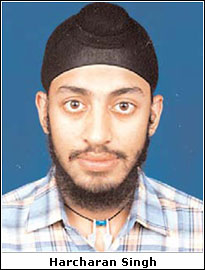 Oh great....Khalistan fauj is now on both sides of border - cries of 'Bole So Nihal' on one side of the border will now be greeted by 'Sat Sri Akal' on the other side. :)
 From Dawn: http://www.dawn.com/2005/12/20/nat12.htm
LAHORE, Dec 19: Harcharan Singh, 19, of the Nankana Sahib, is the first Pakistani Sikh in the country’s 58-year history who has been commissioned in the Pakistan Army as an officer.
The minorities in Pakistan are allowed to sit in all examinations, including the one conducted by Inter Services Selection Board (ISSB), but neither a Hindu nor a Sikh could get selected for the army service since the country’s inception. However, many Christians served in the army.
Harcharan was sceptical this year while appearing in the ISSB’s preliminary tests, thinking that such examinations were not meant for them (Sikhs) as he could not get through the initial phase last year.
“This year, I got through the preliminary phase and appeared in the ISSB examination. However, I was mentally prepared to take admission in BA (Architecture) in the National College of Arts”.
“It was the happiest moment of my life when I came to know about my selection in the army. I am privileged to have this honour which none of my predecessors could ever achieve,” Harcharan told Dawn.
Harcharan, who passed his FSc (pre-engineering) in 2004 with 726 marks, wants the government to open the doors for his community to the law enforcing agencies as well.
Harcharan passed his matriculation from the Government Guru Nanak High School, Nankana Sahib, with 677 marks. He says that his school should be equipped with modern laboratory and competent teaching staff.
He says when his fellow Sikhs in Nankana Sahib learnt about his selection in the army they really felt proud of him. It has also changed their perception. Now they believe that young Sikhs have a fair chance to join the country’s most prestigious institutions.
Having a younger brother and three elder sisters, he wants his brother to follow suit. He says after the death of his father, a shopkeeper, some seven years ago, the credit of their education goes to his mother. “My mother wants me to earn a good name for the country.”
He says that his family migrated to the Northern Areas at the time of partition and in 1970s shifted to Nankana Sahib.
Beware of killer samosas
What with the festive season upon us, here is a Spherical public health announcement... :)

From BBC:
http://news.bbc.co.uk/2/hi/health/3325175.stm
Health chiefs are warning the south asian community about the health risks of their favourite foods. They are concerned that too many people are feasting on tasty, but unhealthy snacks such as samosas. And they believe this is a major reason why diabetes and heart disease are increasing in British cities with large south asian populations.
In Birmingham, health workers are visiting Sikh temples to issue warnings, and offer health checks. Diabetes among the city's Sikhs is now three times higher than within the white European population - and heart disease is one-and-a-half times more prevalent.
Rishpal Chana, an Aston-based health visitor for Heart of Birmingham Teaching Primary Care Trust, has found that nearly a third of those weighed and checked in the Sikh gurdwaras need immediate help from a GP.
Samosas, and other traditional foods from the sub-continent such as pakora and bhajis, are packed with fat.
Ms Chana said: "Samosas are one of the worst foods you can eat and I am trying to get people to eat less of them or cook them with olive oil instead of ghee.
"The Asian diet is very fattening because a lot of the food is fried in this way, yet people don't realise just how bad for you they are." Ms Chana said just one samosa had 25 grams of fat - the same as a large slab of butter.
Blood pressure and blood sugar tests are being offered in the temples on Sundays when they are at their busiest.

From BBC:
http://news.bbc.co.uk/2/hi/health/3325175.stm
Health chiefs are warning the south asian community about the health risks of their favourite foods. They are concerned that too many people are feasting on tasty, but unhealthy snacks such as samosas. And they believe this is a major reason why diabetes and heart disease are increasing in British cities with large south asian populations.
In Birmingham, health workers are visiting Sikh temples to issue warnings, and offer health checks. Diabetes among the city's Sikhs is now three times higher than within the white European population - and heart disease is one-and-a-half times more prevalent.
Rishpal Chana, an Aston-based health visitor for Heart of Birmingham Teaching Primary Care Trust, has found that nearly a third of those weighed and checked in the Sikh gurdwaras need immediate help from a GP.
Samosas, and other traditional foods from the sub-continent such as pakora and bhajis, are packed with fat.
Ms Chana said: "Samosas are one of the worst foods you can eat and I am trying to get people to eat less of them or cook them with olive oil instead of ghee.
"The Asian diet is very fattening because a lot of the food is fried in this way, yet people don't realise just how bad for you they are." Ms Chana said just one samosa had 25 grams of fat - the same as a large slab of butter.
Blood pressure and blood sugar tests are being offered in the temples on Sundays when they are at their busiest.
I feel like Superman...

...well almost, and a cross between Archimedes and the dude who built the Great Pyramids in Egypt.:)) Last weekend I installed one of those over the range microwave appliance that sit 'suspended' in mid-air over the cooker (stove for North Americans). The previous "made-in-the-good ol' U.S of A" microwave had died (surprise, surprise). And after selecting and taking delivery of a replacement Samsung model, I spent most of Sunday with pencil and tape measure, (occasionally scratching my head at the installation instructions) making the theoretical calculations required to locate and drill the required holes both in the wall and cabinets to fit the new appliance. The point of no-return was when I started the drilling..........and guess what, the damn thing actually fitted !!! Yep, no tears, no recriminations, no beating myself over the head !
And as a bonus - to date, fingers crossed, the microwave hasn't collapsed or anything.... :))
I vant this for Christmas....

Oh balle balle.....so I just happened to be browsing the UK Amazon site vhen I came across 'Desi Monopoly'. It's a south asian version of the famous property trading board game presumably set in the Little Punjab(s)/Gujarat(s) of London. Sounds interesting. Vunder if it includes the standard desi hera-pheri and tax avoidance options...... :)
Monday, 19 December 2005
Consultants: Money for nothing ?
"That ain't workin' that's the way you do it
Money for nothin' and your chicks for free" (Dire Straits)
Okay, musical trip down memory lane aside, how many of you have actually got value for money from external consultants ? Specifically those involved in system implementations ? I'm looking at 2 consultant documents in front of me - 1) a sub-standard system design document with what amounts to an incomplete defined scope, non-descript testing and training strategy, a tendency to use verbose abstract concepts which means little to anyone outside of an MBA class and 2) an invoice for payment of consultants whose hourly rate is $250+ per hour.
I am sooooo definitely in the wrong job...
Money for nothin' and your chicks for free" (Dire Straits)
Okay, musical trip down memory lane aside, how many of you have actually got value for money from external consultants ? Specifically those involved in system implementations ? I'm looking at 2 consultant documents in front of me - 1) a sub-standard system design document with what amounts to an incomplete defined scope, non-descript testing and training strategy, a tendency to use verbose abstract concepts which means little to anyone outside of an MBA class and 2) an invoice for payment of consultants whose hourly rate is $250+ per hour.
I am sooooo definitely in the wrong job...
Friday, 16 December 2005
Why are white people..white ?
Well now you finally know.....
ps. I'm just glad I have a sun-kissed complexion. :)
SM starts singing play that funky music white boy... :))
From The Times:
A GENE that partly explains why white people have pale skins has been identified for the first time.
Scientists in the United States have discovered that a tiny mutation in a gene plays a key role in determining skin colour, with Caucasians inheriting a different version from other racial groups.
While it is known that colour is genetically determined, this is the first research to pinpoint a particular stretch of DNA that underlies normal differences in human pigmentation.
The findings promise new insights into cancer and other diseases influenced by genes, and shed light on the evolution of different hues of skin.
The discovery of the gene, named slc245a5, has emerged from research into cancer that used zebrafish as an animal model. A team led by Keith Cheng, of Pennsylvania State University, noted that a variant of the fish, known as “golden”, had paler markings than usual, and that this lighter pigmentation was caused by a mutation in slc245a5.
As the gene is known to exist in people, Dr Cheng wondered whether it might be responsible for some of the variation in human skin colour. First he transplanted the human gene into fish and found that it had the same effect on pigmentation. He then teamed up with a colleague, Mark Shriver, to investigate how different versions of the gene were distributed across human populations, using the recently completed HapMap, which charts genetic variation.
The researchers have found that while people of African and Chinese origin carry one version of slc245a5, those of white European ancestry have a different one. The results, published today in the journal Science, indicate strongly a big influence over skin colour.
The work suggests that the dark version of the gene occurs as a default, and that the light variant is a mutation that probably evolved as humans moved out of Africa and migrated into northern latitudes. This supports a theory that lighter skin evolved as an adaptation to the weaker sunlight of northern climes. Sunlight is essential for the body to manufacture vitamin D, and pale skins make this easier when the Sun’s rays are not particularly strong.
The slc245a5 gene does not vary between Africans and much lighter-skinned Chinese, or between Europeans of Swedish and Greek ancestry. It is thought to be responsible for between 25 and 38 per cent of colour variation between Europeans and Africans, and other genes are certain to be involved.
While genes that are mutated in albino people have been identified, this is the first that has a significant influence on normal variations.
The results promise to assist research into malignant melanoma, the deadliest skin cancer, which is rarer among dark-skinned people. They should also help scientists seeking to tease out the genetic contribution to conditions such as heart disease and diabetes, which are often influenced, like skin colour, by multiple genes.
Dr Shriver said: “We cannot expect to use human genetics to understand complex diseases most effectively without first working out how fundamental characteristics, such as eye, hair and skin colour are determined.”
SKIN DEEP
- Scientists generally assume that the first anatomically modern humans, who evolved in Africa, had dark skins.
- The evolution of other skin types, particularly the fair complexions of Europeans, has long been one of the big mysteries of biology. It has been suggested that dark skin is an adaptation to strong sunlight in the tropics, and protects against skin cancer. While this might be possible if dark skins had evolved from light ones, the process happened the other way around
- A more plausible theory is that light skin evolved as an adaptation to the weaker sunlight of northern latitudes.
- Sunlight is necessary for the body to produce vitamin D, and dark-skinned people struggle to do this when the Sun is weak. Some ethnic minorities in northern Europe have higher rates of rickets, a disease caused by vitamin D deficiency
- Many scientists, however, think the adaptive advantages of light skin are too small for the effect to be the result of natural selection
http://www.timesonline.co.uk/article/0,,11069-1934310,00.html
ps. I'm just glad I have a sun-kissed complexion. :)
SM starts singing play that funky music white boy... :))
From The Times:
A GENE that partly explains why white people have pale skins has been identified for the first time.
Scientists in the United States have discovered that a tiny mutation in a gene plays a key role in determining skin colour, with Caucasians inheriting a different version from other racial groups.
While it is known that colour is genetically determined, this is the first research to pinpoint a particular stretch of DNA that underlies normal differences in human pigmentation.
The findings promise new insights into cancer and other diseases influenced by genes, and shed light on the evolution of different hues of skin.
The discovery of the gene, named slc245a5, has emerged from research into cancer that used zebrafish as an animal model. A team led by Keith Cheng, of Pennsylvania State University, noted that a variant of the fish, known as “golden”, had paler markings than usual, and that this lighter pigmentation was caused by a mutation in slc245a5.
As the gene is known to exist in people, Dr Cheng wondered whether it might be responsible for some of the variation in human skin colour. First he transplanted the human gene into fish and found that it had the same effect on pigmentation. He then teamed up with a colleague, Mark Shriver, to investigate how different versions of the gene were distributed across human populations, using the recently completed HapMap, which charts genetic variation.
The researchers have found that while people of African and Chinese origin carry one version of slc245a5, those of white European ancestry have a different one. The results, published today in the journal Science, indicate strongly a big influence over skin colour.
The work suggests that the dark version of the gene occurs as a default, and that the light variant is a mutation that probably evolved as humans moved out of Africa and migrated into northern latitudes. This supports a theory that lighter skin evolved as an adaptation to the weaker sunlight of northern climes. Sunlight is essential for the body to manufacture vitamin D, and pale skins make this easier when the Sun’s rays are not particularly strong.
The slc245a5 gene does not vary between Africans and much lighter-skinned Chinese, or between Europeans of Swedish and Greek ancestry. It is thought to be responsible for between 25 and 38 per cent of colour variation between Europeans and Africans, and other genes are certain to be involved.
While genes that are mutated in albino people have been identified, this is the first that has a significant influence on normal variations.
The results promise to assist research into malignant melanoma, the deadliest skin cancer, which is rarer among dark-skinned people. They should also help scientists seeking to tease out the genetic contribution to conditions such as heart disease and diabetes, which are often influenced, like skin colour, by multiple genes.
Dr Shriver said: “We cannot expect to use human genetics to understand complex diseases most effectively without first working out how fundamental characteristics, such as eye, hair and skin colour are determined.”
SKIN DEEP
- Scientists generally assume that the first anatomically modern humans, who evolved in Africa, had dark skins.
- The evolution of other skin types, particularly the fair complexions of Europeans, has long been one of the big mysteries of biology. It has been suggested that dark skin is an adaptation to strong sunlight in the tropics, and protects against skin cancer. While this might be possible if dark skins had evolved from light ones, the process happened the other way around
- A more plausible theory is that light skin evolved as an adaptation to the weaker sunlight of northern latitudes.
- Sunlight is necessary for the body to produce vitamin D, and dark-skinned people struggle to do this when the Sun is weak. Some ethnic minorities in northern Europe have higher rates of rickets, a disease caused by vitamin D deficiency
- Many scientists, however, think the adaptive advantages of light skin are too small for the effect to be the result of natural selection
http://www.timesonline.co.uk/article/0,,11069-1934310,00.html
Thursday, 15 December 2005
Badminton musings
 When played well, and I ain't talking about the genteel back garden variety played by folks who think it is played over a volleyball net, badminton is one of the fastest reaction sports in the world. I've made many friends over time through membership of the 5-7 clubs I've been at and it is a rewarding sport. :)
Couple of observations:
1) I've always enjoyed playing a style of badminton which is hard and fast yet also tactical and cerebral....but one inescapable conclusion remains. For the most part, playing mixed doubles remains essentially a game of men's singles with two women standing at the net....LOL Admittedly this may sound parochial but I base this on the average standard of play I've seen over the years both in England and Canada (but more so in the latter). Guys should be prepared to sweat buckets and cover the entire court, as well as shadow his female partner to 'cover' that 'invisible hole' that exists in middle of her racquet...... :)
2) Feather shuttlecocks are over-rated for game play and their exhorbitant price and durability is questionable. I could easily smash through a tube of crappy (and expensive) Yonex feathers in an evening if I was so inclined. The air resistance of feather birds appear to mitigate against a fast smashing game, and it renders cross-court backhand shots ineffectual. And the thing that gets me is the lack of flight consistency viz a viz synthetic shuttles......each feather bird will not always land in the target baseline zone. And I'm not prepared to do some voodoo mumbo-jumbo of steaming the damn things just so that they can supposedly reach a similar flight path quality as their synthetic counter-parts. Their only redeeming feature is the crack sound when hit, but I'll forgo that and the illusion of 'quality' play, in favour of consistency and equitable economy of price for all. (Plus, I ain't really in the mood to catch avian bird flu either...LOL).
Monday, 12 December 2005
It's karaoke time !
 It just occurred to me whilst driving to work this morning and singing along to Malkit Singh's Midas Touch 2 album at full blast, that I may have found my true vocation and passion in life ! The one thing that has been missing in my life is....*drum roll please*........is a karaoke machine ! Jee haa meray pyare dosto - you have been deprived for too long of my singing talents and smooth vocals. LOL. For too long I have been selfishly keeping my vocal talents to myself and the shower, but this is all about to change ! :)
Now being the realistic rational Virgo type :) I don't think my local Walmart is going to stock bhangra/bollywood karaoke tunes, but I would be happy just to belt a few 90s or even 80s songs to my adoring audience. We can go on a collective trip down memory lane and sing Wacko Jacko, Madonna, 2 Unlimited, Duran Duran, Culture Club (I sing a wicked 'Do you really want to hurt me?'..LOL) or even Frankie Goes to Hollywood......oh the memories. :)
Wednesday, 7 December 2005
Where are my Clementines ?
 I've given up on eating tangerine oranges.....besides, I always thought they looked a bit creepy sitting there in the supermarket fruit section.
In the absence of my preferred (seedless) clementines I bought a bag full of tangerines the other day so as to allow me to cope with hitting the 3pm wall, but everytime I got my jaws into salivating eating mode I had to stop to spit out a mouthful of seeds. What is with that ? Where is the instant gratification ? Is this the gastronomic version of coitus interruptus ? You would have thought the way the US government and big agro-food corporations have tried to bully the world into eating genetically modified Frankenstein foods, that they could create some seedless orange varieties for yours truly.... :)
Tuesday, 6 December 2005
Faux pas
I was witness to an unintended social faux pas last weekend. It was with a sense of sympathetic empathy that I felt for the hapless transgressor left to make conciliatory amends.....
...Life can be uncomfortably complicated with it's multi-layered tiers of social norms for those used to a simpler way of life....
...Life can be uncomfortably complicated with it's multi-layered tiers of social norms for those used to a simpler way of life....
Wednesday, 30 November 2005
Iraq is the new Vietnam
Seems like the USA is going to continue their illegal occupation of Iraq for the forseeable future....
http://news.bbc.co.uk/2/hi/americas/4484330.stm
President George W Bush has said he will not accept "anything less than complete victory" in Iraq. In a major policy speech, Mr Bush refused to set an "artificial deadline" to withdraw US troops, saying it was "not a plan for victory".
It comes after the release of the first Iraq strategy document, which rejects widespread calls for a timetable. Mr Bush has come under growing pressure from Democrats on Iraq. Polls give him the lowest approval of his presidency.
They also suggest that six out of 10 Americans think the war in Iraq is not worth the cost. As such, this was a speech from a president in deep trouble, says the BBC's Justin Webb in Washington.


http://news.bbc.co.uk/2/hi/americas/4484330.stm
President George W Bush has said he will not accept "anything less than complete victory" in Iraq. In a major policy speech, Mr Bush refused to set an "artificial deadline" to withdraw US troops, saying it was "not a plan for victory".
It comes after the release of the first Iraq strategy document, which rejects widespread calls for a timetable. Mr Bush has come under growing pressure from Democrats on Iraq. Polls give him the lowest approval of his presidency.
They also suggest that six out of 10 Americans think the war in Iraq is not worth the cost. As such, this was a speech from a president in deep trouble, says the BBC's Justin Webb in Washington.
Friday, 25 November 2005
Genetic basis for caste ?
What do you think ? The evidence is anecdotal and subjective, but I've always seem to notice a physical similarity in people of the same caste. I'm thinking that hundreds and possibly thousands of years of strict marriage within caste has resulted in subtle DNA differences.
If you have the time, read the following academic research paper entitled "Genetic Evidence on Origins of Indian Caste Populations" (pdf file).
http://jorde-lab.genetics.utah.edu/elibrary/Bamshad_2001a.pdf
If you have the time, read the following academic research paper entitled "Genetic Evidence on Origins of Indian Caste Populations" (pdf file).
http://jorde-lab.genetics.utah.edu/elibrary/Bamshad_2001a.pdf
Wednesday, 16 November 2005

Matilda is truly spinning....

Congratulations to Australia in beating Uruguay in the play-offs, and qualifying for the 2006 World Cup for the first time since 1974. As perennial winners of the Oceania qualifying group, they've always come up against the juggernaut of competing with South American teams in a play-off to grab the last spot in the World Cup.

http://news.bbc.co.uk/sport2/hi/football/internationals/4435400.stm
http://news.bbc.co.uk/sport2/hi/football/internationals/4435400.stm
Tuesday, 15 November 2005
Is time passing you by ?
Do you ever feel that the relentless march of time is a little too relentless ? Ever wish you could slow time down ? Does continually procrastinating and delaying a task until next week eventually aggregate into next month and then next year ?
It's quite remarkable how one year seamlessly rolls into another, and you get that constant feeling of deja vu (eg. this Xmas is just like last Xmas, or this summer might as well been last summer etc).
I'm guessing there are a lot more people in the same boat than would care to admit. After all, go-getting types get much more adulation and peer respect than those whose lives seem to be perenially set on auto-pilot - no matter how close those mountain peaks appear to be...

It's quite remarkable how one year seamlessly rolls into another, and you get that constant feeling of deja vu (eg. this Xmas is just like last Xmas, or this summer might as well been last summer etc).
I'm guessing there are a lot more people in the same boat than would care to admit. After all, go-getting types get much more adulation and peer respect than those whose lives seem to be perenially set on auto-pilot - no matter how close those mountain peaks appear to be...

Friday, 11 November 2005
Today is Remembrance Day
Remembering the sacrifices of all soldiers, including the 5 million troops from United India who fought in both World Wars.


Check out this British Ministry of Defence link below which highlights the sacrifices made by soldiers from the Commonwealth nations:
http://www.mod.uk/wewerethere/intro.html
Check out this British Ministry of Defence link below which highlights the sacrifices made by soldiers from the Commonwealth nations:
http://www.mod.uk/wewerethere/intro.html
Monday, 7 November 2005
How do you punish yourself ?
In the 'Da Vinci Code' a member of the Opus Dei sect punishes himself for personal transgressions by use of a cilice - a barbed chain worn around his leg. That is an extreme example, but have you ever felt remorse or regret for something you did and if so, how did you atone for it ? In such circumstances do you deny yourself some worldly pleasure, go into temporary social exile, or subject yourself to some self-imposed onerous task ? Did it make you feel better afterwards ?
Article reference:
http://www.rickross.com/reference/opus/opus56.html
The best-selling novel "The Da Vinci Code" pays hostile attention to the zealously conservative Roman Catholic order Opus Dei and its use of "corporal mortification" - voluntarily punishing one's own body as a spiritual discipline.
This practice may seem odd if not odious to many nowadays but it was used by such revered Catholic saints as Francis of Assisi, England's Thomas More, Jesuit founder Ignatius Loyola and Jerome, translator of the Latin Bible.
In modern times, mortification is associated with some Catholic and Eastern Orthodox monks, but Opus Dei advocates it for lay members in everyday life.
The Rev. Michael Giesler, an Opus Dei priest in St. Louis, defends mortification in the current issue of Crisis, a Catholic magazine. He describes two methods: the cilice, a sharp chain worn around the leg, and "the discipline" or flagellum, a small whip of knotted cords applied to one's back.
One of his arguments is that the practice "dates back to biblical times."
Giesler finds biblical precedent for self-whipping in the scourging of Jesus before his crucifixion. The intent is for the believer to identify with the savior's sufferings. However, Jesus himself provided no example for self-abuse of the body; his punishments were inflicted upon him by others.
The cilice, Giesler says, is a version of the ancient hairshirt, a rough garment of animal hair worn next to the skin for penance. In turn, the Catholic Encyclopedia of 1914 says the hairshirt "was probably the same thing" as sackcloth, an Old Testament garment usually made from goat's hair. Giesler also sees sackcloth as a biblical precedent.
But others disagree. Perhaps with Catholic practices in mind, a Protestant work, "The Interpreter's Dictionary of the Bible," says "there is no indication that the coarseness of the (sackcloth) produced physical discomfort when worn or that it was used for the purpose of self-punishment, but it was put on as a sign of mental anguish at times of personal loss and national calamity."
Sorrow was indeed the stated motive when Old Testament figures wore sackcloth. However, three verses specify extreme circumstances where sackcloth was worn next to the skin, possibly providing background for the hairshirt: Job 16:15, 1 Kings 21:27 and 2 Kings 6:30. The third passage seems to indicate the garment was worn beneath outer clothing to keep it secret, not necessarily for physical punishment.
From the New Testament, Giesler quotes Paul's statement, "I pommel my body and subdue it" (1 Corinthians 9:27), translated in Catholicism's New American Bible as "I drive my body and train it." This passage compares athletic training with spiritual discipline and modern Catholic commentaries do not apply it to mortification.
Other New Testament teachings cited by Opus Dei are generalized admonitions of self-denial or overcoming of bodily temptations, for instance Jesus' statement, "If anyone wishes to come after me, he must deny himself and take up his cross daily and follow me" (Luke 9:23).
In another passage cited by Opus Dei, Paul spiritualizes punishments others inflicted upon him: "I rejoice in my sufferings for your sake, and in my flesh I am filling up what is lacking in the afflictions of Christ on behalf of his body, which is the church" (Colossians 1:24).
There are ample and unambiguous examples from Jesus and other biblical figures for one form of physical denial: fasting (going without food for the purpose of spiritual cleansing and concentration).
Biblical materials aside, it's certain that physical mortification began to be practiced by the hermits and monks during Christianity's early centuries. Giesler acknowledges that things got out of hand with the fanatical "flagellants" in certain 14th-century sects that were repeatedly condemned by Catholic authorities.
Opus Dei notes modern support for its practice in writings by the recent popes John XXIII and Paul VI and by Wisconsin's Bishop Robert Morlino, in a 2003 article criticizing "The Da Vinci Code." Also, Giesler says, Opus Dei founder Josemaria Escriva, who died in 1975 and was named a saint 27 years later, "performed heroic mortifications."
Article reference:
http://www.rickross.com/reference/opus/opus56.html
The best-selling novel "The Da Vinci Code" pays hostile attention to the zealously conservative Roman Catholic order Opus Dei and its use of "corporal mortification" - voluntarily punishing one's own body as a spiritual discipline.
This practice may seem odd if not odious to many nowadays but it was used by such revered Catholic saints as Francis of Assisi, England's Thomas More, Jesuit founder Ignatius Loyola and Jerome, translator of the Latin Bible.
In modern times, mortification is associated with some Catholic and Eastern Orthodox monks, but Opus Dei advocates it for lay members in everyday life.
The Rev. Michael Giesler, an Opus Dei priest in St. Louis, defends mortification in the current issue of Crisis, a Catholic magazine. He describes two methods: the cilice, a sharp chain worn around the leg, and "the discipline" or flagellum, a small whip of knotted cords applied to one's back.
One of his arguments is that the practice "dates back to biblical times."
Giesler finds biblical precedent for self-whipping in the scourging of Jesus before his crucifixion. The intent is for the believer to identify with the savior's sufferings. However, Jesus himself provided no example for self-abuse of the body; his punishments were inflicted upon him by others.
The cilice, Giesler says, is a version of the ancient hairshirt, a rough garment of animal hair worn next to the skin for penance. In turn, the Catholic Encyclopedia of 1914 says the hairshirt "was probably the same thing" as sackcloth, an Old Testament garment usually made from goat's hair. Giesler also sees sackcloth as a biblical precedent.
But others disagree. Perhaps with Catholic practices in mind, a Protestant work, "The Interpreter's Dictionary of the Bible," says "there is no indication that the coarseness of the (sackcloth) produced physical discomfort when worn or that it was used for the purpose of self-punishment, but it was put on as a sign of mental anguish at times of personal loss and national calamity."
Sorrow was indeed the stated motive when Old Testament figures wore sackcloth. However, three verses specify extreme circumstances where sackcloth was worn next to the skin, possibly providing background for the hairshirt: Job 16:15, 1 Kings 21:27 and 2 Kings 6:30. The third passage seems to indicate the garment was worn beneath outer clothing to keep it secret, not necessarily for physical punishment.
From the New Testament, Giesler quotes Paul's statement, "I pommel my body and subdue it" (1 Corinthians 9:27), translated in Catholicism's New American Bible as "I drive my body and train it." This passage compares athletic training with spiritual discipline and modern Catholic commentaries do not apply it to mortification.
Other New Testament teachings cited by Opus Dei are generalized admonitions of self-denial or overcoming of bodily temptations, for instance Jesus' statement, "If anyone wishes to come after me, he must deny himself and take up his cross daily and follow me" (Luke 9:23).
In another passage cited by Opus Dei, Paul spiritualizes punishments others inflicted upon him: "I rejoice in my sufferings for your sake, and in my flesh I am filling up what is lacking in the afflictions of Christ on behalf of his body, which is the church" (Colossians 1:24).
There are ample and unambiguous examples from Jesus and other biblical figures for one form of physical denial: fasting (going without food for the purpose of spiritual cleansing and concentration).
Biblical materials aside, it's certain that physical mortification began to be practiced by the hermits and monks during Christianity's early centuries. Giesler acknowledges that things got out of hand with the fanatical "flagellants" in certain 14th-century sects that were repeatedly condemned by Catholic authorities.
Opus Dei notes modern support for its practice in writings by the recent popes John XXIII and Paul VI and by Wisconsin's Bishop Robert Morlino, in a 2003 article criticizing "The Da Vinci Code." Also, Giesler says, Opus Dei founder Josemaria Escriva, who died in 1975 and was named a saint 27 years later, "performed heroic mortifications."
Thursday, 3 November 2005
Escape Velocity & Survival of Life

Technical description can be found on Wikipedia:
http://en.wikipedia.org/wiki/Escape_velocity
In physics, for a given gravitational field and a given position, the escape velocity is the minimum speed an object without propulsion, at that position, needs to have to move away indefinitely from the source of the field, as opposed to falling back or staying in an orbit within a bounded distance from the source. The object is assumed to be influenced by no forces except the gravitational field; in particular there is no propulsion, as by a rocket, there is no friction, as between the object and the Earth's atmosphere (these conditions correspond to freefall) and there is no gravitational radiation. This definition may need modification for the practical problem of two or more sources in some cases. In any case, the object is assumed to be a point with a mass that is negligible compared with that of the source of the field, usually an excellent approximation. It is commonly described as the speed needed to "break free" from a gravitational field.
In the simple case of the escape velocity from a single body, it can be calculated by setting the kinetic energy equal to minus the gravitational potential energy. This is because the positive kinetic energy is needed to increase the negative gravitational potential energy to zero, which applies when the object is at an infinite distance.

where ve is the escape velocity, G is the gravitational constant, M is the mass of the body being escaped from, m is the mass of the escaping body (factors out), and r is the distance between the centre of the body and the point at which escape velocity is being calculated, and μ is the standard gravitational parameter.
Two moans and you're out !
Interesting article about how to stop negativity in workplace...
**********************************************
A German businesswoman has launched a campaign to stop her fellow countrymen whining, threatening her employees with the sack if they complain.
Ramona Wonneberger, 42, head of a Leipzig IT company, said she introduced a "two moans and you're out" policy to clamp down on "negative energy" stunting its growth.
She has since launched a website called "Be happy" to spread her message across the country.
"Unfortunately, Germans are the world's most inveterate whingers and bellyachers, particularly concerning things they cannot change like the weather or a late train," she said.
"I thought 'I have to do something to change this mentality'."
After a particularly bad bout of complaining at Nutzwerk, her company, "about everything from the traffic to the fact that a husband had forgotten a wedding anniversary", she decided to act, and took her employees to a comedy show.
"After a serious evening of constant laughter which did us a lot of good, I put it to them that we should ban moaning in the company from then on," said Mrs Wonneberger.
Employees now have a clause in their contracts which states: "moaning and whingeing is forbidden... except when accompanied with a constructive suggestion as to how to improve the situation".
So far three employees - two of whom had been given warnings, one of whom chose to go voluntarily, claiming she was being "censored" and had nothing to talk about any more - have been dismissed.
Mrs Wonneberger, whose motto is: "Those who moan rob others of energy and time", says that the company's turnover has doubled to £2 million thanks to the policy.
http://www.telegraph.co.uk/news/main.jhtml?xml=/news/2005/11/03/wmoan03.xml&sSheet=/news/2005/11/03/ixworld.html
**********************************************
A German businesswoman has launched a campaign to stop her fellow countrymen whining, threatening her employees with the sack if they complain.
Ramona Wonneberger, 42, head of a Leipzig IT company, said she introduced a "two moans and you're out" policy to clamp down on "negative energy" stunting its growth.
She has since launched a website called "Be happy" to spread her message across the country.
"Unfortunately, Germans are the world's most inveterate whingers and bellyachers, particularly concerning things they cannot change like the weather or a late train," she said.
"I thought 'I have to do something to change this mentality'."
After a particularly bad bout of complaining at Nutzwerk, her company, "about everything from the traffic to the fact that a husband had forgotten a wedding anniversary", she decided to act, and took her employees to a comedy show.
"After a serious evening of constant laughter which did us a lot of good, I put it to them that we should ban moaning in the company from then on," said Mrs Wonneberger.
Employees now have a clause in their contracts which states: "moaning and whingeing is forbidden... except when accompanied with a constructive suggestion as to how to improve the situation".
So far three employees - two of whom had been given warnings, one of whom chose to go voluntarily, claiming she was being "censored" and had nothing to talk about any more - have been dismissed.
Mrs Wonneberger, whose motto is: "Those who moan rob others of energy and time", says that the company's turnover has doubled to £2 million thanks to the policy.
http://www.telegraph.co.uk/news/main.jhtml?xml=/news/2005/11/03/wmoan03.xml&sSheet=/news/2005/11/03/ixworld.html
Monday, 31 October 2005
Amrita Pritam
From BBC:
Renowned Indian writer Amrita Pritam has died at her home in the Indian capital Delhi after a long illness. Known as the doyenne of Punjabi literature, 86-year-old Ms Pritam also wrote extensively in Hindi and Urdu.

Her first story collection, in the Punjabi language, was published when she was 16 years old. She received many awards, including India's highest literary award, Jnanpith, in 1981. Born to a Sikh family in Gujranwala, Pakistan, in 1919, Ms Pritam crossed to India after the partition of the sub-continent in 1947. Moving to Delhi, she began writing in Hindi and also worked for the state-owned All India Radio till 1961.
The first prominent woman Punjabi poet and fiction writer, many of Ms Pritam's writings dealt with the pain she felt at the division of the sub-continent. One of her famous novels, Pinjar (Skeleton), was made into a feature film a few years ago.

The story is set against the backdrop of the violent frenzy and rioting that engulfed the whole of Punjab in the months preceding partition.
"Her death symbolises the end of an era. Punjabi literature, after the country's independence, will be known as her era," said London-based Punjabi poet, Amarjit Chandan.
Ms Pritam's literary works have been translated in several languages including French, Japanese and Danish.
She has written several novels and short stories.
She often wrote on the condition of Indian women and her writings reflected their neglect and suppression in Indian society.
http://news.bbc.co.uk/2/hi/south_asia/4393970.stm
Renowned Indian writer Amrita Pritam has died at her home in the Indian capital Delhi after a long illness. Known as the doyenne of Punjabi literature, 86-year-old Ms Pritam also wrote extensively in Hindi and Urdu.
Her first story collection, in the Punjabi language, was published when she was 16 years old. She received many awards, including India's highest literary award, Jnanpith, in 1981. Born to a Sikh family in Gujranwala, Pakistan, in 1919, Ms Pritam crossed to India after the partition of the sub-continent in 1947. Moving to Delhi, she began writing in Hindi and also worked for the state-owned All India Radio till 1961.
The first prominent woman Punjabi poet and fiction writer, many of Ms Pritam's writings dealt with the pain she felt at the division of the sub-continent. One of her famous novels, Pinjar (Skeleton), was made into a feature film a few years ago.
The story is set against the backdrop of the violent frenzy and rioting that engulfed the whole of Punjab in the months preceding partition.
"Her death symbolises the end of an era. Punjabi literature, after the country's independence, will be known as her era," said London-based Punjabi poet, Amarjit Chandan.
Ms Pritam's literary works have been translated in several languages including French, Japanese and Danish.
She has written several novels and short stories.
She often wrote on the condition of Indian women and her writings reflected their neglect and suppression in Indian society.
http://news.bbc.co.uk/2/hi/south_asia/4393970.stm
Saturday, 29 October 2005
Forgotten Soldiers of WW1
My maternal great-grandfather fought and died during the First World War in France, so I found this article about forgotten Indian soldiers in Germany a rather poignant one.
Luke Harding in Wünsdorf
Saturday October 29, 2005
The Guardian
Until recently there was nothing to identify the quiet, leafy spot where Jafarullah Mohammad and Mata Din Singh were buried. The two servicemen were among thousands of Indian volunteers who fought for Britain in the first world war, and were captured at sea or on the western front.
For more than 80 years the German graveyard where Mohammad, Singh and 204 other Indian volunteers are buried was forgotten. But today the war cemetery in Wünsdorf, in a forest 40km south of Berlin, is to be officially reopened.
The restoration is a recognition of the role played by troops from undivided India, who fought in the bloody battles of Ypres, Neuve Chapelle and Loos. Many died. Others ended up interned in German prisoner of war camps.
"Very few people are aware of the role Indian troops played in both world wars," Peter Francis of the Commonwealth Graves Commission said. "In some Indian units the casualty rate was 80%. In three days' fighting in Neuve Chapelle in 1915, for instance, some 4,200 Indian soldiers perished." Most of the soldiers and sailors buried at Wünsdorf died of disease while stationed at the PoW camp in the nearby town of Zossen. The Nazis later used the area as a vast military training camp.
After the second world war, the Russians took over the camp, including the graveyard - using the surrounding heathland for mock tank battles. Locals, meanwhile, looted the headstones; the plot disappeared under rhododendrons and fallen oaks. It was only after the fall of the Berlin Wall that British officials were able to gain access to the site.
Diplomats from India, Pakistan and Bangladesh will attend today's rededication ceremony, as well as officials from Russia and France, to honour Tartar soldiers who are buried on the same site.
Luke Harding in Wünsdorf
Saturday October 29, 2005
The Guardian
Until recently there was nothing to identify the quiet, leafy spot where Jafarullah Mohammad and Mata Din Singh were buried. The two servicemen were among thousands of Indian volunteers who fought for Britain in the first world war, and were captured at sea or on the western front.
For more than 80 years the German graveyard where Mohammad, Singh and 204 other Indian volunteers are buried was forgotten. But today the war cemetery in Wünsdorf, in a forest 40km south of Berlin, is to be officially reopened.
The restoration is a recognition of the role played by troops from undivided India, who fought in the bloody battles of Ypres, Neuve Chapelle and Loos. Many died. Others ended up interned in German prisoner of war camps.
"Very few people are aware of the role Indian troops played in both world wars," Peter Francis of the Commonwealth Graves Commission said. "In some Indian units the casualty rate was 80%. In three days' fighting in Neuve Chapelle in 1915, for instance, some 4,200 Indian soldiers perished." Most of the soldiers and sailors buried at Wünsdorf died of disease while stationed at the PoW camp in the nearby town of Zossen. The Nazis later used the area as a vast military training camp.
After the second world war, the Russians took over the camp, including the graveyard - using the surrounding heathland for mock tank battles. Locals, meanwhile, looted the headstones; the plot disappeared under rhododendrons and fallen oaks. It was only after the fall of the Berlin Wall that British officials were able to gain access to the site.
Diplomats from India, Pakistan and Bangladesh will attend today's rededication ceremony, as well as officials from Russia and France, to honour Tartar soldiers who are buried on the same site.
Friday, 28 October 2005

Thursday, 27 October 2005
Lion,Witch & the Wardrobe
As a kid I grew up reading the Narnia Chronicles by C.S.Lewis before graduating onto Tolkien. So I was pleased to hear that the movie version of LWW is coming out in December at cinemas nationwide. Anyone else read the books, or planning to watch the film ? (There is also an excellent animated version which has been around several years).
Of the other Narnia books my other faves include Prince Caspian, The Horse and His Boy and The Silver Chair (the latter I'm re-reading now). There have been several analyses of Lewis's interpretation of 'good' versus 'evil' struggle which manifests itself throughout the books.

Of the other Narnia books my other faves include Prince Caspian, The Horse and His Boy and The Silver Chair (the latter I'm re-reading now). There have been several analyses of Lewis's interpretation of 'good' versus 'evil' struggle which manifests itself throughout the books.
Wednesday, 26 October 2005
Bright
There was a young lady called Bright,
Whose speed was much faster, much faster than light,
She departed one day in a relative way,
And arrived on the previous night.
(Author unknown)
Whose speed was much faster, much faster than light,
She departed one day in a relative way,
And arrived on the previous night.
(Author unknown)
Monday, 24 October 2005
Cultural significance of the Bindi ?
I always wondered about the social anthropological meaning of the Bindi in Indian society. Well now you know.......LOL. :)

Friday, 21 October 2005

Thursday, 20 October 2005
The age of miracles is dead
Main Entry: mir·a·cle
Pronunciation: 'mir-i-k&l
Function: noun
Etymology: Middle English, from Old French, from Late Latin miraculum, from Latin, a wonder, marvel, from mirari to wonder at
1 : an extraordinary event manifesting divine intervention in human affairs
2 : an extremely outstanding or unusual event, thing, or accomplishment
3 Christian Science : a divinely natural phenomenon experienced humanly as the fulfillment of spiritual law
^ ^ ^ ^
My comment:
I don't think the world will ever see a religious miracle on the scale documented in the all the main religious scriptures that exist in this world, either in the East or West. In fact I don't believe any historical episode where apparently some supernatural feat was performed by some messiah, prophet or guru. The tales of resurrection after death, flying chariots, individual faith worshippers killing 100 of the enemy single-handedly, or duels with the devil in the desert are just that - tales - to be treated in the same incredulous grain as the existence of Santa Claus flying around the world on Christmas eve with his herd of reindeer. They are metaphorical allusions to the power of faith - but nothing more.
In an age where digital media and recording devices are as common as sliced bread, of real time streaming internet news, and where every other person has a camera-cellphone and/or mini-camera, how is it that no miracles have yet been captured on film ? The reason: miracles of a divine nature do not exist, never have and never will.
Pronunciation: 'mir-i-k&l
Function: noun
Etymology: Middle English, from Old French, from Late Latin miraculum, from Latin, a wonder, marvel, from mirari to wonder at
1 : an extraordinary event manifesting divine intervention in human affairs
2 : an extremely outstanding or unusual event, thing, or accomplishment
3 Christian Science : a divinely natural phenomenon experienced humanly as the fulfillment of spiritual law
^ ^ ^ ^
My comment:
I don't think the world will ever see a religious miracle on the scale documented in the all the main religious scriptures that exist in this world, either in the East or West. In fact I don't believe any historical episode where apparently some supernatural feat was performed by some messiah, prophet or guru. The tales of resurrection after death, flying chariots, individual faith worshippers killing 100 of the enemy single-handedly, or duels with the devil in the desert are just that - tales - to be treated in the same incredulous grain as the existence of Santa Claus flying around the world on Christmas eve with his herd of reindeer. They are metaphorical allusions to the power of faith - but nothing more.
In an age where digital media and recording devices are as common as sliced bread, of real time streaming internet news, and where every other person has a camera-cellphone and/or mini-camera, how is it that no miracles have yet been captured on film ? The reason: miracles of a divine nature do not exist, never have and never will.
Review: The Tiger Claw
 Finally finished it ! :)
"December moved in, taking up residence with Noor in her cell, and freezing the radiator. Cold coiled in the bowl of her pelvis, turning shiver to quake as she lay beneath her blanket on the cot. Above, snow drifted against glass and bars. Shreds of thoughts, speculations, obsessions...some glue still held her fragments together."
There are writers and there is Shauna Singh Baldwin. The breadth and depth of her latest novel is breathtaking, and leaves you both exhausted and enthralled at the same time.
'Tiger Claw' is based on the true life of Noor Inayat Khan, of Anglo-Indian Muslim origin (and a direct descendent of Tipu Sultan), who served as a secret agent transmitting radio messages from Vichy France during the Second World War. As her life story is in the public domain, I'll make no secret of the fact that she was betrayed and then subsequently captured by the Gestapo and rather than being treated as a prisoner of war, instead was held as a 'night and fog' prisoner (ie. officially does not exist), and eventually executed by her German Nazi captors.
What starts off as a spy thriller, meanders into themes of love, betrayal and idealism. As the tides of fortune slowly turn against Noor, she still harbours the belief that one day she would be re-united with her Jewish lover who is held in an unknown concentration camp. The more poignant parts of the book are when she is almost resigned to the inevitability of death in prison, yet steadfastly refuses to show her fears and still stubbornly clings onto hope where there is none. There is a message in there for all of us somewhere in this book.
One of the more powerful parts of this book, is the parallels that Baldwin draws between German occupied France and British occupied India. Both were acts of aggression, and yet I wasn't aware until reading this book, that 4 millions Bengalis died of starvation during 1943-44 due to a deliberate policy by the British to divert rice to other parts of the empire. Almost as many people died in the Bengal famine as during the Jewish holocaust.
This book will leave a huge impression on me for a very long time. A quality read.
ps. You can read more of her life story here:
http://en.wikipedia.org/wiki/Noor_Inayat_Khan
On natural justice and Saddam Hussein

If Saddam Hussein is to eventually hang from his neck, as inevitably he will given the charade of a show trial he is now involved in, then so should Bush, Rumsfeld, Blair and other war criminal terrorists who illegally invaded and occupied Iraq on the basis of lies, and caused untold genocide upon the ordinary men, women and children of Iraq. Yes, Hussein was a mass murderer, but he was not the only one in the circle of international leaders, and he could not have acted alone in the killing of Kurds and Shias without the active support of the US in the pre-Gulf War days.
There is a difference between 'natural' justice and 'constitutional' justice. The latter is something that can written to appease one's puppet masters (think of Nazi occupied Vichy France, or British occupied India), but natural justice is something that overrides paper charters written in meanigless legal speak. Natural justice can potentially call for an 'eye for an eye', of satiating the human blind rage that has the potential to exist in each one of us, or collectively, in an orphaned brotherhood or nation.
They say history is written by the victors. Never has a statement sounded more truer than that.


Friday, 14 October 2005
If you could see the end...
Last week's terrible devastation from the earthquake in Pakistan has got me thinking as to how fragile human life is. None of us knows when it will be our turn to leave this physical abode known as 'life' and depart forever. The thousands who died never had a chance to say goodbye to their surviving loved ones, and many of those who did survive are now destitute and left to endure a living death of sorts. I pray that through the grace of Waheguru, recovery and relief will be as quick as humanly possible, especially given that the first snow flakes have already landed in some areas heralding the imminent arrival of winter.
Carrying on the theme of an earlier point, what would you do if you knew your final day was to come ? (It's sometimes hard enough driving a loved one to the airport for a long absence abroad, and no matter how much one's eyes may well up with tears at the departure gates, at least in your heart you know they will come back or you can go see them again one day). But what if you knew - this is it. Finito. The End. Then what ? And let's assume, you had a choice of either one month, 6 months or 1 year to live - then what ? Who would you see, what would you do, what would you say? How much more would you talk, joke, laugh, love ? And should it matter what the timeframe is ? Why can't we live life cherishing each day as if this could be our last ?
Carrying on the theme of an earlier point, what would you do if you knew your final day was to come ? (It's sometimes hard enough driving a loved one to the airport for a long absence abroad, and no matter how much one's eyes may well up with tears at the departure gates, at least in your heart you know they will come back or you can go see them again one day). But what if you knew - this is it. Finito. The End. Then what ? And let's assume, you had a choice of either one month, 6 months or 1 year to live - then what ? Who would you see, what would you do, what would you say? How much more would you talk, joke, laugh, love ? And should it matter what the timeframe is ? Why can't we live life cherishing each day as if this could be our last ?
Wednesday, 5 October 2005
Khamosh Pani (Silent Waters)
After searching for what felt like eons, I finally found a copy of 'Khamosh Pani' over the weekend. Will watch it probably tonight. Have heard nothing but good reviews about this film.
http://www.rediff.com/movies/2004/dec/02pani.htm
There is a side to Pakistan most of us are blind to. At least visually. Director Sabiha Sumar presents that side to us -- a desolate, barren Pakistan, a magnificent, sprawling wasteland worthy of a Sergio Leone classic. For someone used to the congested streets of an Indian metropolis, seeing this grand, hilly Pakistani village, full of whispered secrets and echoed threats holds a surreal poignancy.
In the Charkhi village of Punjab in Pakistan, life is quirky, quaint, and increasingly foreboding. The setting itself presents a paradox: there are fortresses available for youngsters to romantically rendezvous, but no place for a kafir (non-Muslim) to hide.
Khamosh Pani revolves around the life of a simple, middle-aged woman, Ayesha, played by Kirron Kher. She seems normal enough, a typical Pakistani lady, living the placid life of a widow, supporting her family by giving Quran lessons to neighbourhood children. As the film builds slowly into its plot, we begin to suspect the central protagonist is actually her wistful son, Saleem.
Saleem, played by Aamir Malik, looks exactly in the Jimmy Mistry (The Guru, East Is East) mould, just floppier, lazy, and intensely likeable. With a boyish grin firmly in place, he is smitten with girl-next-door, the no-nonsense Zubeida, who's trying to goad him into getting a job. As the two murmur besotted secrets to each other across the roofs of conveniently empty minarets, Saleem realises that Zubeidaa's dreams of going to college and fashioning her career and her own riches far outweigh his own. In fact, he doesn't have any dream at all, just shuffling through life listlessly. He needs a vocation, a higher cause to believe in.
At this crucial juncture in his youth, Charkhi's naïveté is shattered by the arrival of Islamic fundamentalists. We suddenly realise that the year is 1979, and we're told emotionally that Prime Minister Zulfikar Ali Bhutto has just been hanged.
There is ample scope for over-dramatisation, but the scene has been handled with wonderful restraint -- a postman stands by his bicycle, seemingly lost. When Ayesha repeatedly asks him what's wrong, he just shakes his head and shows her the paper, muttering in disbelief that the prime minister has been hanged. Immediately, we're framed into uncannily familiar perspective:
General Zia's period of marshal law has begun.
As the Sikhs are allowed to cross the border and revisit their native places of worship, dissent and fundamentalism sets in deeper. Saleem is now one of them, a misguided boy strongly hanging on to a deluded version of Allah.
The film turns darker and more sombre as an important issue comes evocatively to the fore. A gentle visiting Sikh alludes to the prospect of some female relatives being left behind during Partition, but is silenced vehemently by those around him. It is an issue of pride, and we are awakened to the nightmare that families actually killed their own, sacrificing them brutally to avoid dishonour at the hands of the enemy.
The irony is painfully simple: the womanfolk were actually safer in the hands of the very enemy, whose attempt at dishonour was probably preferable to the slaughter their own families put them through.
Zubair (Navtej Johar), however, is a Sikh determined to find his long-lost elder sister, and is sure she lived around these parts. The film is based on true incidents of the time, and as we shuttle through flashback and the present, Khamosh Pani confronts us with information many of us are unaware of.
The film is subtle, and refreshingly free of hysteria, enough to make it one of the best films in the increasingly crowded Partition genre, and reminds us that the subject still has so much to explore. It's a film striking in its simplicity, unlike most recent attempts that usually peter off into melodrama or pander to clichés and even propaganda.
Most directors, with an eye on the festival circuit, try to exaggerate their viewpoints, and show off cinematic abilities. Mira Nair is a case in point. Here, the debutante filmmaker has made a commendable first effort, with visible sincerity. Her lead actress, Kher, has done an overwhelming job, underplayed but truly a wonderfully written role.


http://www.rediff.com/movies/2004/dec/02pani.htm
There is a side to Pakistan most of us are blind to. At least visually. Director Sabiha Sumar presents that side to us -- a desolate, barren Pakistan, a magnificent, sprawling wasteland worthy of a Sergio Leone classic. For someone used to the congested streets of an Indian metropolis, seeing this grand, hilly Pakistani village, full of whispered secrets and echoed threats holds a surreal poignancy.
In the Charkhi village of Punjab in Pakistan, life is quirky, quaint, and increasingly foreboding. The setting itself presents a paradox: there are fortresses available for youngsters to romantically rendezvous, but no place for a kafir (non-Muslim) to hide.
Khamosh Pani revolves around the life of a simple, middle-aged woman, Ayesha, played by Kirron Kher. She seems normal enough, a typical Pakistani lady, living the placid life of a widow, supporting her family by giving Quran lessons to neighbourhood children. As the film builds slowly into its plot, we begin to suspect the central protagonist is actually her wistful son, Saleem.
Saleem, played by Aamir Malik, looks exactly in the Jimmy Mistry (The Guru, East Is East) mould, just floppier, lazy, and intensely likeable. With a boyish grin firmly in place, he is smitten with girl-next-door, the no-nonsense Zubeida, who's trying to goad him into getting a job. As the two murmur besotted secrets to each other across the roofs of conveniently empty minarets, Saleem realises that Zubeidaa's dreams of going to college and fashioning her career and her own riches far outweigh his own. In fact, he doesn't have any dream at all, just shuffling through life listlessly. He needs a vocation, a higher cause to believe in.
At this crucial juncture in his youth, Charkhi's naïveté is shattered by the arrival of Islamic fundamentalists. We suddenly realise that the year is 1979, and we're told emotionally that Prime Minister Zulfikar Ali Bhutto has just been hanged.
There is ample scope for over-dramatisation, but the scene has been handled with wonderful restraint -- a postman stands by his bicycle, seemingly lost. When Ayesha repeatedly asks him what's wrong, he just shakes his head and shows her the paper, muttering in disbelief that the prime minister has been hanged. Immediately, we're framed into uncannily familiar perspective:
General Zia's period of marshal law has begun.
As the Sikhs are allowed to cross the border and revisit their native places of worship, dissent and fundamentalism sets in deeper. Saleem is now one of them, a misguided boy strongly hanging on to a deluded version of Allah.
The film turns darker and more sombre as an important issue comes evocatively to the fore. A gentle visiting Sikh alludes to the prospect of some female relatives being left behind during Partition, but is silenced vehemently by those around him. It is an issue of pride, and we are awakened to the nightmare that families actually killed their own, sacrificing them brutally to avoid dishonour at the hands of the enemy.
The irony is painfully simple: the womanfolk were actually safer in the hands of the very enemy, whose attempt at dishonour was probably preferable to the slaughter their own families put them through.
Zubair (Navtej Johar), however, is a Sikh determined to find his long-lost elder sister, and is sure she lived around these parts. The film is based on true incidents of the time, and as we shuttle through flashback and the present, Khamosh Pani confronts us with information many of us are unaware of.
The film is subtle, and refreshingly free of hysteria, enough to make it one of the best films in the increasingly crowded Partition genre, and reminds us that the subject still has so much to explore. It's a film striking in its simplicity, unlike most recent attempts that usually peter off into melodrama or pander to clichés and even propaganda.
Most directors, with an eye on the festival circuit, try to exaggerate their viewpoints, and show off cinematic abilities. Mira Nair is a case in point. Here, the debutante filmmaker has made a commendable first effort, with visible sincerity. Her lead actress, Kher, has done an overwhelming job, underplayed but truly a wonderfully written role.
Monday, 26 September 2005
Scotia Half-marathon
It's a rainy Monday afternoon outside, and right now my legs feel so stiff and sore after running in the Toronto Waterfront Half-Marathon yesterday.
There is a definite price to pay for running the 21 km (13 miles), but just like the other few thousand runners who took part, it was well worth it. The elated sense of achievement after crossing the line is unbelievable. :)
There is a definite price to pay for running the 21 km (13 miles), but just like the other few thousand runners who took part, it was well worth it. The elated sense of achievement after crossing the line is unbelievable. :)
Sunday, 11 September 2005
Brothers in arms
The lyrics from this classic Dire Straits song have an almost spiritual feel to them. I'm in this kind of mood today...
These mist covered mountains
Are a home now for me
But my home is the lowlands
And always will be
Some day you'll return to
Your valleys and your farms
And you'll no longer burn
To be brothers in arms
Through these fields of destruction
Baptism of fire
I've watched all your suffering
As the battles raged higher
And though they did hurt me so bad
In the fear and alarm
You did not desert me
My brothers in arms
There's so many different worlds
So many different suns
And we have just one world
But we live in different ones
Now the sun's gone to hell
And the moon's riding high
Let me bid you farewell
Every man has to die
But it's written in the starlight
And every line on your palm
We're fools to make war
On our brothers in arms

These mist covered mountains
Are a home now for me
But my home is the lowlands
And always will be
Some day you'll return to
Your valleys and your farms
And you'll no longer burn
To be brothers in arms
Through these fields of destruction
Baptism of fire
I've watched all your suffering
As the battles raged higher
And though they did hurt me so bad
In the fear and alarm
You did not desert me
My brothers in arms
There's so many different worlds
So many different suns
And we have just one world
But we live in different ones
Now the sun's gone to hell
And the moon's riding high
Let me bid you farewell
Every man has to die
But it's written in the starlight
And every line on your palm
We're fools to make war
On our brothers in arms
Monday, 5 September 2005
The Nature of Happiness
What makes you happy ?
At an outer level ? At an inner level ?
Once you have achieved the basics required for human existence - food, clothing, shelter - how do you determine the discretionary components of your life that will make you happy/content/satisfied ? How much love do you need ? How much money ? Spirituality ? Good health ? Sense of social belonging and being able to connect ? What about giving and receiving ? Does a law of diminishing returns also apply to happiness - beyond which one cannot get any happier ?
Perhaps the irony of happiness is that sometimes you need to experience anxiety in order to appreciate the former. Just like you need to experience winter to enjoy summer, or darkness to appreciate light ? And does our definition of 'happiness' change as we get older, or are there a common set of denominators that stay with us throughout our lives ?
At an outer level ? At an inner level ?
Once you have achieved the basics required for human existence - food, clothing, shelter - how do you determine the discretionary components of your life that will make you happy/content/satisfied ? How much love do you need ? How much money ? Spirituality ? Good health ? Sense of social belonging and being able to connect ? What about giving and receiving ? Does a law of diminishing returns also apply to happiness - beyond which one cannot get any happier ?
Perhaps the irony of happiness is that sometimes you need to experience anxiety in order to appreciate the former. Just like you need to experience winter to enjoy summer, or darkness to appreciate light ? And does our definition of 'happiness' change as we get older, or are there a common set of denominators that stay with us throughout our lives ?
Wednesday, 31 August 2005
Brown paper bag test
I always wondered how light and dark skinned blacks perceived each other....
The paper bag test
By BILL MAXWELL, Times Staff Writer
St. Petersburg Times
----------------------------------------------------------------------
Each year, the Equal Employment Opportunity Commission receives about 85,000 discrimination cases, a phenomenon to be expected in a society that touts itself as a "melting pot."
Many of these cases involve the complaints of minority groups against majority groups. We rarely expect a member of a minority group to discriminate against someone else in the same group. But that is exactly what happens among African-Americans.
More than any other minority group in the United States, blacks discriminate against one another. The discrimination, called "colorism," is based on skin tone: whether a person is dark-skinned or light-skinned or in the broad middle somewhere.
Most African-Americans refuse to discuss this self-destructive problem even in private. According to the EEOC, though, the number of such cases are steadily increasing, jumping from 413 in fiscal year 1994 to 1,382 in 2002, a figure that represents about 3 percent of all cases the agency receives yearly.
The most recent case making news in the black press involves two employees of an Applebee's restaurant in Jonesboro, Ga., near Atlanta. There, Dwight Burch, a dark-skinned waiter, who has left the restaurant, filed a lawsuit against Applebee's and his light-skinned African-American manager.
In the suit, Burch alleged that during his three-month stint, the manager repeatedly referred to him as a "black monkey" and a "tar baby." The manager also told Burch to bleach his skin, and Burch was fired after he refused to do so, the suit states.
Colorism has a long and ugly history among American blacks, dating back to slavery, when light-skinned blacks were automatically given preferential treatment by plantation owners and their henchmen.
Colorism's history is fascinating: Fair-skinned slaves automatically enjoyed plum jobs in the master's house, if they had to work at all. Many traveled throughout the nation and abroad with their masters and their families. They were exposed to the finer things, and many became educated as a result. Their darker-tone peers toiled in the fields. They were the ones who were beaten, burned and hanged, the ones permanently condemned to be the lowest of the low in U.S. society. For them, even learning - reading, 'riting, 'rithmetic - was illegal.
When slavery ended, light-skinned blacks established social organizations that barred darker ex-slaves. Elite blacks of the early 20th century were fair-skinned almost to the person. Even today, most blacks in high positions have fair skin tones, and most blacks who do menial jobs or are in prison are dark. Believe it or not, popular black magazines, such as Ebony as Essence, prefer light-skinned models in their beauty product ads.
For many years, entrance to special social events operated on the "brown paper bag" principle, which I will explain. Until quite recently, black fraternities and sororities, for example, recruited according to skin tone. Spike Lee's film School Daze satirizes the problem, and Alice Walker's novel The Color Purple makes it a biting subtext.
In his 1996 book The Future of the Race, Henry Louis Gates Jr., chairman of the Afro-American studies department at Harvard, described his encounter with the brown paper bag when he came to Yale in the late 1960s, when skin-tone bias was brazenly practiced: "Some of the brothers who came from New Orleans held a "bag party.' As a classmate explained it to me, a bag party was a New Orleans custom wherein a brown paper bag was stuck on the door.
"Anyone darker than the bag was denied entrance. That was one cultural legacy that would be put to rest in a hurry - we all made sure of that. But in a manner of speaking, it was replaced by an opposite test whereby those who were deemed "not black enough' ideologically were to be shunned. I was not sure this was an improvement."
Gates was overly optimistic. The brown paper bag test remains in black culture in various incarnations, as the Applebee's case and the EEOC's statistics confirm. We separate ourselves by skin tone almost as much as we ever did. If, say, you check out the "desired" female beauties in rap videos, you will find redbones galore.
Back to the Applebee's case. A spokesman for the chain issued this statement: "No one should have to put up with mean and humiliating comments about the color of their skin on the job. . . . It makes no difference that these comments are made by someone of your own race. Actually, that makes it even worse." Although the chain denied the allegations, it paid Burch $40,000 to settle the suit.
Now for the irony of ironies: Applebee's has added a protection, along with cultural sensitivity training, against skin-tone discrimination to its antidiscrimination policies.
In other words, the company must protect African-Americans from other African-Americans.
Discrimination from whites and other groups remains a big problem for blacks. But colorism is just as serious, if not more so. Colorism saps our strength from the inside. It weakens our power and ability to fight the outside forces that keep us marginalized in larger society.
The paper bag test
By BILL MAXWELL, Times Staff Writer
St. Petersburg Times
----------------------------------------------------------------------
Each year, the Equal Employment Opportunity Commission receives about 85,000 discrimination cases, a phenomenon to be expected in a society that touts itself as a "melting pot."
Many of these cases involve the complaints of minority groups against majority groups. We rarely expect a member of a minority group to discriminate against someone else in the same group. But that is exactly what happens among African-Americans.
More than any other minority group in the United States, blacks discriminate against one another. The discrimination, called "colorism," is based on skin tone: whether a person is dark-skinned or light-skinned or in the broad middle somewhere.
Most African-Americans refuse to discuss this self-destructive problem even in private. According to the EEOC, though, the number of such cases are steadily increasing, jumping from 413 in fiscal year 1994 to 1,382 in 2002, a figure that represents about 3 percent of all cases the agency receives yearly.
The most recent case making news in the black press involves two employees of an Applebee's restaurant in Jonesboro, Ga., near Atlanta. There, Dwight Burch, a dark-skinned waiter, who has left the restaurant, filed a lawsuit against Applebee's and his light-skinned African-American manager.
In the suit, Burch alleged that during his three-month stint, the manager repeatedly referred to him as a "black monkey" and a "tar baby." The manager also told Burch to bleach his skin, and Burch was fired after he refused to do so, the suit states.
Colorism has a long and ugly history among American blacks, dating back to slavery, when light-skinned blacks were automatically given preferential treatment by plantation owners and their henchmen.
Colorism's history is fascinating: Fair-skinned slaves automatically enjoyed plum jobs in the master's house, if they had to work at all. Many traveled throughout the nation and abroad with their masters and their families. They were exposed to the finer things, and many became educated as a result. Their darker-tone peers toiled in the fields. They were the ones who were beaten, burned and hanged, the ones permanently condemned to be the lowest of the low in U.S. society. For them, even learning - reading, 'riting, 'rithmetic - was illegal.
When slavery ended, light-skinned blacks established social organizations that barred darker ex-slaves. Elite blacks of the early 20th century were fair-skinned almost to the person. Even today, most blacks in high positions have fair skin tones, and most blacks who do menial jobs or are in prison are dark. Believe it or not, popular black magazines, such as Ebony as Essence, prefer light-skinned models in their beauty product ads.
For many years, entrance to special social events operated on the "brown paper bag" principle, which I will explain. Until quite recently, black fraternities and sororities, for example, recruited according to skin tone. Spike Lee's film School Daze satirizes the problem, and Alice Walker's novel The Color Purple makes it a biting subtext.
In his 1996 book The Future of the Race, Henry Louis Gates Jr., chairman of the Afro-American studies department at Harvard, described his encounter with the brown paper bag when he came to Yale in the late 1960s, when skin-tone bias was brazenly practiced: "Some of the brothers who came from New Orleans held a "bag party.' As a classmate explained it to me, a bag party was a New Orleans custom wherein a brown paper bag was stuck on the door.
"Anyone darker than the bag was denied entrance. That was one cultural legacy that would be put to rest in a hurry - we all made sure of that. But in a manner of speaking, it was replaced by an opposite test whereby those who were deemed "not black enough' ideologically were to be shunned. I was not sure this was an improvement."
Gates was overly optimistic. The brown paper bag test remains in black culture in various incarnations, as the Applebee's case and the EEOC's statistics confirm. We separate ourselves by skin tone almost as much as we ever did. If, say, you check out the "desired" female beauties in rap videos, you will find redbones galore.
Back to the Applebee's case. A spokesman for the chain issued this statement: "No one should have to put up with mean and humiliating comments about the color of their skin on the job. . . . It makes no difference that these comments are made by someone of your own race. Actually, that makes it even worse." Although the chain denied the allegations, it paid Burch $40,000 to settle the suit.
Now for the irony of ironies: Applebee's has added a protection, along with cultural sensitivity training, against skin-tone discrimination to its antidiscrimination policies.
In other words, the company must protect African-Americans from other African-Americans.
Discrimination from whites and other groups remains a big problem for blacks. But colorism is just as serious, if not more so. Colorism saps our strength from the inside. It weakens our power and ability to fight the outside forces that keep us marginalized in larger society.
Friday, 26 August 2005
My Friday afternoon confession...
I feel so embarrassed...
About a month ago whilst channel surfing I came across 'Sinndoor' - a Hindi drama serial which shows nightly on ATN Zee. It's full of over-the-top melodramatics, family politics, wailing mother-in-laws, errant sons and victimized daughter in laws.
...now I'm hooked. I need my daily fix of drama. Life completely stops for me as I eagerly watch each roller coaster episode. Till now, the only people I thought who avidly watched Hindi drama serials were lobotomized retards....

About a month ago whilst channel surfing I came across 'Sinndoor' - a Hindi drama serial which shows nightly on ATN Zee. It's full of over-the-top melodramatics, family politics, wailing mother-in-laws, errant sons and victimized daughter in laws.
...now I'm hooked. I need my daily fix of drama. Life completely stops for me as I eagerly watch each roller coaster episode. Till now, the only people I thought who avidly watched Hindi drama serials were lobotomized retards....
Saturday, 20 August 2005
Review: The Kite Runner

Just finished 'The Kite Runner' recently. I kept seeing the book in the bookshops and I was for a long time reluctant to read/purchase it because a) it was set in Afghanistan (not exactly the most progressive of societies) and b) dealt with Muslim Pashtun/non-Punjabi characters and I felt I might not be able to relate to the story. But on both counts I'm glad I was proved wrong (it took somebody on another site to persuade me to read it).
Khaled Hosseini's style of writing is beautifully simple and direct, and his portrayal of friendship, love and loss against the background of war-torn Afghan social life is illuminating.
Reading this book has helped me see friendships and the fragility of life in a completely different filter.
I wish the novel would go on and on.....
Subscribe to:
Posts (Atom)