Saturday, 17 November 2007
My return from exile
After a long hiatus I'm finally back in the land of blog ! Call it work, age, the superficial distractions of Facebook, I don't really have any tangible excuses....


Sunday, 15 July 2007
Wine and Crime
It's not just music that can soothe the savage beast.....LOL.
July 14, 2007
Associated Press
WASHINGTON–Police here are baffled by an attempted robbery that began with a handgun put to the head of a 14-year-old girl and ended in a group hug.
A group of friends was finishing dinner when a hooded man slid through an open gate.
"Give me your money or I'll start shooting," he demanded.
"We were just finishing dinner," Cristina Rowan told the man. "Why don't you have a glass of wine with us."
The intruder had a sip of their Château Malescot St-Exupéry and said, "Damn, that's good wine.'' He took another sip and a bite of Camembert cheese, apologized and put the gun in his sweatpants.
"I think I may have come to the wrong house," he said. "Can I get a hug?''
Rowan stood up and wrapped her arms around him and the other guests followed.
The man walked away with the crystal wine glass in his hand. No one was hurt.
July 14, 2007
Associated Press
WASHINGTON–Police here are baffled by an attempted robbery that began with a handgun put to the head of a 14-year-old girl and ended in a group hug.
A group of friends was finishing dinner when a hooded man slid through an open gate.
"Give me your money or I'll start shooting," he demanded.
"We were just finishing dinner," Cristina Rowan told the man. "Why don't you have a glass of wine with us."
The intruder had a sip of their Château Malescot St-Exupéry and said, "Damn, that's good wine.'' He took another sip and a bite of Camembert cheese, apologized and put the gun in his sweatpants.
"I think I may have come to the wrong house," he said. "Can I get a hug?''
Rowan stood up and wrapped her arms around him and the other guests followed.
The man walked away with the crystal wine glass in his hand. No one was hurt.
Thursday, 14 June 2007
"He was a good man......"
Why is it that we only say great things about people after they have died and not during their lifetime ? Why do we have that anguished sense of regret of having missed the opportunity to express real appreciation of another person's company, their contribution and general presence ?
If we spent a fraction of the time and effort used to create an eloquent eulogy praising another (deceased) human being, to instead say that to their face - isn't that sufficient reward just to see their smiling reaction to those words of praise ?
Some things I will never quite fathom.
If we spent a fraction of the time and effort used to create an eloquent eulogy praising another (deceased) human being, to instead say that to their face - isn't that sufficient reward just to see their smiling reaction to those words of praise ?
Some things I will never quite fathom.
Wednesday, 6 June 2007
Gated Communities
Having read a few articles about gated residential communities in South Africa (mainly inhabited by affluent minority whites), complete with 24 hour armed patrols, in-built panic alarms in each house and steel bars on external windows etc, I wondering how much would each of us ever consider living in a fortress style gated community ?
What does the existence of a gated community say about the society you live in and about you ? Is it symbolic of a dysfunctional society whose social-moral framework has broken down between the haves and the have-nots ? Does having a gated community give legitimacy to the existence of structural social and economic inequalities ? Or is having a siege like mentality the only viable sane response to a situation where law and order has broken down and violent crime is endemic ?
What does the existence of a gated community say about the society you live in and about you ? Is it symbolic of a dysfunctional society whose social-moral framework has broken down between the haves and the have-nots ? Does having a gated community give legitimacy to the existence of structural social and economic inequalities ? Or is having a siege like mentality the only viable sane response to a situation where law and order has broken down and violent crime is endemic ?
Sunday, 27 May 2007
Status Anxiety
Do you suffer from it ?
It with a sense of morbid curiosity when I come across individuals whose sense of social self-worth is primarily defined by their material objects and lifestyle, which they evidently use to project their self-worth amongst their "not-so-lucky" peers. What is even more interesting is when it becomes a two-horse race between two individuals or families and turns into a material version of the Cold War M.A.D doctrine, except the weapons at stake are apparently limitless lines of credit and an array of purchase finance options to pursue the 'poor boy made good' dream..... It's not really a case of keeping up with the Joneses or Singhs, it's about exceeding whatever they have and really rubbing their faces in it....
'Status Anxiety' is the title of Alain de Botton's book.
Here is an extract from his website:
http://www.alaindebotton.com/status.htm
 This is a book about an almost universal anxiety that rarely gets mentioned directly: an anxiety about what others think of us; about whether we're judged a success or a failure, a winner or a loser. This is a book about status anxiety.
Alain de Botton, bestselling author of The Consolations of Philosophy and The Art of Travel, asks - with lucidity and charm - where worries about our status come from and what if anything we can do to surmount them. With the help of philosophers, artists and writers, he examines the origins of status anxiety (ranging from the consequences of the French Revolution to our secret dismay at the success of our friends), before revealing ingenious ways in which people have learnt to overcome their worries in their search for happiness. We learn about sandal-less philosophers and topless bohemians, about the benefits of putting skulls on our sideboards and of looking at ruins.
The result is a book that isn't just highly entertaining and thought-provoking, but also genuinely wise and helpful too.
And here's part of a review from the Globe and Mail:
To underscore that point, he includes a strange photograph. It's a picture of the 1902 Heinz Company Convention in Chicago. For this reviewer, that photograph, more than anything else in the book, was chillingly instructive. Looking at the faces of these ketchup and pickle salesmen, then at the date, then back at the faces, you realize that every one of them, to a man, is dead. And so is everything they fretted about at four in the morning: Who's the boss's pet, who got passed over for promotion, who got the job on an uncle's coat-tails -- all gone, poof. De Botton writes, "In the presence of a skeleton, the repressive aspects of others' opinions have a habit of shedding their power to intimidate."
It with a sense of morbid curiosity when I come across individuals whose sense of social self-worth is primarily defined by their material objects and lifestyle, which they evidently use to project their self-worth amongst their "not-so-lucky" peers. What is even more interesting is when it becomes a two-horse race between two individuals or families and turns into a material version of the Cold War M.A.D doctrine, except the weapons at stake are apparently limitless lines of credit and an array of purchase finance options to pursue the 'poor boy made good' dream..... It's not really a case of keeping up with the Joneses or Singhs, it's about exceeding whatever they have and really rubbing their faces in it....
'Status Anxiety' is the title of Alain de Botton's book.
Here is an extract from his website:
http://www.alaindebotton.com/status.htm
This is a book about an almost universal anxiety that rarely gets mentioned directly: an anxiety about what others think of us; about whether we're judged a success or a failure, a winner or a loser. This is a book about status anxiety.Alain de Botton, bestselling author of The Consolations of Philosophy and The Art of Travel, asks - with lucidity and charm - where worries about our status come from and what if anything we can do to surmount them. With the help of philosophers, artists and writers, he examines the origins of status anxiety (ranging from the consequences of the French Revolution to our secret dismay at the success of our friends), before revealing ingenious ways in which people have learnt to overcome their worries in their search for happiness. We learn about sandal-less philosophers and topless bohemians, about the benefits of putting skulls on our sideboards and of looking at ruins.
The result is a book that isn't just highly entertaining and thought-provoking, but also genuinely wise and helpful too.
And here's part of a review from the Globe and Mail:
To underscore that point, he includes a strange photograph. It's a picture of the 1902 Heinz Company Convention in Chicago. For this reviewer, that photograph, more than anything else in the book, was chillingly instructive. Looking at the faces of these ketchup and pickle salesmen, then at the date, then back at the faces, you realize that every one of them, to a man, is dead. And so is everything they fretted about at four in the morning: Who's the boss's pet, who got passed over for promotion, who got the job on an uncle's coat-tails -- all gone, poof. De Botton writes, "In the presence of a skeleton, the repressive aspects of others' opinions have a habit of shedding their power to intimidate."
Saturday, 26 May 2007
Life Strategy 101: Pareto`s 80-20 rule
Hmm...according to this theory it pays to be imbalanced.
Extract:
This counter-intuitive but remarkably simple principle was originated by Vilfredo Pareto, an Italian economist who studied the distribution of wealth in a variety of countries around 1900 and discovered that about 80% of the wealth was owned by 20% of the people.

- In recent times this principle has been expanded and applied to many other areas, think of these (approximates): 80% of the crime is committed by 20% of the criminals, 20% of the clothes in a wardrobe are worn 80% of the time, 20% of customers bring 80% of profits, 80% of the credit received for a job stems from 20% of the effort put in.
- The poignant conclusion of this is that a small number of causes is responsible for a large percentage of the effect, in a ratio of about 20:80, the problem of course is identifying the small number of causes.
- The real stinger is that this means 20% of results absorb 80% of one's resources or efforts
- If this was the situation and nothing can be done this is would depressing indeed, however once identified and observed Pareto's law can be used to gain significant advantage.
- Identify and then focus on developing this key area of any activity, and you will likely see a magnification in the results/credit/profits of that activity.
- It can be applied to almost any situation - focus on the 20% that matters and it will seem as though you have almost an unfair advantage - it seems to be good to be imbalanced.
Extract:
This counter-intuitive but remarkably simple principle was originated by Vilfredo Pareto, an Italian economist who studied the distribution of wealth in a variety of countries around 1900 and discovered that about 80% of the wealth was owned by 20% of the people.
- In recent times this principle has been expanded and applied to many other areas, think of these (approximates): 80% of the crime is committed by 20% of the criminals, 20% of the clothes in a wardrobe are worn 80% of the time, 20% of customers bring 80% of profits, 80% of the credit received for a job stems from 20% of the effort put in.
- The poignant conclusion of this is that a small number of causes is responsible for a large percentage of the effect, in a ratio of about 20:80, the problem of course is identifying the small number of causes.
- The real stinger is that this means 20% of results absorb 80% of one's resources or efforts
- If this was the situation and nothing can be done this is would depressing indeed, however once identified and observed Pareto's law can be used to gain significant advantage.
- Identify and then focus on developing this key area of any activity, and you will likely see a magnification in the results/credit/profits of that activity.
- It can be applied to almost any situation - focus on the 20% that matters and it will seem as though you have almost an unfair advantage - it seems to be good to be imbalanced.
Monday, 19 March 2007
The Village People
No - this post is not about that iconic 70s band that represented all that was flowery, camp and gay......this post is about my extended relatives from the pind (village ) who now call Canada home. When I first came over about 7 years ago, the tribe probably regarded me as something of a cultural novelty......the England wala who preferred to converse in Angrezi, white collar occupation (or at least didn't drive a truck), who preferred soccer to kabbadi, possessed a filled bookcase and preferred sipping wine then the usual macho ritual of getting semicomatose from swigging the hard amber stuff. I'm afraid my attempts at Jatt-ness must have been sorely lacking in the eyes of my fellow chest beating Punjabi babbar sheres...
In moving to Canada, I suppose I've experienced a more rustic Jatt version of 'My Big Fat Greek Wedding' and I've noticed some distinct cultural differences between desis here in Canada and those in England. In England immigration from the sub-continent has been virtually shut down for the last 30 years, resulting I suppose in a more homogenous urban outlook amongst the desi community which has been there since the 50s, 60s and early 70s. Contrastingly, most desis I have come across in my circle have been here for barely 10 years, direct from a rural Punjabi village and via the family class immigration category. Culture and language are two biggest differences I've noticed.....there is a constant western/rural desi cultural faultline which means east and west never quite fuse together. The gurdwaras here (in Ontario) are a lot more hard-core pro-Khalistani than the ones in England, and it seems that bright red lipstick in still in vogue with the chunni and salwaar kameez brigade who go weekend shopping for wholewheat atta and mangoes.
Still, it ain't all bad though....even though my ribs are continually sore from the countless number of bear hugs I've received over the years - it is a testament to the genuine affection I've received from my tribe who ask for nothing and yet are willing to give. In fact it reminds me of a passage in Partap Sharma's 'Days of The Turban' novel:
"The bus will take you there. Now. But before it was wild. Desolate. The backyard of Punjab. Here, in my village, the men carry guns and anger easily between their quotidian farming chores.
These are the men of the far North born out of the forerunners and morass of all civilizations that attacked India through the Himalayan passes. These are the men born out of and into the war.
They carry their bloodshed lightly between jokes and daily lawful living. They are men and women of the earth, as basic as that - as quick to yield harvests of kindness and goodness, as quick to dry up and turn sullen and destroy. These are my people".
ps. and for those of you who did a Google search for Village People (the musical version) and came across my sociological rantings, here is consolation prize for you:
http://www.youtube.com/watch?v=5Jmfix-st9U
In moving to Canada, I suppose I've experienced a more rustic Jatt version of 'My Big Fat Greek Wedding' and I've noticed some distinct cultural differences between desis here in Canada and those in England. In England immigration from the sub-continent has been virtually shut down for the last 30 years, resulting I suppose in a more homogenous urban outlook amongst the desi community which has been there since the 50s, 60s and early 70s. Contrastingly, most desis I have come across in my circle have been here for barely 10 years, direct from a rural Punjabi village and via the family class immigration category. Culture and language are two biggest differences I've noticed.....there is a constant western/rural desi cultural faultline which means east and west never quite fuse together. The gurdwaras here (in Ontario) are a lot more hard-core pro-Khalistani than the ones in England, and it seems that bright red lipstick in still in vogue with the chunni and salwaar kameez brigade who go weekend shopping for wholewheat atta and mangoes.
Still, it ain't all bad though....even though my ribs are continually sore from the countless number of bear hugs I've received over the years - it is a testament to the genuine affection I've received from my tribe who ask for nothing and yet are willing to give. In fact it reminds me of a passage in Partap Sharma's 'Days of The Turban' novel:
"The bus will take you there. Now. But before it was wild. Desolate. The backyard of Punjab. Here, in my village, the men carry guns and anger easily between their quotidian farming chores.
These are the men of the far North born out of the forerunners and morass of all civilizations that attacked India through the Himalayan passes. These are the men born out of and into the war.
They carry their bloodshed lightly between jokes and daily lawful living. They are men and women of the earth, as basic as that - as quick to yield harvests of kindness and goodness, as quick to dry up and turn sullen and destroy. These are my people".
ps. and for those of you who did a Google search for Village People (the musical version) and came across my sociological rantings, here is consolation prize for you:
http://www.youtube.com/watch?v=5Jmfix-st9U
Tuesday, 13 March 2007
Review: Partition - the movie
I recently had, for want of a better word the misfortune to watch 'Partition'. In fact after watching this, I want the 2 hours of my life back that I spent watching it.
Yep - big thumbs down.....the film moved at a glacial pace, and made several cultural sell-out compromises for the white sahibs who will go and watch it......I mean how many sardars in 1947 Punjab publicly french-kissed the way they did in the middle of a field ?? (In fact I thought at one point his false beard was gonna get pulled away by her teeth). Mistry had a permanently pained constipated expression on his face throughout the movie, and his adopted gori begum looked so waif-like that never in a thousand years could she be mistaken for a real Punjabi woman....
Worst of all, the movie suffers by comparison to 'Gadar' on which it is based. Okay, the Bollywood version may have had the usual over-the-top scenes, but if I had to choose between an effeminate mumbling meandering Mistry and a volcanic Sunny Deol at full charge, then I think the latter wins hands down.
2/10.
Yep - big thumbs down.....the film moved at a glacial pace, and made several cultural sell-out compromises for the white sahibs who will go and watch it......I mean how many sardars in 1947 Punjab publicly french-kissed the way they did in the middle of a field ?? (In fact I thought at one point his false beard was gonna get pulled away by her teeth). Mistry had a permanently pained constipated expression on his face throughout the movie, and his adopted gori begum looked so waif-like that never in a thousand years could she be mistaken for a real Punjabi woman....
Worst of all, the movie suffers by comparison to 'Gadar' on which it is based. Okay, the Bollywood version may have had the usual over-the-top scenes, but if I had to choose between an effeminate mumbling meandering Mistry and a volcanic Sunny Deol at full charge, then I think the latter wins hands down.
2/10.
Friday, 9 March 2007
Which is the real rogue state ?
An excellent article from The Guardian:
Noam Chomsky
Friday March 9, 2007
The Guardian
In the energy-rich Middle East, only two countries have failed to subordinate themselves to Washington's basic demands: Iran and Syria. Accordingly both are enemies, Iran by far the more important. As was the norm during the cold war, resort to violence is regularly justified as a reaction to the malign influence of the main enemy, often on the flimsiest of pretexts.
Unsurprisingly, as Bush sends more troops to Iraq, tales surface of Iranian interference in the internal affairs of Iraq - a country otherwise free from any foreign interference - on the tacit assumption that Washington rules the world.
In the cold war-like mentality in Washington, Tehran is portrayed as the pinnacle in the so-called Shia crescent that stretches from Iran to Hizbullah in Lebanon, through Shia southern Iraq and Syria. And again unsurprisingly, the "surge" in Iraq and escalation of threats and accusations against Iran is accompanied by grudging willingness to attend a conference of regional powers, with the agenda limited to Iraq.
Presumably this minimal gesture toward diplomacy is intended to allay the growing fears and anger elicited by Washington's heightened aggressiveness. These concerns are given new substance in a detailed study of "the Iraq effect" by terrorism experts Peter Bergen and Paul Cruickshank, revealing that the Iraq war "has increased terrorism sevenfold worldwide". An "Iran effect" could be even more severe.
For the US, the primary issue in the Middle East has been, and remains, effective control of its unparalleled energy resources. Access is a secondary matter. Once the oil is on the seas it goes anywhere. Control is understood to be an instrument of global dominance. Iranian influence in the "crescent" challenges US control. By an accident of geography, the world's major oil resources are in largely Shia areas of the Middle East: southern Iraq, adjacent regions of Saudi Arabia and Iran, with some of the major reserves of natural gas as well. Washington's worst nightmare would be a loose Shia alliance controlling most of the world's oil and independent of the US.
Such a bloc, if it emerges, might even join the Asian Energy Security Grid based in China. Iran could be a lynchpin. If the Bush planners bring that about, they will have seriously undermined the US position of power in the world.
To Washington, Tehran's principal offence has been its defiance, going back to the overthrow of the Shah in 1979 and the hostage crisis at the US embassy. In retribution, Washington turned to support Saddam Hussein's aggression against Iran, which left hundreds of thousands dead. Then came murderous sanctions and, under Bush, rejection of Iranian diplomatic efforts.
Last July, Israel invaded Lebanon, the fifth invasion since 1978. As before, US support was a critical factor, the pretexts quickly collapse on inspection, and the consequences for the people of Lebanon are severe. Among the reasons for the US-Israel invasion is that Hizbullah's rockets could be a deterrent to a US-Israeli attack on Iran. Despite the sabre-rattling it is, I suspect, unlikely that the Bush administration will attack Iran. Public opinion in the US and around the world is overwhelmingly opposed. It appears that the US military and intelligence community is also opposed. Iran cannot defend itself against US attack, but it can respond in other ways, among them by inciting even more havoc in Iraq. Some issue warnings that are far more grave, among them the British military historian Corelli Barnett, who writes that "an attack on Iran would effectively launch world war three".
Then again, a predator becomes even more dangerous, and less predictable, when wounded. In desperation to salvage something, the administration might risk even greater disasters. The Bush administration has created an unimaginable catastrophe in Iraq. It has been unable to establish a reliable client state within, and cannot withdraw without facing the possible loss of control of the Middle East's energy resources.
Meanwhile Washington may be seeking to destabilise Iran from within. The ethnic mix in Iran is complex; much of the population isn't Persian. There are secessionist tendencies and it is likely that Washington is trying to stir them up - in Khuzestan on the Gulf, for example, where Iran's oil is concentrated, a region that is largely Arab, not Persian.
Threat escalation also serves to pressure others to join US efforts to strangle Iran economically, with predictable success in Europe. Another predictable consequence, presumably intended, is to induce the Iranian leadership to be as repressive as possible, fomenting disorder while undermining reformers.
It is also necessary to demonise the leadership. In the west, any wild statement by President Ahmadinejad is circulated in headlines, dubiously translated. But Ahmadinejad has no control over foreign policy, which is in the hands of his superior, the Supreme Leader Ayatollah Ali Khamenei. The US media tend to ignore Khamenei's statements, especially if they are conciliatory. It's widely reported when Ahmadinejad says Israel shouldn't exist - but there is silence when Khamenei says that Iran supports the Arab League position on Israel-Palestine, calling for normalisation of relations with Israel if it accepts the international consensus of a two-state settlement.
The US invasion of Iraq virtually instructed Iran to develop a nuclear deterrent. The message was that the US attacks at will, as long as the target is defenceless. Now Iran is ringed by US forces in Afghanistan, Iraq, Turkey and the Persian Gulf, and close by are nuclear-armed Pakistan and Israel, the regional superpower, thanks to US support.
In 2003, Iran offered negotiations on all outstanding issues, including nuclear policies and Israel-Palestine relations. Washington's response was to censure the Swiss diplomat who brought the offer. The following year, the EU and Iran reached an agreement that Iran would suspend enriching uranium; in return the EU would provide "firm guarantees on security issues" - code for US-Israeli threats to bomb Iran.
Apparently under US pressure, Europe did not live up to the bargain. Iran then resumed uranium enrichment. A genuine interest in preventing the development of nuclear weapons in Iran would lead Washington to implement the EU bargain, agree to meaningful negotiations and join with others to move toward integrating Iran into the international economic system.
Noam Chomsky
Friday March 9, 2007
The Guardian
In the energy-rich Middle East, only two countries have failed to subordinate themselves to Washington's basic demands: Iran and Syria. Accordingly both are enemies, Iran by far the more important. As was the norm during the cold war, resort to violence is regularly justified as a reaction to the malign influence of the main enemy, often on the flimsiest of pretexts.
Unsurprisingly, as Bush sends more troops to Iraq, tales surface of Iranian interference in the internal affairs of Iraq - a country otherwise free from any foreign interference - on the tacit assumption that Washington rules the world.
In the cold war-like mentality in Washington, Tehran is portrayed as the pinnacle in the so-called Shia crescent that stretches from Iran to Hizbullah in Lebanon, through Shia southern Iraq and Syria. And again unsurprisingly, the "surge" in Iraq and escalation of threats and accusations against Iran is accompanied by grudging willingness to attend a conference of regional powers, with the agenda limited to Iraq.
Presumably this minimal gesture toward diplomacy is intended to allay the growing fears and anger elicited by Washington's heightened aggressiveness. These concerns are given new substance in a detailed study of "the Iraq effect" by terrorism experts Peter Bergen and Paul Cruickshank, revealing that the Iraq war "has increased terrorism sevenfold worldwide". An "Iran effect" could be even more severe.
For the US, the primary issue in the Middle East has been, and remains, effective control of its unparalleled energy resources. Access is a secondary matter. Once the oil is on the seas it goes anywhere. Control is understood to be an instrument of global dominance. Iranian influence in the "crescent" challenges US control. By an accident of geography, the world's major oil resources are in largely Shia areas of the Middle East: southern Iraq, adjacent regions of Saudi Arabia and Iran, with some of the major reserves of natural gas as well. Washington's worst nightmare would be a loose Shia alliance controlling most of the world's oil and independent of the US.
Such a bloc, if it emerges, might even join the Asian Energy Security Grid based in China. Iran could be a lynchpin. If the Bush planners bring that about, they will have seriously undermined the US position of power in the world.
To Washington, Tehran's principal offence has been its defiance, going back to the overthrow of the Shah in 1979 and the hostage crisis at the US embassy. In retribution, Washington turned to support Saddam Hussein's aggression against Iran, which left hundreds of thousands dead. Then came murderous sanctions and, under Bush, rejection of Iranian diplomatic efforts.
Last July, Israel invaded Lebanon, the fifth invasion since 1978. As before, US support was a critical factor, the pretexts quickly collapse on inspection, and the consequences for the people of Lebanon are severe. Among the reasons for the US-Israel invasion is that Hizbullah's rockets could be a deterrent to a US-Israeli attack on Iran. Despite the sabre-rattling it is, I suspect, unlikely that the Bush administration will attack Iran. Public opinion in the US and around the world is overwhelmingly opposed. It appears that the US military and intelligence community is also opposed. Iran cannot defend itself against US attack, but it can respond in other ways, among them by inciting even more havoc in Iraq. Some issue warnings that are far more grave, among them the British military historian Corelli Barnett, who writes that "an attack on Iran would effectively launch world war three".
Then again, a predator becomes even more dangerous, and less predictable, when wounded. In desperation to salvage something, the administration might risk even greater disasters. The Bush administration has created an unimaginable catastrophe in Iraq. It has been unable to establish a reliable client state within, and cannot withdraw without facing the possible loss of control of the Middle East's energy resources.
Meanwhile Washington may be seeking to destabilise Iran from within. The ethnic mix in Iran is complex; much of the population isn't Persian. There are secessionist tendencies and it is likely that Washington is trying to stir them up - in Khuzestan on the Gulf, for example, where Iran's oil is concentrated, a region that is largely Arab, not Persian.
Threat escalation also serves to pressure others to join US efforts to strangle Iran economically, with predictable success in Europe. Another predictable consequence, presumably intended, is to induce the Iranian leadership to be as repressive as possible, fomenting disorder while undermining reformers.
It is also necessary to demonise the leadership. In the west, any wild statement by President Ahmadinejad is circulated in headlines, dubiously translated. But Ahmadinejad has no control over foreign policy, which is in the hands of his superior, the Supreme Leader Ayatollah Ali Khamenei. The US media tend to ignore Khamenei's statements, especially if they are conciliatory. It's widely reported when Ahmadinejad says Israel shouldn't exist - but there is silence when Khamenei says that Iran supports the Arab League position on Israel-Palestine, calling for normalisation of relations with Israel if it accepts the international consensus of a two-state settlement.
The US invasion of Iraq virtually instructed Iran to develop a nuclear deterrent. The message was that the US attacks at will, as long as the target is defenceless. Now Iran is ringed by US forces in Afghanistan, Iraq, Turkey and the Persian Gulf, and close by are nuclear-armed Pakistan and Israel, the regional superpower, thanks to US support.
In 2003, Iran offered negotiations on all outstanding issues, including nuclear policies and Israel-Palestine relations. Washington's response was to censure the Swiss diplomat who brought the offer. The following year, the EU and Iran reached an agreement that Iran would suspend enriching uranium; in return the EU would provide "firm guarantees on security issues" - code for US-Israeli threats to bomb Iran.
Apparently under US pressure, Europe did not live up to the bargain. Iran then resumed uranium enrichment. A genuine interest in preventing the development of nuclear weapons in Iran would lead Washington to implement the EU bargain, agree to meaningful negotiations and join with others to move toward integrating Iran into the international economic system.
Wednesday, 7 March 2007
Advice fatigue syndrome
Do you ever get that sense of déjà vu when the same person(s) periodically ask for your advice on something time and time again ? And when you give that advice (providing part mixture of guarded encouragement and part reality check), they still go bunny hopping away full of false hope and you know it’s gonna end in tears for the umpteenth time ?
Do you:
a) Forgive and forget and keep up the late night radio talk-in persona and listen to their latest crisis ?
b) Keep repeating the ‘I’m here for you’ routine and keep up the charade of being an unquestioning sycophant
c) Or just screw it and tell them as it really is and point out their A-Z of character deficiencies and flaws ?
Do you:
a) Forgive and forget and keep up the late night radio talk-in persona and listen to their latest crisis ?
b) Keep repeating the ‘I’m here for you’ routine and keep up the charade of being an unquestioning sycophant
c) Or just screw it and tell them as it really is and point out their A-Z of character deficiencies and flaws ?
Wednesday, 21 February 2007
Pitfalls of car buying research
Okay right now I'm looking to replace my current vehicle and one of the biggest frustrations when researching for a car on the internet is that amid all the car review sites, discussion forums etc, is that I have to apply a great big King Kong sized discount factor to North American opinions about what is acceptable or unacceptable in a vehicle. The easiest analogy I can think of right now are men who choose their partners based solely on bra size and degree of blondness......LOL.
Okay I admit, I came from a high fuel cost country where a 2.0 litre engine was considered big or at least satisfactory for 99.9999% of all A to B driving needs. The upside was an emphasis on style and practicality as well as a fun to drive factor. Given all that, I have to decipher if a car would meet my needs based on the meandering ramblings of American car journalists who write in their reviews that certain models are:
1) Not powerful enough for North American tastes (less than 3.5 litres is considered puny)
2) No V8 option available
3) Not big enough (seats are too narrow for the typical American waistline)
4) Styling failed a focus group (at some McDonalds drive thru in creationist theory loving Kansas)
5) Interior is too sophisticated (presumably for the NASCAR fan base)
6) Horror of horrors - it's a hatchback (second only in crime to supporting Osama)
7) Ride is too hard (we like to float)
8) Have to shift the manual transmission (like DUH.....)
9) Cup-holders not wide enough (supersize me baby !)
10) Not enough chrome
It is little wonder that the Big 3 North American auto makers are in dire straits, when practicality and styling take a back seat and lip service is paid to both Kyoto and the status of non-renewable fossil fuels. In the meantime, the search for an intelligent, interesting, humorous and talented partner rather than a 42DD air-head continues............
Okay I admit, I came from a high fuel cost country where a 2.0 litre engine was considered big or at least satisfactory for 99.9999% of all A to B driving needs. The upside was an emphasis on style and practicality as well as a fun to drive factor. Given all that, I have to decipher if a car would meet my needs based on the meandering ramblings of American car journalists who write in their reviews that certain models are:
1) Not powerful enough for North American tastes (less than 3.5 litres is considered puny)
2) No V8 option available
3) Not big enough (seats are too narrow for the typical American waistline)
4) Styling failed a focus group (at some McDonalds drive thru in creationist theory loving Kansas)
5) Interior is too sophisticated (presumably for the NASCAR fan base)
6) Horror of horrors - it's a hatchback (second only in crime to supporting Osama)
7) Ride is too hard (we like to float)
8) Have to shift the manual transmission (like DUH.....)
9) Cup-holders not wide enough (supersize me baby !)
10) Not enough chrome
It is little wonder that the Big 3 North American auto makers are in dire straits, when practicality and styling take a back seat and lip service is paid to both Kyoto and the status of non-renewable fossil fuels. In the meantime, the search for an intelligent, interesting, humorous and talented partner rather than a 42DD air-head continues............
Friday, 2 February 2007
Indo-Canadians & their love of big houses
I was somewhat bemused to read the following article....
http://www.canada.com/vancouversun/news/westcoastnews/story.html?id=d3b84f97-81ad-4098-84da-5b0e390ff5f6&k=87735
SURREY - New Indo-Canadian residents of north Surrey vowed to continue their battle for bigger homes after city council voted Monday for the second time in five weeks in favour of smaller house sizes in the area.
Kamaljit Singh Thind said he will go back to the St. Helen's Park neighbourhood to try to get more support for zoning that would favour his position.
Thind, who bought in the neighbourhood last April because of a new Khalsa School being built nearby, said he was disappointed that council had twice voted to reduce the maximum house size.And he said he is sure the issue is being motivated by racism, despite strong denials by councillors, the mayor and long-time area residents.
"We will continue our fight. I have made an opposition party over there," Thind said late Monday, surrounded by dozens of disappointed supporters.
Thind has registered a new group called the St. Helen's Park Neighbourhood Ratepayers' Association, to take on the long-established South Westminster Ratepayers' Association that lobbied for almost three years for smaller house sizes in the historic neighbourhood.
After the South Westminster group's success at council last month, many Indo-Canadians led by Thind said they felt the restrictions were racist since it was their community that wanted larger homes.
About 150 people attended a public hearing Monday night at which Councillor Judy Higginbotham tried to put through a motion to reconsider the issue.Higginbotham said she felt the other motion had gone through too quickly and without the chance for the minority to have its say. But South Westminster association president Grant Rice told The Vancouver Sun that the group had gone through a meticulous process over three years to place the 3,250-square-foot limit on house size.
Rice said he was disappointed the contentious issue was coming up just a month after the original council vote.Thind said his realtor told him nothing of the fact there was a plan to change regulations in the neighbourhood by cutting back house sizes by 300 square feet.
Paul Brar, who lives nearby, said some people have been unfairly describing Indo-Canadian homes as "monster houses."
"Is it fair to say we live in monster houses? We are not monsters," Brar said.
He said Indo-Canadian developers are responsible for cleaning up some of Surrey's worst neighbourhoods."There are many people who resent the success of our hard-working people," he said.With more and more real estate for sale in the vicinity of the new Khalsa School on Old Yale Road, the issue is likely to continue to spark controversy.
http://www.canada.com/vancouversun/news/westcoastnews/story.html?id=d3b84f97-81ad-4098-84da-5b0e390ff5f6&k=87735
SURREY - New Indo-Canadian residents of north Surrey vowed to continue their battle for bigger homes after city council voted Monday for the second time in five weeks in favour of smaller house sizes in the area.
Kamaljit Singh Thind said he will go back to the St. Helen's Park neighbourhood to try to get more support for zoning that would favour his position.
Thind, who bought in the neighbourhood last April because of a new Khalsa School being built nearby, said he was disappointed that council had twice voted to reduce the maximum house size.And he said he is sure the issue is being motivated by racism, despite strong denials by councillors, the mayor and long-time area residents.
"We will continue our fight. I have made an opposition party over there," Thind said late Monday, surrounded by dozens of disappointed supporters.
Thind has registered a new group called the St. Helen's Park Neighbourhood Ratepayers' Association, to take on the long-established South Westminster Ratepayers' Association that lobbied for almost three years for smaller house sizes in the historic neighbourhood.
After the South Westminster group's success at council last month, many Indo-Canadians led by Thind said they felt the restrictions were racist since it was their community that wanted larger homes.
About 150 people attended a public hearing Monday night at which Councillor Judy Higginbotham tried to put through a motion to reconsider the issue.Higginbotham said she felt the other motion had gone through too quickly and without the chance for the minority to have its say. But South Westminster association president Grant Rice told The Vancouver Sun that the group had gone through a meticulous process over three years to place the 3,250-square-foot limit on house size.
Rice said he was disappointed the contentious issue was coming up just a month after the original council vote.Thind said his realtor told him nothing of the fact there was a plan to change regulations in the neighbourhood by cutting back house sizes by 300 square feet.
Paul Brar, who lives nearby, said some people have been unfairly describing Indo-Canadian homes as "monster houses."
"Is it fair to say we live in monster houses? We are not monsters," Brar said.
He said Indo-Canadian developers are responsible for cleaning up some of Surrey's worst neighbourhoods."There are many people who resent the success of our hard-working people," he said.With more and more real estate for sale in the vicinity of the new Khalsa School on Old Yale Road, the issue is likely to continue to spark controversy.
Monday, 15 January 2007
Review: Children of Men
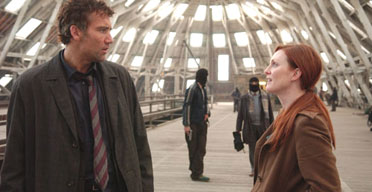
Watched the futuristic nightmare thriller 'Children of Men' last night. Definitely a visual feast for the eyes, set in a dystopian future Britain which appears to be on the brink of social and economic implosion. It is a society devoid of collective moral values, exacerbated by the fact that the human race is on it's last legs as no child has been born anywhere in the last 18 years. Women have become mysteriously infertile across the world, and whether it is due to pollution, chemical contaminants in food, genetic experimentation etc, no one is quite sure. Into this world comes a woman who has inexplicably become pregnant and the rest of the film focuses on various attempts to protect her from harm.
More than the actual storyline, are the apocalyptic scenes which I found most compelling. London in the year 2027 has become another grimy Beirut with terrorist attacks almost daily, and the government has set up a series of Guantanamo style camps for illegal refugee immigrants. The general populace looks haggard and fear is everywhere, and various violent cults have sprouted in spritual response to the awaited end of the human world.
Great film. 8/10.
Friday, 5 January 2007
Brown politicians make me sick.....
The recent news that Wajid Khan, MP for Streetsville-Mississauga has decided to switch from Liberal to Conservative does not surprise me in the least.
Brown politicians make me sick....most of them are only in it for themselves, and create a bad name for the south asian community. On my drive home today, CBC radio had an interview with the President of the Liberal Riding Association in Streetsville, another Pak Muslim, who said in his broken English that he fully supported Khan's decision since he is a close friend of his.....I mean like WTF ???? Does your 'effing sharia wife-beating, honour killing tribal loyalty take precedent over the Canadian citizens who voted that idiot into power ?
Other notable examples in recent times include Ujjal Dosanjh who switched from NDP to Liberal after leading the NDP to their biggest defeat in the BC provincial elections in 2001. And then we have that buffoon Gurmant Grewal and his pathetic attempts to secretly negotiate his switch from Conservatives to Liberals a couple of years back. And don't think it's just an Indo-Canadian thing......British Asian MPs have been known for accepting stuffed brown envelopes too.....
Brown politicians make me sick....most of them are only in it for themselves, and create a bad name for the south asian community. On my drive home today, CBC radio had an interview with the President of the Liberal Riding Association in Streetsville, another Pak Muslim, who said in his broken English that he fully supported Khan's decision since he is a close friend of his.....I mean like WTF ???? Does your 'effing sharia wife-beating, honour killing tribal loyalty take precedent over the Canadian citizens who voted that idiot into power ?
Other notable examples in recent times include Ujjal Dosanjh who switched from NDP to Liberal after leading the NDP to their biggest defeat in the BC provincial elections in 2001. And then we have that buffoon Gurmant Grewal and his pathetic attempts to secretly negotiate his switch from Conservatives to Liberals a couple of years back. And don't think it's just an Indo-Canadian thing......British Asian MPs have been known for accepting stuffed brown envelopes too.....
Thursday, 28 December 2006
Express shopping lines for non-Christians ?
Having seen the mad rush last week of brain-washed Xmas shoppers, I reckon that shops should have express counters for non-Christians and those who are not celebrating the birth of the prophet Jesus. Upon producing the appropriate documentation (eg. identity papers, copy of Koran/Gita, Yellow Star of David, branded tattoes, ethnic gear etc), these shoppers could be allowed to enter the express queue and purchase their everyday items in relative tranquility.
Friday, 17 November 2006
Monday, 13 November 2006
The Sigmoid Curve
What dya reckon ?
Apparently according to proponents of the theory, it can be applied to all areas of human life (eg.career changes,emigration,spiritual etc), and allows you to re-generate upward growth before you reach downward decline. The hardest part appears to be the ability to have the foresight to quit while the going is good, and move on and do something else that will start another upward growth curve.
Here's an extract:
"The sigmoid curve is the S-shaped curve that has intrigued people throughout history. The curve sums up the story and time line of life itself; we start slowly, we experiment and falter, we then grow rapidly, then wax, and wane. It is the product life cycle, it is the biological life cycle. It describes the rise and fall of empires, dynasties, companies, and individuals. It also describes the course of love and relationships."
And here's a pic...

Apparently according to proponents of the theory, it can be applied to all areas of human life (eg.career changes,emigration,spiritual etc), and allows you to re-generate upward growth before you reach downward decline. The hardest part appears to be the ability to have the foresight to quit while the going is good, and move on and do something else that will start another upward growth curve.
Here's an extract:
"The sigmoid curve is the S-shaped curve that has intrigued people throughout history. The curve sums up the story and time line of life itself; we start slowly, we experiment and falter, we then grow rapidly, then wax, and wane. It is the product life cycle, it is the biological life cycle. It describes the rise and fall of empires, dynasties, companies, and individuals. It also describes the course of love and relationships."
And here's a pic...

Sunday, 5 November 2006
Spheric revealed
Yes...this is moi! Kinda felt guilty that I knew what other bloggers look like but never reciprocated...till now.

Friday, 3 November 2006
Winter approaches...
It felt good this morning when I got out of the car and my shoes made contact with the first snow of the year. That the snow was but a light sprinkled dusting in a town located in the rural bible belt of Ontario is neither here nor there. I have decided that in the 6 years since I came to Canada, I prefer winter to the oppressively hot humid summers of Ontario. I can actually think and focus better in a colder climate - my level of mental alertness increases exponentially in a shivering environment, and the quality of my night sleep improves significantly. Plus I appreciate more the bricks-and-mortar sanctuary that I call home as the North Wind howls outside....
In fact I am positively looking forward to arctic sub-zero temperatures, more of the white stuff and even have a secret hankering for the occasional winter storm. No doubt I'll be watching 'The Weather Network' with a heightened sense of anticipation in the days ahead...... :)
In fact I am positively looking forward to arctic sub-zero temperatures, more of the white stuff and even have a secret hankering for the occasional winter storm. No doubt I'll be watching 'The Weather Network' with a heightened sense of anticipation in the days ahead...... :)
Wednesday, 1 November 2006
America's first Socialist senator ?
Comrades,
Our day is finally approaching....... :)

From The Guardian:
Amid the furious debate over Iraq and the speculation that George Bush may be a lame duck after next Tuesday's mid-term elections, an extraordinary political milestone is approaching: a cantankerous 65-year-old called Bernie looks set to become the first socialist senator in US history.
Bernie Sanders is so far ahead in the contest for Vermont's vacant seat for the US Senate that it seems only sudden illness or accident could derail his rendezvous with destiny, after eight terms as the state's only congressman. His success flies in the face of all the conventional wisdom about American politics.
He is an unapologetic socialist and proud of it. Even his admirers admit that he lacks social skills, and he tends to speak in tirades. Yet that has not stopped him winning eight consecutive elections to the US House of Representatives.
"Twenty years ago when people here thought about socialism they were thinking about the Soviet Union, about Albania," Mr Sanders told the Guardian in a telephone interview from the campaign trail. "Now they think about Scandinavia. In Vermont people understand I'm talking about democratic socialism."
Democratic socialism, however, has hardly proved to be a vote-winning formula in a country where even the word "liberal" is generally treated as an insult. Until now the best showing in a Senate race by a socialist of any stripe was in 1930 by Emil Seidel, who won 6% of the vote.
John McLaughry, the head of a free-market Vermont thinktank, the Ethan Allen Institute, said Mr Sanders is a throwback to that era. "Bernie Sanders is an unreconstructed 1930s socialist and proud of it. He's a skilful demagogue who casts every issue in that framework, a master practitioner of class warfare."
When Mr Sanders, a penniless but eloquent import from New York, got himself elected mayor of Burlington in 1981, at the height of the cold war, it rang some alarm bells. "I had to persuade the air force base across the lake that Bernie's rise didn't mean there was a communist takeover of Burlington," recalled Garrison Nelson, a politics professor at the University of Vermont who has known him since the 1970s.
"He used to sleep on the couch of a friend of mine, walking about town with no work," Prof Nelson said. "Bernie really is a subject for political anthropology. He has no political party. He has never been called charming. He has no money, and none of the resources we normally associate with success. However, he learned how to speak to a significant part of the disaffected population of Vermont."
Mr Sanders turned out to be a success as mayor, rejuvenating the city government and rehabilitating Burlington's depressed waterfront on Lake Champlain while ensuring that it was not gentrified beyond the reach of ordinary local people. "He stood this town on its ear," said Peter Freyne, a local journalist.
"I tried to make the government work for working people, and not just for corporations, and on that basis I was elected to Congress," Mr Sanders said. He has served 16 years in the House of Representatives, a lonely voice since the Republican takeover in 1994. He has however struck some interesting cross-party deals, siding with libertarian Republicans to oppose a clause in the Patriot Act which allowed the FBI to find out what books Americans borrowed from libraries.
He says his consistent electoral success reflects the widespread discontent with rising inequality, deepening poverty and dwindling access to affordable healthcare in the US. "People realise there is a lot to be learned from the democratic socialist models in northern Europe," Mr Sanders said. "The untold story here is the degree to which the middle class is shrinking and the gap between rich and poor is widening. It is a disgrace that the US has the highest rate of childhood poverty of any industrialised country on earth. Iraq is important, but it's not the only issue."
In a state of just over 600,000 people he also has a significant advantage over his Republican opponent, Rich Tarrant, a businessman who has spent about $7m on his campaign. "Sanders is popular because even if you disagree with him you know where he stands," said Eric Davis, a political scientist at Vermont's Middlebury College. "He pays attention to his political base. He's independent and iconoclastic and Vermonters like that."
Our day is finally approaching....... :)

From The Guardian:
Amid the furious debate over Iraq and the speculation that George Bush may be a lame duck after next Tuesday's mid-term elections, an extraordinary political milestone is approaching: a cantankerous 65-year-old called Bernie looks set to become the first socialist senator in US history.
Bernie Sanders is so far ahead in the contest for Vermont's vacant seat for the US Senate that it seems only sudden illness or accident could derail his rendezvous with destiny, after eight terms as the state's only congressman. His success flies in the face of all the conventional wisdom about American politics.
He is an unapologetic socialist and proud of it. Even his admirers admit that he lacks social skills, and he tends to speak in tirades. Yet that has not stopped him winning eight consecutive elections to the US House of Representatives.
"Twenty years ago when people here thought about socialism they were thinking about the Soviet Union, about Albania," Mr Sanders told the Guardian in a telephone interview from the campaign trail. "Now they think about Scandinavia. In Vermont people understand I'm talking about democratic socialism."
Democratic socialism, however, has hardly proved to be a vote-winning formula in a country where even the word "liberal" is generally treated as an insult. Until now the best showing in a Senate race by a socialist of any stripe was in 1930 by Emil Seidel, who won 6% of the vote.
John McLaughry, the head of a free-market Vermont thinktank, the Ethan Allen Institute, said Mr Sanders is a throwback to that era. "Bernie Sanders is an unreconstructed 1930s socialist and proud of it. He's a skilful demagogue who casts every issue in that framework, a master practitioner of class warfare."
When Mr Sanders, a penniless but eloquent import from New York, got himself elected mayor of Burlington in 1981, at the height of the cold war, it rang some alarm bells. "I had to persuade the air force base across the lake that Bernie's rise didn't mean there was a communist takeover of Burlington," recalled Garrison Nelson, a politics professor at the University of Vermont who has known him since the 1970s.
"He used to sleep on the couch of a friend of mine, walking about town with no work," Prof Nelson said. "Bernie really is a subject for political anthropology. He has no political party. He has never been called charming. He has no money, and none of the resources we normally associate with success. However, he learned how to speak to a significant part of the disaffected population of Vermont."
Mr Sanders turned out to be a success as mayor, rejuvenating the city government and rehabilitating Burlington's depressed waterfront on Lake Champlain while ensuring that it was not gentrified beyond the reach of ordinary local people. "He stood this town on its ear," said Peter Freyne, a local journalist.
"I tried to make the government work for working people, and not just for corporations, and on that basis I was elected to Congress," Mr Sanders said. He has served 16 years in the House of Representatives, a lonely voice since the Republican takeover in 1994. He has however struck some interesting cross-party deals, siding with libertarian Republicans to oppose a clause in the Patriot Act which allowed the FBI to find out what books Americans borrowed from libraries.
He says his consistent electoral success reflects the widespread discontent with rising inequality, deepening poverty and dwindling access to affordable healthcare in the US. "People realise there is a lot to be learned from the democratic socialist models in northern Europe," Mr Sanders said. "The untold story here is the degree to which the middle class is shrinking and the gap between rich and poor is widening. It is a disgrace that the US has the highest rate of childhood poverty of any industrialised country on earth. Iraq is important, but it's not the only issue."
In a state of just over 600,000 people he also has a significant advantage over his Republican opponent, Rich Tarrant, a businessman who has spent about $7m on his campaign. "Sanders is popular because even if you disagree with him you know where he stands," said Eric Davis, a political scientist at Vermont's Middlebury College. "He pays attention to his political base. He's independent and iconoclastic and Vermonters like that."
Wednesday, 25 October 2006
Automative thought of the day
Well, actually a plea to new model Honda Civic drivers. At night when it's dark and stormy outside and you're insulated and cocooned from the rest of the world, driving along without a care in the world, and the light from your dashboard controls and dials bathes in you in a blue-ish spaceship glow.....think of us poor humble drivers right behind you.........and switch your bloody rear lights on !!!!!!!!!!
Sidenote: I dunno if it's a Honda design fault but Honda Civics dashboard lights and rear lights are not automatically linked.....not sure why this is the case - perhaps Japanese babies are born with night X-ray vision ?
Sidenote: I dunno if it's a Honda design fault but Honda Civics dashboard lights and rear lights are not automatically linked.....not sure why this is the case - perhaps Japanese babies are born with night X-ray vision ?
Saturday, 21 October 2006
Diabetes and Indian lifestyle
Yes, I know it's kind of ironic that I post this on Diwali (btw, Diwali greetings to everyone !), but I felt this needs to take precedence over any festive candle pictures etc. Don't think I'll be touching gulab jamum or jalebi for a while......
Article (N.Y.Times)
Modern Ways Open India’s Doors to Diabetes
CHENNAI, India — There are many ways to understand diabetes in this choking city of automakers and software companies, where the disease seems as commonplace as saris. One way is through the story of P. Ganam, 50, a proper woman reduced to fake gold.
Her husband, K. Palayam, had diabetes do its corrosive job on him: ulcers bore into both feet and cost him a leg. To pay for his care in a country where health insurance is rare, P. Ganam sold all her cherished jewelry — gold, as she saw it, swapped for life.
She was asked about the necklaces and bracelets she was now wearing.
They were, as it happened, worthless impostors.
“Diabetes,” she said, “has the gold.”
And now, Ms. Ganam, the scaffolding of her hard-won middle-class existence already undone, has diabetes too.
In its hushed but unrelenting manner, Type 2 diabetes is engulfing India, swallowing up the legs and jewels of those comfortable enough to put on weight in a country better known for famine. Here, juxtaposed alongside the stick-thin poverty, the malaria and the AIDS, the number of diabetics now totals around 35 million, and counting.
The future looks only more ominous as India hurtles into the present, modernizing and urbanizing at blinding speed. Even more of its 1.1 billion people seem destined to become heavier and more vulnerable to Type 2 diabetes, a disease of high blood sugar brought on by obesity, inactivity and genes, often culminating in blindness, amputations and heart failure. In 20 years, projections are that there may be a staggering 75 million Indian diabetics.
“Diabetes unfortunately is the price you pay for progress,” said Dr. A. Ramachandran, the managing director of the M.V. Hospital for Diabetes, in Chennai (formerly Madras).
For decades, Type 2 diabetes has been the “rich man’s burden,” a problem for industrialized countries to solve.
But as the sugar disease, as it is often called, has penetrated the United States and other developed nations, it has also trespassed deep into the far more populous developing world.
In Italy or Germany or Japan, diabetes is on the rise. In Bahrain and Cambodia and Mexico — where industrialization and Western food habits have taken hold— it is rising even faster. For the world has now reached the point, according to the United Nations, where more people are overweight than undernourished.
Diabetes does not convey the ghastly despair of AIDS or other killers. But more people worldwide now die from chronic diseases like diabetes than from communicable diseases. And the World Health Organization expects that of the more than 350 million diabetics projected in 2025, three-fourths will inhabit the third world.
“I’m concerned for virtually every country where there’s modernization going on, because of the diabetes that follows,” said Dr. Paul Zimmet, the director of the International Diabetes Institute in Melbourne, Australia. “I’m fearful of the resources ever being available to address it.”
India and China are already home to more diabetics than any other country. Prevalence among adults in India is estimated about 6 percent, two-thirds of that in the United States, but the illness is traveling faster, particularly in the country’s large cities.
Throughout the world, Type 2 diabetes, once predominantly a disease of the old, has been striking younger people. But because Indians have such a pronounced genetic vulnerability to the disease, they tend to contract it 10 years earlier than people in developed countries. It is because India is so youthful — half the population is under 25 — that the future of diabetes here is so chilling.
In this boiling city of five million perched on the Bay of Bengal, amid the bleating horns of the autorickshaws and the shriveled mendicants peddling combs on the dust-beaten streets, diabetes can be found everywhere.
A Noxious Sign of Success
The conventional way to see India is to inspect the want — the want for food, the want for money, the want for life. The 300 million who struggle below the poverty line. The debt-crippled farmers who kill themselves. The millions of children with too little to eat.
But there is another way to see it: through its newfound excesses and expanding middle and upper classes. In a changing India, it seems to go this way: make good money and get cars, get houses, get servants, get meals out, get diabetes.
In perverse fashion, obesity and diabetes stand almost as joint totems of success.
Last year, for instance, the MW fast-food and ice cream restaurant in this city proclaimed a special promotion: “Overweight? Congratulations.” The limited-time deal afforded diners savings equal to 50 percent of their weight (in kilograms). The heaviest arrival lugged in 135 kilograms (297 pounds) and ate lustily at 67.5 percent off.
Too much food has pernicious implications for a people with a genetic susceptibility to diabetes, possibly the byproduct of ancestral genes developed to hoard fat during cycles of feast and famine. This vulnerability was first spotted decades ago when immigrant Indians settled in Western countries and in their retrofitted lifestyles got diabetes at levels dwarfing those in India. Now Westernization has come to India and is bringing the disease home.
Though 70 percent of the population remains rural, Indians are steadily forsaking paddy fields for a city lifestyle that entails less movement, more fattening foods and higher stress: a toxic brew for diabetes. In Chennai, about 16 percent of adults are thought to have the disease, one of India’s highest concentrations, more than the soaring levels in New York, and triple the rate two decades ago. Three local hospitals, quaintly known as the sugar hospitals, are devoted to the illness.
The traditional Indian diet can itself be generous with calories. But urban residents switch from ragi and fresh vegetables to fried fast food and processed goods. The pungent aromas of quick-food emporiums waft everywhere here: Sowbakiya Fast Food, Nic-Nac Fast Food, Pizza Hut. Coke and Pepsi are pervasive, but rarely their diet versions.
The country boasts a ravenous sweet tooth, hence the ubiquitous sweet shops, where customers eagerly lap up laddu and badam pista rolls. Sweets are obligatory at social occasions — birthdays, office parties, mourning observances for the dead — and during any visit to someone’s home, a signal of how welcome the visitors are and that God is present.

“When you come to the office after getting a haircut, people say, ‘So where are the sweets?’ ” said Dr. N. Murugesan, the project director at the M.V. Hospital for Diabetes.
The sovereignty of sweets can pose ticklish choices for a doctor. Trying to set an example, Dr. V. Mohan, chairman of the Diabetes Specialities Centre, a local hospital, said he had omitted sweets at a business affair he arranged, and nearly incited a riot. Last year, his daughter was married. Lesson learned, he laid out a spread of regular sweets on one side of the hall and on the other stationed a table laden with sugar-free treats. Everyone left smiling.
In the United States, an inverse correlation persists between income and diabetes. Since fattening food is cheap, the poor become heavier than the rich, and they exercise less and receive inferior health care. In India, the disease tends to directly track income.
“Jokingly in talks, I say you haven’t made it in society until you get a touch of diabetes,” Dr. Mohan said. He points out that people who once balanced water jugs and construction material on their heads now carry nothing heavier than a cellphone. At a four-star restaurant, it is not unusual to see a patron yank out his kit and give himself an insulin injection.
The very wealthy have begun to recoil at ballooning waistlines, and there has been a rise in slimming centers and stomach-shrinking operations. In high-end stores, one can find a CD, “Music for Diabetes,” with raga selections chosen to dampen stress.
The rest of urban India, however, sits and eats.
In Chennai, workers in the software industry rank among the envied elite. Doctors worry about their habits — tapping keys for exercise, ingesting junk food at the computer. Dr. C. R. Anand Moses, a local diabetologist, sees a steady parade of eager software professionals, devoured by diabetes. “They work impossible hours sitting still,” he said.
S. Venkatesh, 28, a thick-around-the-middle programmer, knows the diabetes narrative. Much of his work is for Western companies that operate during the Indian night. So he works in the dark, sleeps in the day.
“The software industry is full of pressure, because you are paid well,” he said. “In India, if you work in software, your hours are the office.”
His sole exercise is to sometimes climb the stairs. A year and a half ago, he found out he had diabetes.
Unshod, and Unprotected
The diabetic foot is a recurrent backdrop among the unending cases that clog the waiting area at the M.V. Hospital. Dr. Ramachandran, its managing director, sees the parade of festering sores and frightful infections. He knows that only creative thinking can help.
The difficulty is that bare feet prevail here. People shuck their shoes before funneling into homes, some offices and always the temple. Farmers go barefoot in the country. In the cities, autorickshaw operators thunder through town, flesh pressed against hot pedals.
Diabetes, though, ruins sensation in the legs, and foot infections go undetected and are often a preamble to amputations. So doctors like Dr. Ramachandran strongly recommend against going barefoot. Yet the culture demands precisely the opposite.
Seeking a middle ground, Dr. Ramachandran presses his patients to don what he calls Temple Socks during worship. They are made at his hospital, conventional socks with rubber bases stitched inside. They are a slow sell.
Dr. Vijay Viswanathan, the hospital’s joint director, gives patients stickers to affix to their bathroom mirrors: “Take care of your feet.” Like doctors elsewhere, he promotes custom shoes. He drifted into them because of leprosy footwear.
Leprosy damages feet and requires special shoes, with tougher undersoles and without nails or sharp edges, that also suit diabetics. But when the diabetics in the telltale footwear appeared at restaurants, they were shooed away, thought to be lepers. So now the hospital makes distinctly different designs.
The consequences of the diabetic foot can be grim. While the affliction knows no class distinctions, the solutions do.
In his lectures, Dr. Ramachandran recounts the case of an impoverished diabetic with a hideously infected leg. Unable to find medical care, he laid the leg across the railroad tracks. The next train to hurtle past did the surgery.
For a limb replacement, the very poor may make do with a $50 wooden leg that does not bend. A woman like Mrs. Chitrarangarajan, 49, who runs a school for the autistic and is married to an oil executive, opts for the best. Her right leg was surrendered to diabetes in 2001. She found a German leg for $6,000 and ordered it over the Internet.
S. P. M. Ameer owned a shoe store when diabetes befell him 30 years ago. Soon, circulatory problems attacked, he closed his shop, he lost his wife, then his leg last January.
Now, at 58, occupying a mirthless room in a cheap hotel on a rackety side street, he no longer recognized the solemn shape of his life. He rarely left his squalid room. “Who hires a man without a leg?” he asked.
He had yet to arrange for a prosthesis. He had no way to pay for one. “God has to apply,” he said.
These stories circulate. But the cultural imperatives hold strong. Even in the sugar hospitals, with admonishments plastered on the walls, some patients insouciantly stride about barefoot. Directly outside the office of one local sugar doctor, beside a sign preaching against the perils of bare feet, another sign notified patients to remove their shoes before entering. And so, barefoot, they sat before him and heard him lecture them not to go barefoot.
Sick Without a Safety Net
Krishnasamy Srinivasan, 66, did not look good. He rarely did anymore. He was recumbent in a hospital bed, his shirt off, his eyes underslung with bags. He had come in by train for another checkup. He now lived deep in the suburbs, where it was cheaper, part of the sad new mix of his life.
He had done very well as a textile exporter, came to own four homes, and enjoyed rental income from those he did not occupy. Then diabetes hit when he was 40. He paid it little mind as it marinated inside his body. Over the last 15 years came heart problems and the need for bypass surgery. His kidneys deteriorated. He is now on dialysis.
He held up the needle-marked right arm of his malfunctioning body, identifying it as “my dialysis arm.”
He had to stop working. To cover the medical costs, he sold three of the homes. His family has been living off the evaporating proceeds, their past irreclaimable.
Diabetes is bankrupting people in the country, often the reasonably well off, and mainly because of a lack of insurance.
Few in India have health insurance, and among those who do, policies generally do not cover diabetes. Middle-class diabetics often exhaust a quarter or more of their income on medications and care. Instances abound where the sick must sell their possessions and compress their lives to feed the diabetes maw.
S. Kalyanasundaram, the chief regional manager in charge at the Chennai office of the National Insurance Company, one of the country’s biggest, explained that the issue with insurance was the odds. “Insurance can only work if the law of averages applies,” he said. “There are too many people with diabetes.”
Some concepts are easy to sell in India, Mr. Kalyanasundaram said, but health insurance is not one of them. “The capacity to pay is not there,” he said. “And many people take disease as a God-given thing to just accept. So why buy insurance?”
Things are beginning to change, even the possibility that policies may cover diabetes for an appropriate premium, but who knows how much they will change? Mr. Kalyanasundaram mentioned that certain preferential customers merited customized policies with an unorthodox clause. If they have diabetes and claim no expenses for four years, then afterward their diabetes will be covered.
“We are testing a belief,” he said. “We think it possible that if diabetes doesn’t manifest in those four years, then it will not manifest in the future.”
It was an odd thought for a disease that usually worsens with time. As for the results, he said it was too early to know how the test was going. “We are still testing.”
With many things it is still too early in India. And so rural dwellers often cope with unavailable or inaccessible health care, frequently relying on unlicensed doctors, many knowing little, if anything, about diabetes. Diabetes researchers estimate that three-quarters of those stricken with the disease in rural villages do not know they have it.
In urban areas, the sick, other than the poorest, prefer to bypass beleaguered government hospitals and seek private care. But without insurance, the cost of a long-term illness can be crushing.
Mr. Srinivasan’s wife, Srinivasan Muthammal, 61, also has the sugar, but not its complications yet. Like her husband, she is overweight. As she listened to him talk of their black hours, her face was frozen.
“We are angry with the god,” she said. “You gave us four houses in four directions and all the wealth, and now you have taken it all away. Why?”
Mr. Srinivasan suggested they had cash for one more year, perhaps a little more.
“I’m angry with the diabetes,” he said. “You are a pauper all because of the sugar.”
Till Diabetes Do Us Part
Divorce is rare in India, but in these changing times it is very much on the upsweep. Diabetes, here and there, even figures in the marital strife. Women may be stigmatized. Men find themselves impotent and then newly single.
K. Sumathi, a Chennai lawyer who sometimes deals in the accelerating number of divorces, appreciates the impact of diabetes in a country where different centuries breathe side by side.
She said a young woman with diabetes, for example, is often deemed damaged and unmarriageable, or must marry into a lower caste. Indian law recognizes five broad grounds for divorce, one being if either spouse acquires a chronic disease. Diabetes can rapidly debilitate a breadwinner and impose impotency, either outcome a solid marriage wrecker.
She told the story of a recent case: A wife, living as custom has it with her in-laws, said the stress of the circumstances contributed to her getting diabetes. She wound up in a diabetic coma and had to be hospitalized. Her husband, a dentist, chose to attend to cavities rather than visit her. The divorce was completed seven months ago.
There was also the account of a husband who accused his unhappy wife of sneaking extra sugar in his tea, hoping he would acquire diabetes and die. It proved to be a poor concept. He survived. The marriage did not.
J. Vasanthakumari, a marriage counselor who is friendly with Ms. Sumathi, said she has seen the disease percolate in the back stories of some of her clientele. Diabetes. Then sexual dysfunction. Unhappiness. Appointments with her.
“You must understand one basic thing,” she said. “People in personal matters will not bring diabetes to the surface. But women tell me, ‘He’s not affectionate, he’s not taking care of me, he’s not like before.’ It’s the diabetes.”
She went on: “Sometimes someone gets diabetes partly because he’s an alcoholic. The marriage falls apart. The real reason is the alcoholism. But the diabetes becomes the last straw on the camel’s back.”
Folklore and Frustration
The shabby disease remedy shop was small for its outsize promises. A dusty storefront crunched between souvenir stands, it sat near the Kapaleeswarar temple, a familiar tourist choice in Chennai. Inside spilled a teetering mass of ready relief for arthritis, heartburn, gout, piles. Beneath the scalding sun, an ox cart pounded past, scattering a swarm of people padding down the street.
The grizzled proprietor, who was asked if he had anything for diabetes, readily proffered a bottle of pea-soup-colored liquid. It cost roughly $3. Its exact contents, the man said, were as privileged as Coke’s formula. But drink a capful twice a day for three months, he assured, and the diabetes would vanish.
Though no universal cure exists for diabetes, “cures” and other mischievous medicines nonetheless abound in India. Much of the population gravitates to cryptic beliefs threaded with untruths that are hard to nullify.
People believe in bitter gourd juice and fenugreek, an Indian spice, which can temper sugar levels, but are not cures. Some years ago, the wood water cure gained considerable traction. Drink water stored overnight in a tumbler made of Pterocarpus marsupium heartwood, the promotion went, and it would wash away the diabetes.
All this exasperates Dr. Murugesan. He is among those trying to stanch the spread of the disease. Diabetes education is hard enough, without tomfoolery and witchcraft to discredit.
He had something to show on his desktop computer at the M.V. Hospital for Diabetes, a prevention program known as “Chubby Cheeks.” Animated mothers on the screen merrily admitted that they associated being chubby with health. Animated chubby students chafed that their parents refused to let them play, but forced them to study endlessly so they could become doctors and engineers. They studied, they sat, they enlarged. Dr. Murugesan takes his cautionary tale around to schools and waves it like a lantern.
Dr. Murugesan is himself an Indian diabetes story. A health educator, he devoted 20 years to erasing leprosy in southern India. Two years ago, with that scourge largely beaten back, he itched for a fresh menace. He chose diabetes. He saw its rapid ascent.
What’s more, he had diabetes.
Upon enlisting in the sugar fight, he felt it behooved him to test the blood sugar levels of his own family, and he excavated truths he had not wished for. His wife, daughter and one of his sons were all bordering on becoming diabetic. His other son, just 28 then, already had diabetes.
“I say it’s like Jesus Christ,” he said. “When you don’t look for him, he’s not there. When you look for him, he’s there. You look for diabetes, and it’s there.”
Prevention, he recognizes, is a mountainous climb in a country with a severe shortage of medical workers. What health care money exists is overwhelmingly applied to infectious perils.
The health minister, Dr. Anbumani Ramadoss, recently said he would begin a diabetes program, but the timetable and scope are unclear. Indian politicians in pursuit of votes rarely campaign on matters of health, but promise the poor cheap rice or free color televisions.
All of which perpetuates a dual continuum. Rural Indians flock to the cities, only to encounter diabetes, while Westernization sweeps its way to the villages, carrying diabetes as its passenger.
Thus Dr. Mohan, among other efforts, dispatches prevention teams to Chunampet, a cluster of villages a couple of hours south that are a feeder area for Chennai. Most of the villagers have no idea what diabetes is.
Meanwhile, Dr. Murugesan has enlistees operating in the Srinivasapuram slum, a grid of cramped thatched huts and makeshift tents that hug Chennai’s long beach.
The diabetes rates among these raggedly lives are notably below those of the middle and upper classes. But they are catching up. When evening gushes over the slum and the mosquitoes emerge, a scattering of diabetics drift over to the tiny Vijaya Medical shop. They are poor at “self-poking,” as they explain, and have no refrigerators to chill their insulin. Some fill mud pots with water and stuff their vials in there. Others rely on the medical shop proprietor, a merry young man with legs withered by polio.
He tapes their names to the appropriate bottles and, each day, administers shots.
Misconceptions populate the conversations. Some residents say they occasionally have diabetes: a few years with it, then a few years without it. They think that diabetes pays visits.
Others are rabid apologists for the disease. Uninterested in eating less, they say that when they feel like a big meal, a luscious plate of sweets, they just swallow an extra pill or inject themselves with more insulin.
“They don’t understand,” Dr. Murugesan said. “They don’t see the darkness of this disease.”
Late in the day, back at the M.V. Hospital, he trooped upstairs to the rooftop auditorium, where 40-odd doctors had assembled to talk about prevention efforts. One thing they talked of uncomfortably: A particular profession in India, they heard, a well-paying one involving a lot of standing around, had practitioners who did not necessarily heed their own advice.
The profession was thick with diabetes. It was doctors themselves.
Article (N.Y.Times)
Modern Ways Open India’s Doors to Diabetes
CHENNAI, India — There are many ways to understand diabetes in this choking city of automakers and software companies, where the disease seems as commonplace as saris. One way is through the story of P. Ganam, 50, a proper woman reduced to fake gold.
Her husband, K. Palayam, had diabetes do its corrosive job on him: ulcers bore into both feet and cost him a leg. To pay for his care in a country where health insurance is rare, P. Ganam sold all her cherished jewelry — gold, as she saw it, swapped for life.
She was asked about the necklaces and bracelets she was now wearing.
They were, as it happened, worthless impostors.
“Diabetes,” she said, “has the gold.”
And now, Ms. Ganam, the scaffolding of her hard-won middle-class existence already undone, has diabetes too.
In its hushed but unrelenting manner, Type 2 diabetes is engulfing India, swallowing up the legs and jewels of those comfortable enough to put on weight in a country better known for famine. Here, juxtaposed alongside the stick-thin poverty, the malaria and the AIDS, the number of diabetics now totals around 35 million, and counting.
The future looks only more ominous as India hurtles into the present, modernizing and urbanizing at blinding speed. Even more of its 1.1 billion people seem destined to become heavier and more vulnerable to Type 2 diabetes, a disease of high blood sugar brought on by obesity, inactivity and genes, often culminating in blindness, amputations and heart failure. In 20 years, projections are that there may be a staggering 75 million Indian diabetics.
“Diabetes unfortunately is the price you pay for progress,” said Dr. A. Ramachandran, the managing director of the M.V. Hospital for Diabetes, in Chennai (formerly Madras).
For decades, Type 2 diabetes has been the “rich man’s burden,” a problem for industrialized countries to solve.
But as the sugar disease, as it is often called, has penetrated the United States and other developed nations, it has also trespassed deep into the far more populous developing world.
In Italy or Germany or Japan, diabetes is on the rise. In Bahrain and Cambodia and Mexico — where industrialization and Western food habits have taken hold— it is rising even faster. For the world has now reached the point, according to the United Nations, where more people are overweight than undernourished.
Diabetes does not convey the ghastly despair of AIDS or other killers. But more people worldwide now die from chronic diseases like diabetes than from communicable diseases. And the World Health Organization expects that of the more than 350 million diabetics projected in 2025, three-fourths will inhabit the third world.
“I’m concerned for virtually every country where there’s modernization going on, because of the diabetes that follows,” said Dr. Paul Zimmet, the director of the International Diabetes Institute in Melbourne, Australia. “I’m fearful of the resources ever being available to address it.”
India and China are already home to more diabetics than any other country. Prevalence among adults in India is estimated about 6 percent, two-thirds of that in the United States, but the illness is traveling faster, particularly in the country’s large cities.
Throughout the world, Type 2 diabetes, once predominantly a disease of the old, has been striking younger people. But because Indians have such a pronounced genetic vulnerability to the disease, they tend to contract it 10 years earlier than people in developed countries. It is because India is so youthful — half the population is under 25 — that the future of diabetes here is so chilling.
In this boiling city of five million perched on the Bay of Bengal, amid the bleating horns of the autorickshaws and the shriveled mendicants peddling combs on the dust-beaten streets, diabetes can be found everywhere.
A Noxious Sign of Success
The conventional way to see India is to inspect the want — the want for food, the want for money, the want for life. The 300 million who struggle below the poverty line. The debt-crippled farmers who kill themselves. The millions of children with too little to eat.
But there is another way to see it: through its newfound excesses and expanding middle and upper classes. In a changing India, it seems to go this way: make good money and get cars, get houses, get servants, get meals out, get diabetes.
In perverse fashion, obesity and diabetes stand almost as joint totems of success.
Last year, for instance, the MW fast-food and ice cream restaurant in this city proclaimed a special promotion: “Overweight? Congratulations.” The limited-time deal afforded diners savings equal to 50 percent of their weight (in kilograms). The heaviest arrival lugged in 135 kilograms (297 pounds) and ate lustily at 67.5 percent off.
Too much food has pernicious implications for a people with a genetic susceptibility to diabetes, possibly the byproduct of ancestral genes developed to hoard fat during cycles of feast and famine. This vulnerability was first spotted decades ago when immigrant Indians settled in Western countries and in their retrofitted lifestyles got diabetes at levels dwarfing those in India. Now Westernization has come to India and is bringing the disease home.
Though 70 percent of the population remains rural, Indians are steadily forsaking paddy fields for a city lifestyle that entails less movement, more fattening foods and higher stress: a toxic brew for diabetes. In Chennai, about 16 percent of adults are thought to have the disease, one of India’s highest concentrations, more than the soaring levels in New York, and triple the rate two decades ago. Three local hospitals, quaintly known as the sugar hospitals, are devoted to the illness.
The traditional Indian diet can itself be generous with calories. But urban residents switch from ragi and fresh vegetables to fried fast food and processed goods. The pungent aromas of quick-food emporiums waft everywhere here: Sowbakiya Fast Food, Nic-Nac Fast Food, Pizza Hut. Coke and Pepsi are pervasive, but rarely their diet versions.
The country boasts a ravenous sweet tooth, hence the ubiquitous sweet shops, where customers eagerly lap up laddu and badam pista rolls. Sweets are obligatory at social occasions — birthdays, office parties, mourning observances for the dead — and during any visit to someone’s home, a signal of how welcome the visitors are and that God is present.
“When you come to the office after getting a haircut, people say, ‘So where are the sweets?’ ” said Dr. N. Murugesan, the project director at the M.V. Hospital for Diabetes.
The sovereignty of sweets can pose ticklish choices for a doctor. Trying to set an example, Dr. V. Mohan, chairman of the Diabetes Specialities Centre, a local hospital, said he had omitted sweets at a business affair he arranged, and nearly incited a riot. Last year, his daughter was married. Lesson learned, he laid out a spread of regular sweets on one side of the hall and on the other stationed a table laden with sugar-free treats. Everyone left smiling.
In the United States, an inverse correlation persists between income and diabetes. Since fattening food is cheap, the poor become heavier than the rich, and they exercise less and receive inferior health care. In India, the disease tends to directly track income.
“Jokingly in talks, I say you haven’t made it in society until you get a touch of diabetes,” Dr. Mohan said. He points out that people who once balanced water jugs and construction material on their heads now carry nothing heavier than a cellphone. At a four-star restaurant, it is not unusual to see a patron yank out his kit and give himself an insulin injection.
The very wealthy have begun to recoil at ballooning waistlines, and there has been a rise in slimming centers and stomach-shrinking operations. In high-end stores, one can find a CD, “Music for Diabetes,” with raga selections chosen to dampen stress.
The rest of urban India, however, sits and eats.
In Chennai, workers in the software industry rank among the envied elite. Doctors worry about their habits — tapping keys for exercise, ingesting junk food at the computer. Dr. C. R. Anand Moses, a local diabetologist, sees a steady parade of eager software professionals, devoured by diabetes. “They work impossible hours sitting still,” he said.
S. Venkatesh, 28, a thick-around-the-middle programmer, knows the diabetes narrative. Much of his work is for Western companies that operate during the Indian night. So he works in the dark, sleeps in the day.
“The software industry is full of pressure, because you are paid well,” he said. “In India, if you work in software, your hours are the office.”
His sole exercise is to sometimes climb the stairs. A year and a half ago, he found out he had diabetes.
Unshod, and Unprotected
The diabetic foot is a recurrent backdrop among the unending cases that clog the waiting area at the M.V. Hospital. Dr. Ramachandran, its managing director, sees the parade of festering sores and frightful infections. He knows that only creative thinking can help.
The difficulty is that bare feet prevail here. People shuck their shoes before funneling into homes, some offices and always the temple. Farmers go barefoot in the country. In the cities, autorickshaw operators thunder through town, flesh pressed against hot pedals.
Diabetes, though, ruins sensation in the legs, and foot infections go undetected and are often a preamble to amputations. So doctors like Dr. Ramachandran strongly recommend against going barefoot. Yet the culture demands precisely the opposite.
Seeking a middle ground, Dr. Ramachandran presses his patients to don what he calls Temple Socks during worship. They are made at his hospital, conventional socks with rubber bases stitched inside. They are a slow sell.
Dr. Vijay Viswanathan, the hospital’s joint director, gives patients stickers to affix to their bathroom mirrors: “Take care of your feet.” Like doctors elsewhere, he promotes custom shoes. He drifted into them because of leprosy footwear.
Leprosy damages feet and requires special shoes, with tougher undersoles and without nails or sharp edges, that also suit diabetics. But when the diabetics in the telltale footwear appeared at restaurants, they were shooed away, thought to be lepers. So now the hospital makes distinctly different designs.
The consequences of the diabetic foot can be grim. While the affliction knows no class distinctions, the solutions do.
In his lectures, Dr. Ramachandran recounts the case of an impoverished diabetic with a hideously infected leg. Unable to find medical care, he laid the leg across the railroad tracks. The next train to hurtle past did the surgery.
For a limb replacement, the very poor may make do with a $50 wooden leg that does not bend. A woman like Mrs. Chitrarangarajan, 49, who runs a school for the autistic and is married to an oil executive, opts for the best. Her right leg was surrendered to diabetes in 2001. She found a German leg for $6,000 and ordered it over the Internet.
S. P. M. Ameer owned a shoe store when diabetes befell him 30 years ago. Soon, circulatory problems attacked, he closed his shop, he lost his wife, then his leg last January.
Now, at 58, occupying a mirthless room in a cheap hotel on a rackety side street, he no longer recognized the solemn shape of his life. He rarely left his squalid room. “Who hires a man without a leg?” he asked.
He had yet to arrange for a prosthesis. He had no way to pay for one. “God has to apply,” he said.
These stories circulate. But the cultural imperatives hold strong. Even in the sugar hospitals, with admonishments plastered on the walls, some patients insouciantly stride about barefoot. Directly outside the office of one local sugar doctor, beside a sign preaching against the perils of bare feet, another sign notified patients to remove their shoes before entering. And so, barefoot, they sat before him and heard him lecture them not to go barefoot.
Sick Without a Safety Net
Krishnasamy Srinivasan, 66, did not look good. He rarely did anymore. He was recumbent in a hospital bed, his shirt off, his eyes underslung with bags. He had come in by train for another checkup. He now lived deep in the suburbs, where it was cheaper, part of the sad new mix of his life.
He had done very well as a textile exporter, came to own four homes, and enjoyed rental income from those he did not occupy. Then diabetes hit when he was 40. He paid it little mind as it marinated inside his body. Over the last 15 years came heart problems and the need for bypass surgery. His kidneys deteriorated. He is now on dialysis.
He held up the needle-marked right arm of his malfunctioning body, identifying it as “my dialysis arm.”
He had to stop working. To cover the medical costs, he sold three of the homes. His family has been living off the evaporating proceeds, their past irreclaimable.
Diabetes is bankrupting people in the country, often the reasonably well off, and mainly because of a lack of insurance.
Few in India have health insurance, and among those who do, policies generally do not cover diabetes. Middle-class diabetics often exhaust a quarter or more of their income on medications and care. Instances abound where the sick must sell their possessions and compress their lives to feed the diabetes maw.
S. Kalyanasundaram, the chief regional manager in charge at the Chennai office of the National Insurance Company, one of the country’s biggest, explained that the issue with insurance was the odds. “Insurance can only work if the law of averages applies,” he said. “There are too many people with diabetes.”
Some concepts are easy to sell in India, Mr. Kalyanasundaram said, but health insurance is not one of them. “The capacity to pay is not there,” he said. “And many people take disease as a God-given thing to just accept. So why buy insurance?”
Things are beginning to change, even the possibility that policies may cover diabetes for an appropriate premium, but who knows how much they will change? Mr. Kalyanasundaram mentioned that certain preferential customers merited customized policies with an unorthodox clause. If they have diabetes and claim no expenses for four years, then afterward their diabetes will be covered.
“We are testing a belief,” he said. “We think it possible that if diabetes doesn’t manifest in those four years, then it will not manifest in the future.”
It was an odd thought for a disease that usually worsens with time. As for the results, he said it was too early to know how the test was going. “We are still testing.”
With many things it is still too early in India. And so rural dwellers often cope with unavailable or inaccessible health care, frequently relying on unlicensed doctors, many knowing little, if anything, about diabetes. Diabetes researchers estimate that three-quarters of those stricken with the disease in rural villages do not know they have it.
In urban areas, the sick, other than the poorest, prefer to bypass beleaguered government hospitals and seek private care. But without insurance, the cost of a long-term illness can be crushing.
Mr. Srinivasan’s wife, Srinivasan Muthammal, 61, also has the sugar, but not its complications yet. Like her husband, she is overweight. As she listened to him talk of their black hours, her face was frozen.
“We are angry with the god,” she said. “You gave us four houses in four directions and all the wealth, and now you have taken it all away. Why?”
Mr. Srinivasan suggested they had cash for one more year, perhaps a little more.
“I’m angry with the diabetes,” he said. “You are a pauper all because of the sugar.”
Till Diabetes Do Us Part
Divorce is rare in India, but in these changing times it is very much on the upsweep. Diabetes, here and there, even figures in the marital strife. Women may be stigmatized. Men find themselves impotent and then newly single.
K. Sumathi, a Chennai lawyer who sometimes deals in the accelerating number of divorces, appreciates the impact of diabetes in a country where different centuries breathe side by side.
She said a young woman with diabetes, for example, is often deemed damaged and unmarriageable, or must marry into a lower caste. Indian law recognizes five broad grounds for divorce, one being if either spouse acquires a chronic disease. Diabetes can rapidly debilitate a breadwinner and impose impotency, either outcome a solid marriage wrecker.
She told the story of a recent case: A wife, living as custom has it with her in-laws, said the stress of the circumstances contributed to her getting diabetes. She wound up in a diabetic coma and had to be hospitalized. Her husband, a dentist, chose to attend to cavities rather than visit her. The divorce was completed seven months ago.
There was also the account of a husband who accused his unhappy wife of sneaking extra sugar in his tea, hoping he would acquire diabetes and die. It proved to be a poor concept. He survived. The marriage did not.
J. Vasanthakumari, a marriage counselor who is friendly with Ms. Sumathi, said she has seen the disease percolate in the back stories of some of her clientele. Diabetes. Then sexual dysfunction. Unhappiness. Appointments with her.
“You must understand one basic thing,” she said. “People in personal matters will not bring diabetes to the surface. But women tell me, ‘He’s not affectionate, he’s not taking care of me, he’s not like before.’ It’s the diabetes.”
She went on: “Sometimes someone gets diabetes partly because he’s an alcoholic. The marriage falls apart. The real reason is the alcoholism. But the diabetes becomes the last straw on the camel’s back.”
Folklore and Frustration
The shabby disease remedy shop was small for its outsize promises. A dusty storefront crunched between souvenir stands, it sat near the Kapaleeswarar temple, a familiar tourist choice in Chennai. Inside spilled a teetering mass of ready relief for arthritis, heartburn, gout, piles. Beneath the scalding sun, an ox cart pounded past, scattering a swarm of people padding down the street.
The grizzled proprietor, who was asked if he had anything for diabetes, readily proffered a bottle of pea-soup-colored liquid. It cost roughly $3. Its exact contents, the man said, were as privileged as Coke’s formula. But drink a capful twice a day for three months, he assured, and the diabetes would vanish.
Though no universal cure exists for diabetes, “cures” and other mischievous medicines nonetheless abound in India. Much of the population gravitates to cryptic beliefs threaded with untruths that are hard to nullify.
People believe in bitter gourd juice and fenugreek, an Indian spice, which can temper sugar levels, but are not cures. Some years ago, the wood water cure gained considerable traction. Drink water stored overnight in a tumbler made of Pterocarpus marsupium heartwood, the promotion went, and it would wash away the diabetes.
All this exasperates Dr. Murugesan. He is among those trying to stanch the spread of the disease. Diabetes education is hard enough, without tomfoolery and witchcraft to discredit.
He had something to show on his desktop computer at the M.V. Hospital for Diabetes, a prevention program known as “Chubby Cheeks.” Animated mothers on the screen merrily admitted that they associated being chubby with health. Animated chubby students chafed that their parents refused to let them play, but forced them to study endlessly so they could become doctors and engineers. They studied, they sat, they enlarged. Dr. Murugesan takes his cautionary tale around to schools and waves it like a lantern.
Dr. Murugesan is himself an Indian diabetes story. A health educator, he devoted 20 years to erasing leprosy in southern India. Two years ago, with that scourge largely beaten back, he itched for a fresh menace. He chose diabetes. He saw its rapid ascent.
What’s more, he had diabetes.
Upon enlisting in the sugar fight, he felt it behooved him to test the blood sugar levels of his own family, and he excavated truths he had not wished for. His wife, daughter and one of his sons were all bordering on becoming diabetic. His other son, just 28 then, already had diabetes.
“I say it’s like Jesus Christ,” he said. “When you don’t look for him, he’s not there. When you look for him, he’s there. You look for diabetes, and it’s there.”
Prevention, he recognizes, is a mountainous climb in a country with a severe shortage of medical workers. What health care money exists is overwhelmingly applied to infectious perils.
The health minister, Dr. Anbumani Ramadoss, recently said he would begin a diabetes program, but the timetable and scope are unclear. Indian politicians in pursuit of votes rarely campaign on matters of health, but promise the poor cheap rice or free color televisions.
All of which perpetuates a dual continuum. Rural Indians flock to the cities, only to encounter diabetes, while Westernization sweeps its way to the villages, carrying diabetes as its passenger.
Thus Dr. Mohan, among other efforts, dispatches prevention teams to Chunampet, a cluster of villages a couple of hours south that are a feeder area for Chennai. Most of the villagers have no idea what diabetes is.
Meanwhile, Dr. Murugesan has enlistees operating in the Srinivasapuram slum, a grid of cramped thatched huts and makeshift tents that hug Chennai’s long beach.
The diabetes rates among these raggedly lives are notably below those of the middle and upper classes. But they are catching up. When evening gushes over the slum and the mosquitoes emerge, a scattering of diabetics drift over to the tiny Vijaya Medical shop. They are poor at “self-poking,” as they explain, and have no refrigerators to chill their insulin. Some fill mud pots with water and stuff their vials in there. Others rely on the medical shop proprietor, a merry young man with legs withered by polio.
He tapes their names to the appropriate bottles and, each day, administers shots.
Misconceptions populate the conversations. Some residents say they occasionally have diabetes: a few years with it, then a few years without it. They think that diabetes pays visits.
Others are rabid apologists for the disease. Uninterested in eating less, they say that when they feel like a big meal, a luscious plate of sweets, they just swallow an extra pill or inject themselves with more insulin.
“They don’t understand,” Dr. Murugesan said. “They don’t see the darkness of this disease.”
Late in the day, back at the M.V. Hospital, he trooped upstairs to the rooftop auditorium, where 40-odd doctors had assembled to talk about prevention efforts. One thing they talked of uncomfortably: A particular profession in India, they heard, a well-paying one involving a lot of standing around, had practitioners who did not necessarily heed their own advice.
The profession was thick with diabetes. It was doctors themselves.
Wednesday, 18 October 2006
Do friendships have an expiry date ?
I'm trying to type up a report and the sounds of a once familiar song which I last heard several years ago come floating into range:
I step off the train,
I'm walking down your street again,
and past your door,
but you don't live there anymore.
And I miss you
- like the deserts miss the rain.
And I miss you -
like the deserts miss the rain.
What happens inside of us when we come to the realization that a friendship has died ? Do we shrug our shoulders, take a deep breath and quietly express 'That's life' type sentiments ? And in doing so, do we have an implied karmic acceptance that no friendship lasts forever ?....that we are all but transients in this journey called life, with people temporarily sharing a collective conscience and then hopping off when another destination (or duty) calls ?
Sometimes it may be due to circumstances beyond our control (eg. changing countries, physical distance, careers, or just growing up) that a friendship dissipates over time...indeed it is a rare occurrence where a dosti will just fracture and snap instaneously. But what about those past friends who still exist in near physical, social (and virtual) proximity, but for which now exists radio silence ? Why did we both move on to different frequencies ? Some questions have no answers....
Irrespective of how a friendship evaporates, do we ever bother to commemorate that time together, the lessons learnt and the lasting legacies that will pass into the next phases of our life ? I think of past friendships from which I learnt much about myself, and look forward to future new friendships that may transpire.
I wish you all a great journey and many travelling companions....
I step off the train,
I'm walking down your street again,
and past your door,
but you don't live there anymore.
And I miss you
- like the deserts miss the rain.
And I miss you -
like the deserts miss the rain.
What happens inside of us when we come to the realization that a friendship has died ? Do we shrug our shoulders, take a deep breath and quietly express 'That's life' type sentiments ? And in doing so, do we have an implied karmic acceptance that no friendship lasts forever ?....that we are all but transients in this journey called life, with people temporarily sharing a collective conscience and then hopping off when another destination (or duty) calls ?
Sometimes it may be due to circumstances beyond our control (eg. changing countries, physical distance, careers, or just growing up) that a friendship dissipates over time...indeed it is a rare occurrence where a dosti will just fracture and snap instaneously. But what about those past friends who still exist in near physical, social (and virtual) proximity, but for which now exists radio silence ? Why did we both move on to different frequencies ? Some questions have no answers....
Irrespective of how a friendship evaporates, do we ever bother to commemorate that time together, the lessons learnt and the lasting legacies that will pass into the next phases of our life ? I think of past friendships from which I learnt much about myself, and look forward to future new friendships that may transpire.
I wish you all a great journey and many travelling companions....
Wednesday, 13 September 2006
Bahai Principles
Is there anyone here who is a Bahai ? Very occasionally for the last couple of years or so, I go and read some of the principles of the Bahai faith. I find them to be both inspirational and up to date. They have a really beautiful temple located in Delhi, shaped like a lotus flower....

1. The oneness of mankind
"It is not for him to pride himself who loveth his own country, but rather for him who loveth the whole world. The earth is but one country and mankind its citizens." --Gleanings from the Writings of Baha'u'llah, p. 250.
2. The oneness of religion
"All these divisions we see on all sides, all these disputes and opposition, are caused because men cling to ritual and outward observances, and forget the simple, underlying truth. It is the outward practices of religion that are so different, and it is they that cause disputes and enmity -- while the reality is always the same, and one. The Reality is the Truth, and truth has no division. Truth is God's guidance, it is the light of the world, it is love, it is mercy. These attributes of truth are also human virtues inspiredby the Holy Spirit."
3. Independent investigation of truth
"Furthermore, know ye that God has created in man the power of reason, whereby man is enabled to investigate reality. God has not intended man to imitate blindly his fathers and ancestors. He has endowed him with mind, or the faculty of reasoning, by the exercise of which he is to investigate and discover the truth, and that which he finds real and true he must accept."
4. Religion as a source of unity
"He (Baha'u'llah) sets forth a new principle for this day in the announcement that religion must be the cause of unity, harmony and agreement among mankind. If it be the cause of discord and hostility,if it leads to separation and creates conflict, the absence of religion would be preferable in the world."
5. The evolutionary nature of religion
Baha'is view religion as a progressive, evolutionary process which needs to be updated as humanity evolves mentally, socially, and spiritually. Every so often a new Prophet is sent to humanity to update religion to the current needs of mankind. These Prophets bring essentially the same spiritual message to mankind; in a form that meets the needs of the people of Their time. Baha'is believe that Baha'u'llah has brought an updated message for mankind today.
"There is no distinction whatsoever among the Bearers of My Message. They all have but one purpose; their secret is the same secret. To prefer one in honor to another, to exalt certain ones above the rest, is in no wise to be permitted. Every true Prophet hath regarded His Message as fundamentally the same as the Revelation of every other Prophet gone before Him... The measure of the revelation of the Prophets of God in this world, however, must differ. Each and every one of them hath been the Bearer of a distinct Message, and hath been commissioned to reveal Himself through specific acts. It is for this reason that they appear to vary in their greatness... It is clear and evident, therefore, that any apparent variation in the intensity of their light is not inherent in the light itself, but should rather be attributed to the varying receptivity of an ever-changing world. Every Prophet Whom the Almighty and Peerless Creator hath purposed to send to the peoples of the earth hath been entrusted with a Message, and charged to act in a manner that would best meet the requirements of the age in which He appeared."
6. Harmony between religion, science, and reason
"Religion and science are the two wings upon which man's intelligence can soar into the heights, with which the human soul can progress. It is not possible to fly with one wing alone! Should a man try to fly with the wing of religion alone he would quickly fall into the quagmire of superstition, whilst on the other hand, with the wing of science alone he would also make no progress, but fall into thedespairing slough of materialism."
7. Peaceful consultation as a means for resolving differences
In the Baha'i Faith, difference of opinion is not squelched, in fact it is encouraged. "The shining spark of truth cometh forth only after the clash of differing opinions."
However, differences of opinion can be expressed in a way that doesn't humiliate another human being. The Baha'i principle of consultation requires that an individual be detached from his or her opinions and always be open to the truth, from whoever or wherever it comes from.
"They must then proceed with the utmost devotion, courtesy, dignity, care and moderation to express their views. They must in every manner search out the truth and not insist upon their own opinion, for stubbornness and persistence in one's views will lead ultimately to discord and wrangling and the truth will remain hidden. The honored members (of the consulting body) must with all freedom express theirown thoughts, and it is in no wise permissible for one to belittle the thought of another, nay, he must with moderation set forth the truth..."
8. An international auxiliary language
"It behoveth the sovereigns of the world -- may God assist them -- or the ministers of the earth to take counsel together and to adopt one of the existing languages or a new one to be taught to children in schools throughout the world, and likewise one script. Thus the whole earth will come to be regarded as one country."
9. Universal education
"Unto every father hath been enjoined the instruction of his son and daughter in the art of reading and writing and in all that hath been laid down in the Holy Tablet. He that putteth away that which is commanded unto him, the Trustees of the House of Justice are then to recover from him that which is required for their instruction, if he be wealthy, and if not the matter devolveth upon the House of Justice. Verily, have We made it a shelter for the poor and needy. He that bringeth up his son or the son of another, it is as though he hath brought up a son of Mine; upon him rest My Glory, My Loving-Kindness, My Mercy, that have compassed the world."
10. The elimination of all forms of prejudice
"...again, as to religious, racial, national and political bias: all these prejudices strike at the very root of human life; one and all they beget bloodshed, and the ruination of the world. So long as these prejudices survive, there will be continuous and fearsome wars."
11. Equality of men and women
"To accept and observe a distinction which God has not intended in creation is ignorance and superstition. The fact which is to be considered, however, is that woman, having formerly been deprived, must now be allowed equal opportunities with man for education and training. There must be no difference in their education. Until the reality of equality between man and woman is fully established and attained, the highest social development of mankind is not possible"
12. The abolition of the extremes of wealth and poverty
"O Ye Rich Ones on Earth! The poor in your midst are My trust; guard ye My trust, and be notintent only on your own ease."
"We see amongst us men who are overburdened with riches on the one hand, and on the other those unfortunate ones who starve with nothing; those who possess several stately palaces, and those who have not where to lay their head. Some we find with numerous courses of costly and dainty food; whilst others can scarce find sufficient crusts to keep them alive. Whilst some are clothed in velvets, furs and fine linen, others have insufficient, poor and thin garments with which to protect them from the cold. This condition of affairs is wrong and must be remedied. Now the remedy must be carefully undertaken."
13. Universal peace
"The time must come when the imperative necessity for the holding of a vast, an all-embracing assemblage of men will be universally realized. The rulers and kings of the earth must needs attend it, and, participating in its deliberations, must consider such ways and means as will lay the foundations of the world's Great Peace amongst men. Such a peace demandeth that the Great Powers should resolve, for the sake of the tranquillity of the peoples of the earth, to be fully reconciled among themselves. Should any king take up arms against another, all should unitedly arise and prevent him. If this be done, the nations of the world will no longer require any armaments, except for the purpose of preserving the security of their realms and of maintaining internal order within their territories."
1. The oneness of mankind
"It is not for him to pride himself who loveth his own country, but rather for him who loveth the whole world. The earth is but one country and mankind its citizens." --Gleanings from the Writings of Baha'u'llah, p. 250.
2. The oneness of religion
"All these divisions we see on all sides, all these disputes and opposition, are caused because men cling to ritual and outward observances, and forget the simple, underlying truth. It is the outward practices of religion that are so different, and it is they that cause disputes and enmity -- while the reality is always the same, and one. The Reality is the Truth, and truth has no division. Truth is God's guidance, it is the light of the world, it is love, it is mercy. These attributes of truth are also human virtues inspiredby the Holy Spirit."
3. Independent investigation of truth
"Furthermore, know ye that God has created in man the power of reason, whereby man is enabled to investigate reality. God has not intended man to imitate blindly his fathers and ancestors. He has endowed him with mind, or the faculty of reasoning, by the exercise of which he is to investigate and discover the truth, and that which he finds real and true he must accept."
4. Religion as a source of unity
"He (Baha'u'llah) sets forth a new principle for this day in the announcement that religion must be the cause of unity, harmony and agreement among mankind. If it be the cause of discord and hostility,if it leads to separation and creates conflict, the absence of religion would be preferable in the world."
5. The evolutionary nature of religion
Baha'is view religion as a progressive, evolutionary process which needs to be updated as humanity evolves mentally, socially, and spiritually. Every so often a new Prophet is sent to humanity to update religion to the current needs of mankind. These Prophets bring essentially the same spiritual message to mankind; in a form that meets the needs of the people of Their time. Baha'is believe that Baha'u'llah has brought an updated message for mankind today.
"There is no distinction whatsoever among the Bearers of My Message. They all have but one purpose; their secret is the same secret. To prefer one in honor to another, to exalt certain ones above the rest, is in no wise to be permitted. Every true Prophet hath regarded His Message as fundamentally the same as the Revelation of every other Prophet gone before Him... The measure of the revelation of the Prophets of God in this world, however, must differ. Each and every one of them hath been the Bearer of a distinct Message, and hath been commissioned to reveal Himself through specific acts. It is for this reason that they appear to vary in their greatness... It is clear and evident, therefore, that any apparent variation in the intensity of their light is not inherent in the light itself, but should rather be attributed to the varying receptivity of an ever-changing world. Every Prophet Whom the Almighty and Peerless Creator hath purposed to send to the peoples of the earth hath been entrusted with a Message, and charged to act in a manner that would best meet the requirements of the age in which He appeared."
6. Harmony between religion, science, and reason
"Religion and science are the two wings upon which man's intelligence can soar into the heights, with which the human soul can progress. It is not possible to fly with one wing alone! Should a man try to fly with the wing of religion alone he would quickly fall into the quagmire of superstition, whilst on the other hand, with the wing of science alone he would also make no progress, but fall into thedespairing slough of materialism."
7. Peaceful consultation as a means for resolving differences
In the Baha'i Faith, difference of opinion is not squelched, in fact it is encouraged. "The shining spark of truth cometh forth only after the clash of differing opinions."
However, differences of opinion can be expressed in a way that doesn't humiliate another human being. The Baha'i principle of consultation requires that an individual be detached from his or her opinions and always be open to the truth, from whoever or wherever it comes from.
"They must then proceed with the utmost devotion, courtesy, dignity, care and moderation to express their views. They must in every manner search out the truth and not insist upon their own opinion, for stubbornness and persistence in one's views will lead ultimately to discord and wrangling and the truth will remain hidden. The honored members (of the consulting body) must with all freedom express theirown thoughts, and it is in no wise permissible for one to belittle the thought of another, nay, he must with moderation set forth the truth..."
8. An international auxiliary language
"It behoveth the sovereigns of the world -- may God assist them -- or the ministers of the earth to take counsel together and to adopt one of the existing languages or a new one to be taught to children in schools throughout the world, and likewise one script. Thus the whole earth will come to be regarded as one country."
9. Universal education
"Unto every father hath been enjoined the instruction of his son and daughter in the art of reading and writing and in all that hath been laid down in the Holy Tablet. He that putteth away that which is commanded unto him, the Trustees of the House of Justice are then to recover from him that which is required for their instruction, if he be wealthy, and if not the matter devolveth upon the House of Justice. Verily, have We made it a shelter for the poor and needy. He that bringeth up his son or the son of another, it is as though he hath brought up a son of Mine; upon him rest My Glory, My Loving-Kindness, My Mercy, that have compassed the world."
10. The elimination of all forms of prejudice
"...again, as to religious, racial, national and political bias: all these prejudices strike at the very root of human life; one and all they beget bloodshed, and the ruination of the world. So long as these prejudices survive, there will be continuous and fearsome wars."
11. Equality of men and women
"To accept and observe a distinction which God has not intended in creation is ignorance and superstition. The fact which is to be considered, however, is that woman, having formerly been deprived, must now be allowed equal opportunities with man for education and training. There must be no difference in their education. Until the reality of equality between man and woman is fully established and attained, the highest social development of mankind is not possible"
12. The abolition of the extremes of wealth and poverty
"O Ye Rich Ones on Earth! The poor in your midst are My trust; guard ye My trust, and be notintent only on your own ease."
"We see amongst us men who are overburdened with riches on the one hand, and on the other those unfortunate ones who starve with nothing; those who possess several stately palaces, and those who have not where to lay their head. Some we find with numerous courses of costly and dainty food; whilst others can scarce find sufficient crusts to keep them alive. Whilst some are clothed in velvets, furs and fine linen, others have insufficient, poor and thin garments with which to protect them from the cold. This condition of affairs is wrong and must be remedied. Now the remedy must be carefully undertaken."
13. Universal peace
"The time must come when the imperative necessity for the holding of a vast, an all-embracing assemblage of men will be universally realized. The rulers and kings of the earth must needs attend it, and, participating in its deliberations, must consider such ways and means as will lay the foundations of the world's Great Peace amongst men. Such a peace demandeth that the Great Powers should resolve, for the sake of the tranquillity of the peoples of the earth, to be fully reconciled among themselves. Should any king take up arms against another, all should unitedly arise and prevent him. If this be done, the nations of the world will no longer require any armaments, except for the purpose of preserving the security of their realms and of maintaining internal order within their territories."
Sunday, 6 August 2006
The village soldiers of Hezbollah
Irrespective of one's politics and views on the current conflict, from a purely human perspective one has to admire the courage of those on the very frontline fighting against the fourth most powerful army in the world.
The Observer - 6th Aug 2006.
When war came to the southern Lebanese village of Kfar Kila, a stronghold of the Hizbollah-led Islamic Resistance, it did not have very far to travel. A kilometre of olive groves, and decades of hatred and mutually divisive history, separate this impoverished mountain village from the uniformly red-roofed houses of Metula, Kfar Kila's nearest neighbouring town. Except Metula is in Israel.
They are so close that from the village you can see Israeli cars parked by their houses. So close that the border at one point - at the Fatima Gate - forms the eastern boundary of the village.
Now Israel is at war with Hizbollah, Kfar Kila is at the very front of the front line. The olive trees on the ridge above the village have been scorched black by the phosphorus flares Israeli soldiers used last week to set them aflame. Buildings have been smashed and ruined, set on fire. Some are stained with blood.
Farm animals, kept in sheds and yards behind the bigger houses, have been injured by the shrapnel from tank shells, which scream in with a jarring, lethal regularity. Ibrahim Yahia, a 26-year-old farmer and part-time defender of Kfar Kila, leads us to a Friesian cow, blinded in one eye by shrapnel. Blood streams from one nostril. As Yahia tries to take its muzzle and comfort it, the animal is spooked, and bucks and kicks.
But nothing appears to spook Yahia. A member of Amal, the group fighting alongside Hizbollah in the Islamic Resistance, he barely flinches as the Israeli shells crash in. The streets are open on one side to observation from the gunners around Metula. 'If they want to come, they'll come,' he said sombrely, showing off the rubble in his parents' house, where a shell had punched a hole through the wall. 'Then we will fight them.'
It is a confidence buoyed by the sense of victory that followed the fighters of Kfar Kila's first major encounter with Israeli ground forces in this war. The day before we spoke, the Israelis had tried to take the village with three tanks and infantry advancing from two directions. Over two days, Yahia and his colleagues fought them to a standstill.
One tank was disabled, by Israel's account - three according to Hizbollah's - before the Israeli troops pulled back from Kfar Kila across the fence, burning the olive groves as they went, to resume the business of hurling high explosives against the ridges above the village.
'I'm not like the Israelis,' Yahia said.
'I won't fight without a reason. But because I have a reason I will fight. Because this is my land, I am prepared to die for it. How could you stay silent when you see your land burn and your children get killed? The whole population here is now resisting.'
It is a crucial difference, he seems to suggest, which explains why Israel is struggling to make ground in this campaign - its soldiers are not fighting in their own villages to defend their homes. 'They hit and run,' Yahia said scathingly about the Israeli tactics. 'When they meet us they run like rabbits.'
It is something that strikes you forcefully when you reach the front line of this war. In these villages that form the strongholds of the Islamic Resistance, the men - many of them obviously fighters out of uniform - do not talk much in terms of ideology or religious fanaticism. They are not the zealots and jihadis that Israel claims. Instead, they talk about their damaged property and their livestock scattered by the shelling on the mountains. They talk about family who have fled and those who have stayed. And all the time they carefully skirt talk of the fighters. If they do talk politics it is sometimes with an unexpected spin. Several say that it is not so much the Israelis they blame for this - indeed, who they suggest would agree to a truce - but US President George Bush, who they claim is the real force behind the war.
While religion is an element, it is part of a much more complex formula. Yahia mentions that he follows Ayatollah Sistani, the moderate Shia leader in Iraq, and says he is prepared to be a martyr in this fight for his home. But it is said in a casual way. For Yahia, like the other men in the village, religion is important in the same way as his land, his home, his family and his people.
The south of Lebanon, with its Shia majority, is both strongly observant and socially conservative. 'We do have time to pray while we are fighting,' said Yahia. 'Some of us defend while others pray and then we pray while others defend. If I get an hour of rest I will try to visit my family. Otherwise we eat sand and bullets!'
As we talk, Yahia's commander and another younger fighter arrive to examine a dud shell. The older man is bearded and in his late fifties. 'I don't want to say how many fighters we have in Kfar Kila, but it is a large number. If the Israelis come again they will not get in.'
All the evidence suggests that the commander is not exaggerating. While uniformed members of the Hizbollah missile brigades in the villages around the largely Christian town of Marjeyoun are almost invisible, evidence of their presence is not. It suggests that the fighters here are more numerous, better armed and better trained than Israel imagined.
One afternoon, by chance, we do see three Hizbollah fighters walking down from the olive groves on the slopes into Kfar Kila carrying an ammunition bag. Despite the bombardment, their walk is jaunty and they return a wave with an embarrassed grin, as if caught out by being spotted in the open.
Otherwise, the presence of Hizbollah is only discernible in the puff and whoosh of their missiles; by the scorched ground in the scrub where the launchers briefly halt to fire, and by their many bunkers, heavily camouflaged on the hillsides.
While both sides speak of their victories, seen from the frontline vantage point of Kfar Kila, this is a grinding, grimly pointless war of mutual intimidation that, it appears, neither side can win.
Israeli jets drop their expensive US bombs, usually far from where Hizbollah has been firing. Tanks pound the limestone ridges and envelop them in smoke ('Shooting at ghosts and trees,' says Yahia wryly). In retaliation, Hizbollah fires its rockets blindly across the border, while Metula's sirens wail.
Meanwhile, the Israeli army, the world's fourth most powerful, is driven back by the fierce resistance of shepherds, farmers and mechanics - who are not afraid to die, unlike young Israelis - and then retreats, while leaders on both sides threaten worse, while hinting at conditions for peace.
Caught in the middle, inevitably, are Lebanon's civilians. And every day they flee or die. And sometimes both. Last Tuesday afternoon, as the Israelis were still trying to enter Kfar Kila, we met Ismail Hamoud, 53, on the northern outskirts of the town. His family have gone but, like so many men, Hamoud has chosen to remain.
'It's the second day that the Israelis have tried to advance,' he said wearily, after a sleepless and fearful night and amid the noise of shellfire hitting the village's southern half. 'They already tried once to get into the village and then at 5.30 last night they tried again to come in from the other side of the town.
'We heard small-arms fire, but the resistance fought back and hit three of their tanks. That is when they started firing phosphorus and setting fire to the crops, burning all the houses on the hill.'
And while the Islamic Resistance claimed the battle as a victory, other villagers are less certain. The Israeli action, they suspect, was not to capture Kfar Kila, but to frighten out its remaining residents.
With Hamoud was Yamen Hassan, a tattooed young man in a blue T-shirt. As Hamoud looked warily up the street, Hassan called us over to observe a small group of approaching Israeli troops, moving through the olive trees on the small plain between Metula and the northern outskirts of Kfar Kila, trying to outflank the fighters in the village.
Hassan had come to Kfar Kila to rescue families trapped beneath the Israeli bombardment, but he had halted on its outskirts. 'I am crazy,' he said. 'But I am not so crazy that I will go any further.'
Instead, Hassan had found different passengers to drive out of the town, Mousab and Zainub Rida, who on hearing that Israeli soldiers were creeping through the groves beside their home, elected to flee with a handful of their belongings. As Zainub packed a few possessions on to a tractor-trailer for her husband to take out of town, she wept.
'I've had enough,' said Mousab, a rubbish collector. 'And my wife is just too scared for us to stay.'
A day later, however, they returned to their house. It was only a brief respite. The next day, amid new fears of a general Israeli invasion of the south, up to the Litani river, we saw them once again. This time they finally had fled Kfar Kila. They had not been alone in struggling between fear and their desire to remain.
After more than three weeks of shelling that has seen most of the population of 12,000 flee, a handful are still slipping out of the village every day, their endurance finally brought - like the Ridas' - to snapping point. A few escape in private cars driven by volunteers such as Yamen Hassan. Others leave in a private ambulance, whose insanely cheerful drivers - apparently impervious to the fear of death - shuttle in and out a day, even under the worst fire, delivering bread and other food provided by the local municipality and taking out those who want to leave to the school in Marjeyoun.
But there are those in Kfar Kila - a few hundred at most, perhaps - who have decided to stay. Among them is Mahmoud Hassan Ali, 76. We met him among a small group of women and children who had emerged from their shelters during a lull in the bombing. He showed us his home, damaged by an Israeli shell. 'We were in the house sleeping when the shell came in,' he said. 'Then we ran.'
While we were talking another shell came into the village, scattering the residents back to their homes and basement shelters. So Kfar Kila's war goes on.
The Observer - 6th Aug 2006.
When war came to the southern Lebanese village of Kfar Kila, a stronghold of the Hizbollah-led Islamic Resistance, it did not have very far to travel. A kilometre of olive groves, and decades of hatred and mutually divisive history, separate this impoverished mountain village from the uniformly red-roofed houses of Metula, Kfar Kila's nearest neighbouring town. Except Metula is in Israel.
They are so close that from the village you can see Israeli cars parked by their houses. So close that the border at one point - at the Fatima Gate - forms the eastern boundary of the village.
Now Israel is at war with Hizbollah, Kfar Kila is at the very front of the front line. The olive trees on the ridge above the village have been scorched black by the phosphorus flares Israeli soldiers used last week to set them aflame. Buildings have been smashed and ruined, set on fire. Some are stained with blood.
Farm animals, kept in sheds and yards behind the bigger houses, have been injured by the shrapnel from tank shells, which scream in with a jarring, lethal regularity. Ibrahim Yahia, a 26-year-old farmer and part-time defender of Kfar Kila, leads us to a Friesian cow, blinded in one eye by shrapnel. Blood streams from one nostril. As Yahia tries to take its muzzle and comfort it, the animal is spooked, and bucks and kicks.
But nothing appears to spook Yahia. A member of Amal, the group fighting alongside Hizbollah in the Islamic Resistance, he barely flinches as the Israeli shells crash in. The streets are open on one side to observation from the gunners around Metula. 'If they want to come, they'll come,' he said sombrely, showing off the rubble in his parents' house, where a shell had punched a hole through the wall. 'Then we will fight them.'
It is a confidence buoyed by the sense of victory that followed the fighters of Kfar Kila's first major encounter with Israeli ground forces in this war. The day before we spoke, the Israelis had tried to take the village with three tanks and infantry advancing from two directions. Over two days, Yahia and his colleagues fought them to a standstill.
One tank was disabled, by Israel's account - three according to Hizbollah's - before the Israeli troops pulled back from Kfar Kila across the fence, burning the olive groves as they went, to resume the business of hurling high explosives against the ridges above the village.
'I'm not like the Israelis,' Yahia said.
'I won't fight without a reason. But because I have a reason I will fight. Because this is my land, I am prepared to die for it. How could you stay silent when you see your land burn and your children get killed? The whole population here is now resisting.'
It is a crucial difference, he seems to suggest, which explains why Israel is struggling to make ground in this campaign - its soldiers are not fighting in their own villages to defend their homes. 'They hit and run,' Yahia said scathingly about the Israeli tactics. 'When they meet us they run like rabbits.'
It is something that strikes you forcefully when you reach the front line of this war. In these villages that form the strongholds of the Islamic Resistance, the men - many of them obviously fighters out of uniform - do not talk much in terms of ideology or religious fanaticism. They are not the zealots and jihadis that Israel claims. Instead, they talk about their damaged property and their livestock scattered by the shelling on the mountains. They talk about family who have fled and those who have stayed. And all the time they carefully skirt talk of the fighters. If they do talk politics it is sometimes with an unexpected spin. Several say that it is not so much the Israelis they blame for this - indeed, who they suggest would agree to a truce - but US President George Bush, who they claim is the real force behind the war.
While religion is an element, it is part of a much more complex formula. Yahia mentions that he follows Ayatollah Sistani, the moderate Shia leader in Iraq, and says he is prepared to be a martyr in this fight for his home. But it is said in a casual way. For Yahia, like the other men in the village, religion is important in the same way as his land, his home, his family and his people.
The south of Lebanon, with its Shia majority, is both strongly observant and socially conservative. 'We do have time to pray while we are fighting,' said Yahia. 'Some of us defend while others pray and then we pray while others defend. If I get an hour of rest I will try to visit my family. Otherwise we eat sand and bullets!'
As we talk, Yahia's commander and another younger fighter arrive to examine a dud shell. The older man is bearded and in his late fifties. 'I don't want to say how many fighters we have in Kfar Kila, but it is a large number. If the Israelis come again they will not get in.'
All the evidence suggests that the commander is not exaggerating. While uniformed members of the Hizbollah missile brigades in the villages around the largely Christian town of Marjeyoun are almost invisible, evidence of their presence is not. It suggests that the fighters here are more numerous, better armed and better trained than Israel imagined.
One afternoon, by chance, we do see three Hizbollah fighters walking down from the olive groves on the slopes into Kfar Kila carrying an ammunition bag. Despite the bombardment, their walk is jaunty and they return a wave with an embarrassed grin, as if caught out by being spotted in the open.
Otherwise, the presence of Hizbollah is only discernible in the puff and whoosh of their missiles; by the scorched ground in the scrub where the launchers briefly halt to fire, and by their many bunkers, heavily camouflaged on the hillsides.
While both sides speak of their victories, seen from the frontline vantage point of Kfar Kila, this is a grinding, grimly pointless war of mutual intimidation that, it appears, neither side can win.
Israeli jets drop their expensive US bombs, usually far from where Hizbollah has been firing. Tanks pound the limestone ridges and envelop them in smoke ('Shooting at ghosts and trees,' says Yahia wryly). In retaliation, Hizbollah fires its rockets blindly across the border, while Metula's sirens wail.
Meanwhile, the Israeli army, the world's fourth most powerful, is driven back by the fierce resistance of shepherds, farmers and mechanics - who are not afraid to die, unlike young Israelis - and then retreats, while leaders on both sides threaten worse, while hinting at conditions for peace.
Caught in the middle, inevitably, are Lebanon's civilians. And every day they flee or die. And sometimes both. Last Tuesday afternoon, as the Israelis were still trying to enter Kfar Kila, we met Ismail Hamoud, 53, on the northern outskirts of the town. His family have gone but, like so many men, Hamoud has chosen to remain.
'It's the second day that the Israelis have tried to advance,' he said wearily, after a sleepless and fearful night and amid the noise of shellfire hitting the village's southern half. 'They already tried once to get into the village and then at 5.30 last night they tried again to come in from the other side of the town.
'We heard small-arms fire, but the resistance fought back and hit three of their tanks. That is when they started firing phosphorus and setting fire to the crops, burning all the houses on the hill.'
And while the Islamic Resistance claimed the battle as a victory, other villagers are less certain. The Israeli action, they suspect, was not to capture Kfar Kila, but to frighten out its remaining residents.
With Hamoud was Yamen Hassan, a tattooed young man in a blue T-shirt. As Hamoud looked warily up the street, Hassan called us over to observe a small group of approaching Israeli troops, moving through the olive trees on the small plain between Metula and the northern outskirts of Kfar Kila, trying to outflank the fighters in the village.
Hassan had come to Kfar Kila to rescue families trapped beneath the Israeli bombardment, but he had halted on its outskirts. 'I am crazy,' he said. 'But I am not so crazy that I will go any further.'
Instead, Hassan had found different passengers to drive out of the town, Mousab and Zainub Rida, who on hearing that Israeli soldiers were creeping through the groves beside their home, elected to flee with a handful of their belongings. As Zainub packed a few possessions on to a tractor-trailer for her husband to take out of town, she wept.
'I've had enough,' said Mousab, a rubbish collector. 'And my wife is just too scared for us to stay.'
A day later, however, they returned to their house. It was only a brief respite. The next day, amid new fears of a general Israeli invasion of the south, up to the Litani river, we saw them once again. This time they finally had fled Kfar Kila. They had not been alone in struggling between fear and their desire to remain.
After more than three weeks of shelling that has seen most of the population of 12,000 flee, a handful are still slipping out of the village every day, their endurance finally brought - like the Ridas' - to snapping point. A few escape in private cars driven by volunteers such as Yamen Hassan. Others leave in a private ambulance, whose insanely cheerful drivers - apparently impervious to the fear of death - shuttle in and out a day, even under the worst fire, delivering bread and other food provided by the local municipality and taking out those who want to leave to the school in Marjeyoun.
But there are those in Kfar Kila - a few hundred at most, perhaps - who have decided to stay. Among them is Mahmoud Hassan Ali, 76. We met him among a small group of women and children who had emerged from their shelters during a lull in the bombing. He showed us his home, damaged by an Israeli shell. 'We were in the house sleeping when the shell came in,' he said. 'Then we ran.'
While we were talking another shell came into the village, scattering the residents back to their homes and basement shelters. So Kfar Kila's war goes on.
Saturday, 22 July 2006
Saving Private Ryanstein - the Israeli version
The irony about the the current Israeli version of Spielberg's cinematic epic, is that the two kidnapped soldiers are more likely to be killed by Israel's indiscriminate air bombing of Lebanon than anything else. It would appear that in the currency exhange of human life, the life of an innocent Arab civilian blown to bits by a US-made satellite guided bomb is worth infinitely less than that of a non-Arab.
And on another note - it is curiously interesting to note that western news media avoid use of the term 'war' in articles about Lebanon, Iraq etc preferring the more neutral 'conflict' as a term of reference. (Terms like 'illegal occupation', 'invasion' and 'installation of pro-US puppet regime' are similarly avoided but that's another topic for another day). My dictionary defines 'War' as a state of armed conflict between two or more opposing groups, usually state sponsored. What is happening in Lebanon is war....nothing less. Israel destruction of Lebanon's infrastructure and the indiscriminate killing of hundreds of civilians is nothing short of war, and is a disproportionate and barbaric response to the kidnapping of two soldiers (note: Hezbollah targetted soldiers not civilians, with the aim of a prisoner swap for which previous precedents exist). There is nothing 'self-defence' about the Israeli response and they and their puppet masters, the US, risk further alienation in a world which is teetering on the brink of regional anarchy due to constant invasions and illegal occupations.
And on another note - it is curiously interesting to note that western news media avoid use of the term 'war' in articles about Lebanon, Iraq etc preferring the more neutral 'conflict' as a term of reference. (Terms like 'illegal occupation', 'invasion' and 'installation of pro-US puppet regime' are similarly avoided but that's another topic for another day). My dictionary defines 'War' as a state of armed conflict between two or more opposing groups, usually state sponsored. What is happening in Lebanon is war....nothing less. Israel destruction of Lebanon's infrastructure and the indiscriminate killing of hundreds of civilians is nothing short of war, and is a disproportionate and barbaric response to the kidnapping of two soldiers (note: Hezbollah targetted soldiers not civilians, with the aim of a prisoner swap for which previous precedents exist). There is nothing 'self-defence' about the Israeli response and they and their puppet masters, the US, risk further alienation in a world which is teetering on the brink of regional anarchy due to constant invasions and illegal occupations.
Tuesday, 9 May 2006
Happiness...Bhutanese style
Found this interesting to read about (from the BBC):
The remote Himalayan kingdom of Bhutan is the only country in the world which puts happiness at the heart of government policy.

The government must consider every policy for its impact not only on Gross Domestic Product, but also on GNH: "Gross National Happiness".
The politics of happiness has led Bhutan to make very different decisions from countries simply searching for wealth.
The capital, Thimpu, is remarkable for its lack of advertising. In an attempt to hold back consumerism the city council recently banned hoardings promoting Coke and Pepsi.
Bhutan was the last nation in the world to introduce television in 1999. Recently they banned a number of channels including international wrestling and MTV, which they felt did little to promote happiness.

Bhutan has even banned plastic bags and tobacco on the grounds that they make the country less happy.
The one set of traffic lights Bhutan ever had was on this junction. But people found them frustrating, so they went back to a human being.

In Bhutan the government puts inner spiritual development on a par with material improvement.
One of the pillars of Bhutan's happiness philosophy is care for the environment. Strict conservation laws are aimed at achieving sustainable development.

Development has been moderated and people are less well off financially than they could have been.
Bhutan has been able to adopt radical policies partly because it is a remote kingdom and partly because it is an absolute monarchy.

The remote Himalayan kingdom of Bhutan is the only country in the world which puts happiness at the heart of government policy.
The government must consider every policy for its impact not only on Gross Domestic Product, but also on GNH: "Gross National Happiness".
The politics of happiness has led Bhutan to make very different decisions from countries simply searching for wealth.
The capital, Thimpu, is remarkable for its lack of advertising. In an attempt to hold back consumerism the city council recently banned hoardings promoting Coke and Pepsi.
Bhutan was the last nation in the world to introduce television in 1999. Recently they banned a number of channels including international wrestling and MTV, which they felt did little to promote happiness.
Bhutan has even banned plastic bags and tobacco on the grounds that they make the country less happy.
The one set of traffic lights Bhutan ever had was on this junction. But people found them frustrating, so they went back to a human being.
In Bhutan the government puts inner spiritual development on a par with material improvement.
One of the pillars of Bhutan's happiness philosophy is care for the environment. Strict conservation laws are aimed at achieving sustainable development.
Development has been moderated and people are less well off financially than they could have been.
Bhutan has been able to adopt radical policies partly because it is a remote kingdom and partly because it is an absolute monarchy.
Friday, 14 April 2006
On assignment in the Lone Star state
I recently returned from a consulting engagement in Dallas, Texas and the above is the view from my hotel room, which was what I called 'home' for 6 days and 5 nights. Of course it was nothing like home, lacking in the usual creature comforts and the routines that come with home family life. There was no pyaar or emotional support that radiated from the 4 walls of my room. My only link to the outside world, apart from my daily visits to the client, were the room TV, the high speed internet connection and of course, my cell phone. Otherwise, I think I would have (as the Brits call it) 'lost my marbles'.
On another level observations I noted in general about Texan life:
a) Texans love their food (even by the excessive standards of North America). Every day of the week, the restaurants were packed. And it would appear that the concept of 'vegetarianism' does not exist in these parts.....now don't get me wrong, as a red-blooded Punjabi shere (hahahaha) I enjoy meat too, but not to the extent that Texans devour the stuff with the appetite of a resident of Jurassic Park.
b) Maybe related to the above, the average waistline of the Texans I met were 2-3 inches wider than their Torontonian counter-parts...I kid you not amigos. :)
c) I guess my appearance confused some of my Texan clients - both Anglos and Hispanics. The only Indians most Texans have had dealings with are the south Indian software coolie types (LOL) or watching Apu on the Simpsons. North Indian types are a rarity in their world. They automatically presumed I was of Latino origin, and occasionally a Spanish phrase would come my way awaiting an expectant response. And I suppose it was even more disorientating for them when I opened my mouth and sounded more like Hugh Grant in About a Boy rather than Manuel from Guadalajara...lol. :)
d) Overall, Texans are a very friendly open bunch of people whom I'd gladly invite to my next backyard barbecue. :) (Though I'd probably want to filter out the bible preaching types).
e) Texas is a big place. Even Dallas airport has it's own 3 lane highway connecting between the different terminals.
That all said, glad to be back in Maple Leaf country. :)
Thursday, 6 April 2006
Review: V for Vendetta
 Have to say I totally enjoyed this movie based on the book of the same name. Set in a totalitarian fascist Britain, the film follows the story of 'V' a political anarchist whose reasons for his violent actions are gradually revealed through a series of flashbacks of his past life. At one level the film is a very human drama with all kinds of emotions on display. Yes, there is violence too, but thankfully it is all in the context of the plot.
The film diverges significantly in parts from the book which I read a while back, but that is okay as allows the viewer and reader to have two different comparative interpretations. Interpretation is a subjective thing, and one of the messages I took away is that sometimes it is harder to free yourself from the prison of your own mind than it is to break free from the bricks and mortar kind.
A most definitive 10/10.
Monday, 3 April 2006
I am Canadian !
 After almost 2 long years since applying, I finally became a Canadian citizen last Thursday. The sense of belonging is now complete. Things would definitely have been quicker had it not been for the events of 9/11. Still, I can now show my Canadian passport at Pearson Airport without the usual accusatory glances from Canadian/and or onsite US immigration officers wanting to know where I'm going, where I'm coming from, why am I going/arriving etc. The times when a British passport would inspire awe and head-bowing respect from the natives have long since gone.....LOL. :)
The citizenship ceremony was interesting enough. There were 127 people from 28 countries represented at the Mississauga Citizenship Office. The oath of allegiance could do with some updating though......4 of the 5 lines were all to do with swearing allegiance to the Queen and her successors. Once all the speeches were done and we received our citizenship certificates, we were asked to congratulate folks sitting on either side and you could sense the genuine happiness and warmth of the occasion.
After that, it was a fast drive to the passport office to apply for my new shiny blue passport.
Friday, 24 March 2006
My God is better than your God
How is it that conversion only works one-way for certain religions ? After hearing about this case I wonder if the world would be better off if we all turned atheist......
Asia Times:
Losing faith in Afghanistan
Syed Saleem Shahzad KARACHI
Even as the Bush administration steps up pressure on Afghanistan over the plight of a Christian convert, thousands of youths are descending on Kabul to demand that he be hanged for renouncing Islam.
US President George W Bush and other Western leaders have latched onto the case of Abdul Rahman, 41, who was arrested last month and accused of apostasy for converting to Christianity in 1990, saying that the issue was one of "honoring the universal principle of freedom".
For many Afghans, though, it is just another rallying point to step up pressure for a broader alliance against the presence of foreign forces in the country, while for the Bush administration and its allies it is an opportunity to rethink their position on Afghanistan. The United States has more than 18,000 troops in the country, while the UN-mandated International Security Assistance Force numbers about the same. Germany and Italy have already hinted they may reassess military support for Afghanistan. And German Interior Minister Wolfgang Schaeuble suggested that Afghanistan could lose aid or technical support for reconstruction because of the case.
The US begun reducing its troop strength in Afghanistan this year and has indicated that it will continue to do so. Bush said this week that US forces did not help liberate Afghanistan from Taliban rule so that conservative Islamic judges could issue death sentences against people because of their religious beliefs. He added that he was "deeply troubled" by the case, while Secretary of State Condoleezza Rice phoned Afghan President Hamid Karzai to call for a "favorable resolution to this case at the earliest possible moment". The masses in Afghanistan are not listening, though.
"Regardless of the court decision [whether or not he is hanged], there is unanimous agreement by all religious scholars from the north to the south, the east to the west of Afghanistan, that Abdul Rahman should be executed," Engineer Ahmad Shah Ahmad Zai told Asia Times Online on telephone from Kabul.
Ahmad Shah is a prominent mujahideen leader and head of the Hizb-i-Iqtadar-i-Islami Afghanistan. He was an acting prime minister in the government of Professor Burhanuddin Rabbani before the Taliban came to power in 1996.
"There is widespread dissent among the masses against the activities of Christian missionaries. These missions exploit the poverty of Afghan people and they pay them to convert. These activities will only translate into fierce reaction as Afghans do not tolerate anything against their religion," Ahmad Shah said.
"Since Abdul Rahman comes from the Panjshir Valley, people of the area are coming down to Kabul to show their dissent against him and demand that the court execute him," Ahmad Shah explained.
Rahman, a former medical aid worker, faces the death penalty under Afghanistan's Islamic laws for becoming a Christian. His trial began last week, and now the Afghan government is desperately searching for a way to drop the case, with the latest move being to call for Rahman to undergo psychological examinations to see whether he is fit to stand trial. Senior clerics in Afghanistan, however, have already given their verdict: he should die.
"We will not allow God to be humiliated," Abdul Raoulf, a member of the Ulama Council, Afghanistan's main clerical organization, told Associated Press. "We will call on the people to pull him into pieces so there's nothing left."
Asia Times Online contacts in Afghanistan say that ministers in the cabinet are reluctant to take a stand on the issue because of fierce public reaction. There are clear indications that the minute the court gives any decision other than death penalty, Islamic parties will make it an issue with which to tackle the US-backed Karzai government and allied forces for intervening in the Islamic laws of Afghanistan. The Afghan constitution has contradictory provisions. Article 7 commits Afghanistan to observing the United Nations charter and the Universal Declaration of Human Rights, which guarantees freedom of religion. But Article 3 says that no law can contradict Islam.
It is significant that the issue has come at a time that efforts are being made by Islamic parties in the north and south to forge an alliance inside and outside parliament. Unpublicized negotiations have taken place in southern Afghanistan between various tribal leaders so that they can present a united front against the foreign presence in the country.
In a separate development, the Taliban's spring offensive has begun, with the insurgency significantly increasing its activities. Rahman's case is the latest of several controversial issues that have served to strengthen the hands of clerics calling for a nationwide, broad-based opposition to foreign elements in the country. Last year, anger swept the country over reports that US interrogators had desecrated the Koran at the Guantanamo prison facility in Cuba, while cartoons published in Europe this year ridiculing the Prophet Mohammed further inflamed passions.
Religious aspects apart from the serious political implications, Rahman's case raises some thorny religious issues, with non-Muslims questioning how it can be acceptable for people of other faiths to convert to Islam, but not the other way round.
"It is more of an ontological debate than anything," said renowned Muslim intellectual Shahnawaz Farooqui. "If somebody tries to practice his religion or faith, Muslim society will not stop him or pressurize him to change his faith. Nobody is allowed to even motivate a non-Muslim to change his religion. However, discourse is allowed. After such discourse, if somebody feels they want to embrace Islam, it is allowed," Shahnawaz said.
However, for a Muslim to change his religion, "he will have to be executed because it is related to an ontological debate". "If somebody at one point affirms the truth [belief in God] and then rejects it or denies it, it would jeopardize the whole paradigm of truth. This is such a big offense that the penalty can only be death." Execution for apostasy has been accepted in Muslim society from the times of the Prophet Mohammed, and there is no difference among the schools of Islamic jurisprudence, be they Hanafi, Malaki, Shaafai, Hanbli or Jafari (Shi'ite). "At the very most, some scholars argue that the person should be given time to rethink, and if he embraces Islam again, he will be forgiven," said Shahnawaz. "I saw President Bush's statement in which he asked to honor the universal principle of freedom. This is not a question of social liberty or social rights or freedom, this is a question for the affirmation of truth and nobody will be allowed to distort the truth. No society can give people the right to distort the truth or play around with it".
Asia Times:
Losing faith in Afghanistan
Syed Saleem Shahzad KARACHI
Even as the Bush administration steps up pressure on Afghanistan over the plight of a Christian convert, thousands of youths are descending on Kabul to demand that he be hanged for renouncing Islam.
US President George W Bush and other Western leaders have latched onto the case of Abdul Rahman, 41, who was arrested last month and accused of apostasy for converting to Christianity in 1990, saying that the issue was one of "honoring the universal principle of freedom".
For many Afghans, though, it is just another rallying point to step up pressure for a broader alliance against the presence of foreign forces in the country, while for the Bush administration and its allies it is an opportunity to rethink their position on Afghanistan. The United States has more than 18,000 troops in the country, while the UN-mandated International Security Assistance Force numbers about the same. Germany and Italy have already hinted they may reassess military support for Afghanistan. And German Interior Minister Wolfgang Schaeuble suggested that Afghanistan could lose aid or technical support for reconstruction because of the case.
The US begun reducing its troop strength in Afghanistan this year and has indicated that it will continue to do so. Bush said this week that US forces did not help liberate Afghanistan from Taliban rule so that conservative Islamic judges could issue death sentences against people because of their religious beliefs. He added that he was "deeply troubled" by the case, while Secretary of State Condoleezza Rice phoned Afghan President Hamid Karzai to call for a "favorable resolution to this case at the earliest possible moment". The masses in Afghanistan are not listening, though.
"Regardless of the court decision [whether or not he is hanged], there is unanimous agreement by all religious scholars from the north to the south, the east to the west of Afghanistan, that Abdul Rahman should be executed," Engineer Ahmad Shah Ahmad Zai told Asia Times Online on telephone from Kabul.
Ahmad Shah is a prominent mujahideen leader and head of the Hizb-i-Iqtadar-i-Islami Afghanistan. He was an acting prime minister in the government of Professor Burhanuddin Rabbani before the Taliban came to power in 1996.
"There is widespread dissent among the masses against the activities of Christian missionaries. These missions exploit the poverty of Afghan people and they pay them to convert. These activities will only translate into fierce reaction as Afghans do not tolerate anything against their religion," Ahmad Shah said.
"Since Abdul Rahman comes from the Panjshir Valley, people of the area are coming down to Kabul to show their dissent against him and demand that the court execute him," Ahmad Shah explained.
Rahman, a former medical aid worker, faces the death penalty under Afghanistan's Islamic laws for becoming a Christian. His trial began last week, and now the Afghan government is desperately searching for a way to drop the case, with the latest move being to call for Rahman to undergo psychological examinations to see whether he is fit to stand trial. Senior clerics in Afghanistan, however, have already given their verdict: he should die.
"We will not allow God to be humiliated," Abdul Raoulf, a member of the Ulama Council, Afghanistan's main clerical organization, told Associated Press. "We will call on the people to pull him into pieces so there's nothing left."
Asia Times Online contacts in Afghanistan say that ministers in the cabinet are reluctant to take a stand on the issue because of fierce public reaction. There are clear indications that the minute the court gives any decision other than death penalty, Islamic parties will make it an issue with which to tackle the US-backed Karzai government and allied forces for intervening in the Islamic laws of Afghanistan. The Afghan constitution has contradictory provisions. Article 7 commits Afghanistan to observing the United Nations charter and the Universal Declaration of Human Rights, which guarantees freedom of religion. But Article 3 says that no law can contradict Islam.
It is significant that the issue has come at a time that efforts are being made by Islamic parties in the north and south to forge an alliance inside and outside parliament. Unpublicized negotiations have taken place in southern Afghanistan between various tribal leaders so that they can present a united front against the foreign presence in the country.
In a separate development, the Taliban's spring offensive has begun, with the insurgency significantly increasing its activities. Rahman's case is the latest of several controversial issues that have served to strengthen the hands of clerics calling for a nationwide, broad-based opposition to foreign elements in the country. Last year, anger swept the country over reports that US interrogators had desecrated the Koran at the Guantanamo prison facility in Cuba, while cartoons published in Europe this year ridiculing the Prophet Mohammed further inflamed passions.
Religious aspects apart from the serious political implications, Rahman's case raises some thorny religious issues, with non-Muslims questioning how it can be acceptable for people of other faiths to convert to Islam, but not the other way round.
"It is more of an ontological debate than anything," said renowned Muslim intellectual Shahnawaz Farooqui. "If somebody tries to practice his religion or faith, Muslim society will not stop him or pressurize him to change his faith. Nobody is allowed to even motivate a non-Muslim to change his religion. However, discourse is allowed. After such discourse, if somebody feels they want to embrace Islam, it is allowed," Shahnawaz said.
However, for a Muslim to change his religion, "he will have to be executed because it is related to an ontological debate". "If somebody at one point affirms the truth [belief in God] and then rejects it or denies it, it would jeopardize the whole paradigm of truth. This is such a big offense that the penalty can only be death." Execution for apostasy has been accepted in Muslim society from the times of the Prophet Mohammed, and there is no difference among the schools of Islamic jurisprudence, be they Hanafi, Malaki, Shaafai, Hanbli or Jafari (Shi'ite). "At the very most, some scholars argue that the person should be given time to rethink, and if he embraces Islam again, he will be forgiven," said Shahnawaz. "I saw President Bush's statement in which he asked to honor the universal principle of freedom. This is not a question of social liberty or social rights or freedom, this is a question for the affirmation of truth and nobody will be allowed to distort the truth. No society can give people the right to distort the truth or play around with it".
Saturday, 18 March 2006
Person of the week award goes to...
 ...Senator Celine Hervieux-Payette.
CanWest News Service:
Coming to the defense of Canada's seal hunt, a Liberal senator has lashed out at the United States' foreign policy, the Iraq war, the death penalty and the country's gun culture in an email to an American family considering cancelling a vacation because they are opposed to the "horrific" annual seal cull.
"What I find 'horrific' about your country is the daily killing of innocent people in Iraq, the execution of mainly black prisoners in U.S., the massive sale of guns to U.S. citizens every day, the destabilization of the whole world by the aggressive foreign policy of U.S. government, etc.," Senator Celine Hervieux-Payette wrote in an email response to the McLellan family of Minnesota.
The initial March 12 letter, from Ann, Pam, Nancy and Dale McLellan to all Canadian senators, urges an end to the "horrific mass slaughter of innocent harp seals" and warns of a boycott on travel and Canadian seafood because the annual cull is "going against what we like about Canada."
The McLellans wrote they have "great respect" for the country because their "ancestors" were Canadians and they live near the Canada-U.S. border, but they are loathe to spend $8,000 on a vacation while the hunt goes on.
Hervieux-Payette's response, coming two days later, defended the harp seal hunt as an exercise in controlling the population and ensuring the livelihood of local hunters and fishermen.
"They are not killed for sport reasons like our deer, moose by Canadian and U.S. hunters," the senator from Montreal wrote. "You may visit us and you will see that we are a safe and humane society, respecting the traditions of the aboriginal people, not trying to impose the 'white people' standards of living on them."
The regulated, two-month hunt of the 5-million-strong seal herd is intended to keep the fast-growing population in check and to maintain the fish stocks on which Inuit and Atlantic Canadian fishermen earn a living.
Senator George Baker, a Newfoundland Liberal, deemed his colleague's response inappropriate, but he said it may have been influenced by her time on the Senate legal affairs committee, where members were subject to a fierce protest when they were studying a recent animal cruelty bill.
© The Gazette (Montreal) 2006
Subscribe to:
Posts (Atom)